


Table of content
Introduction
Why Long-Term Contracts Are Critical in Steel Manufacturing
Challenges Steel Manufacturers Face in Managing Long-Term Agreements
How Salesforce Manufacturing Cloud Streamlines Contract Management
Key Features Beneficial for Steel Contract Optimization
Real-World Outcomes for Steel Manufacturers
Why Now Is the Time to Digitize Contract Management
Conclusion
If you’re ready to modernize long-term contract management for your steel manufacturing operations
1.Introduction
Steel manufacturing is an industry defined by high volumes, long production cycles, and contract-driven sales. Most steel producers work with long-term customer agreements that include locked pricing, volume commitments, rebate programs, and periodic renegotiations.
- Managed manually
- Spread across spreadsheets and PDFs
- Prone to errors or misaligned commitments
- Disconnected from production and forecasting data
Salesforce Manufacturing Cloud eliminates these issues by providing a centralized contract and forecasting engine tailored for steel companies.
2. Why Long-Term Contracts Are Critical in Steel Manufacturing
Steel manufacturers rely heavily on contracts when dealing with:
- Automotive OEMs
- Heavy machinery producers
- Construction and infrastructure contractors
- Raw material distributors
- International buyers
Long-term contracts guarantee:
- Volume stability
- Predictable revenue
- Reliable production planning
- Better material procurement decisions
Yet, these benefits only work if the contracts are accurately tracked, consistently monitored, and fully visible across teams.
3. Challenges Steel Manufacturers Face in Managing Long-Term Agreements
❗ Frequent Pricing Volatility
Steel prices fluctuate based on:
- Raw material availability
- Energy costs
- Market demand
- Global supply chain shifts
Managing these changes manually creates revenue leakage.
❗ Complex Volume Commitments
Contracts include monthly, quarterly, or yearly volume allocations — often updated frequently.
❗ Lack of Sales–Production Alignment
Sales locks volumes, but production may not have material or machine availability.
❗ Limited Visibility Into Customer Changes
Customers often adjust orders last minute, creating scheduling disruptions.
❗ Manual Rebate and Discount Tracking
Incorrect rebate calculations lead to lost margins and unhappy customers.
4. How Salesforce Manufacturing Cloud Streamlines Contract Management
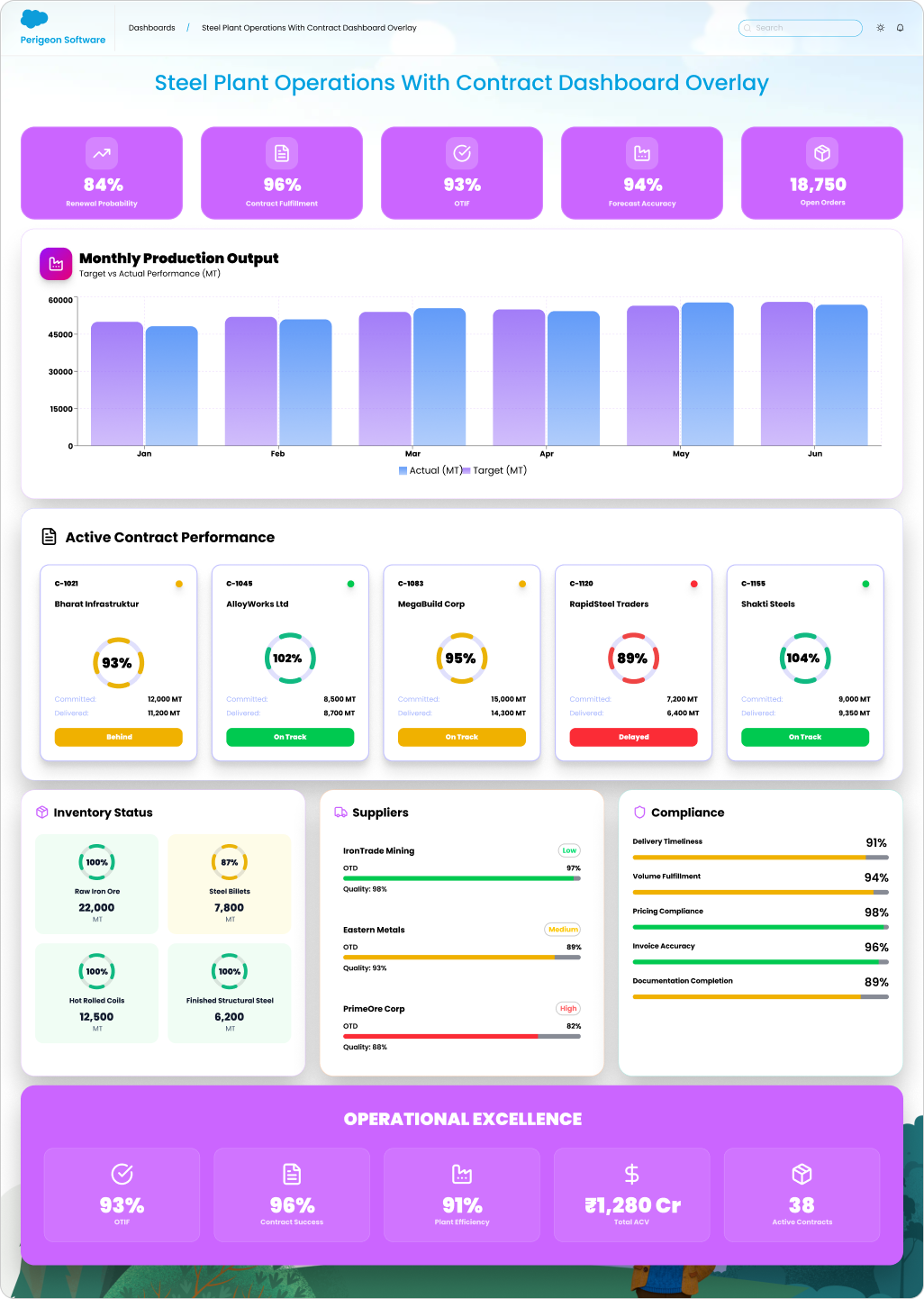
? Sales Agreements Management
This is the core feature steel manufacturers rely on.
Manufacturing Cloud allows teams to:
- Create standardized digital contracts
- Track volume and pricing commitments
- Monitor consumed vs. committed quantities
- Adjust terms dynamically
- Sync agreements with ERP and finance systems
? Real-Time Forecasting Linked to Contracts
As contract terms change, forecasts update automatically, keeping:
- Sales
- Finance
- Operations
- Production planning
? Automated Change Tracking
Steel customers frequently adjust volumes — Salesforce provides:
- Version control
- Automated amendments
- Real-time notifications
- Collaborative approval workflows
No more lost emails or outdated spreadsheets.
? Rebate & Margin Visibility
Manufacturing Cloud helps steel companies automate:
- Tiered rebates
- Incentive calculations
- Profit margin analysis
- Customer profitability scoring
This reduces financial leakage significantly.
? 360° Customer Contract Insights
Every stakeholder gets access to:
- Contract history
- Pending renewals
- Performance analytics
- Renewal recommendations
This strengthens long-term customer relationships.
5. Key Features Beneficial for Steel Contract Optimization
✔ Sales Agreement Workspace
Tracks real-time performance of each contract against targeted KPIs.
✔ Forecast Adjustment Engine
Forecasts update instantly when prices, volumes, or schedules change.
✔ Partner Collaboration Tools
Distributors, OEMs, and large buyers can collaborate through Experience Cloud.
✔ ERP & SAP Integration
Ensures clean, accurate data flows between Salesforce and core production systems.
✔ Revenue Optimization
Predictive analytics highlight high-value customers and at-risk agreements.
6. Real-World Outcomes for Steel Manufacturers
Steel producers using Salesforce Manufacturing Cloud have seen:
? 35% reduction in contract-related errors
Due to automated versioning and real-time updates.
? 25% better forecast accuracy
With contract-linked forecasting.
⏳ 40% faster contract negotiation cycles
Thanks to digital workflows.
? 10–15% margin improvement
Through better rebate tracking and pricing visibility.
? Stronger long-term customer relationships
With transparent, accurate data sharing.
7. Why Now Is the Time to Digitize Contract Management
The steel industry is impacted by:
- Rapid market price fluctuations
- Increased global competition
- Higher expectations from OEMs
- Pressure for traceability and transparency
Digital transformation with Salesforce is no longer optional.
It’s a competitive advantage.
8. Conclusion
Long-term contracts are the backbone of steel manufacturing — but only when managed accurately and efficiently. Salesforce Manufacturing Cloud empowers steel producers with centralized contract management, automated forecasting, real-time tracking, and strong customer collaboration.
This leads to:
- Better profitability
- Reduced operational risk
- Consistent production planning
- Strong, reliable customer partnerships
If you’re ready to modernize long-term contract management for your steel manufacturing operations
If you’re ready to modernize long-term contract management for your steel manufacturing operations, Perigeon Software can help you implement and customize Salesforce Manufacturing Cloud.