

Table of content
Introduction
The Alignment Challenge in Aluminum Manufacturing
Why Sales Agreements Matter for Production Planning
How Manufacturing Cloud Connects Sales & Production
Key Features for Aluminum Manufacturers
Benefits of Alignment Across Operations
Real-World Use Cases
Conclusion
Want to align your aluminum manufacturing operations for maximum efficiency?
1.Introduction
Aluminum manufacturing is a complex industry driven by fluctuating demand, variable production schedules, and long-term customer agreements. Customers—from automotive manufacturers to aerospace and packaging—depend on consistent supply, predictable pricing, and reliable delivery.
To deliver on these expectations, manufacturers must ensure that sales agreements, demand forecasts, and production planning are always aligned.
Salesforce Manufacturing Cloud bridges this critical gap by connecting front-office sales operations with back-office production teams, providing a unified view of demand, commitments, capacity, and inventory.
2. The Alignment Challenge in Aluminum Manufacturing
Aluminum manufacturers face unique challenges due to:
? Long production cycles
Rolling, extrusion, and casting require advance scheduling and capacity planning.
⚙️ High energy consumption
Production planning impacts cost efficiency directly
? Volatile pricing & demand
Market fluctuations can disrupt planned production.
? Long-term contracts
Automotive and industrial customers commit to multi-month or multi-year agreements.
Without alignment between sales agreements and production, manufacturers face risks such as:
- Overproduction
- Underutilized capacity
- Missed delivery deadlines
- Contract penalties
- Margin leakage
3. Why Sales Agreements Matter for Production Planning
Sales agreements define:
- Volume commitments
- Price stability
- Delivery schedules
- Product quality/grade specifications
These details directly influence:
✔ Production volume
✔ Machine scheduling
✔ Raw material procurement
✔ Staffing and shift planning
✔ Energy usage planning
✔ Inventory strategies
However, many manufacturers track agreements manually—leading to misalignment and operational inefficiencies.
4. How Salesforce Manufacturing Cloud Connects Sales & Production
Manufacturing Cloud provides a single source of truth where:
- Sales
- Production
- Operations
- Finance
- Distributors
…all work from the same real-time data.
✔ Sales Agreement Workspace
Digitalized agreements store every detail including:
- Contracted quantities
- Pricing
- Terms
- Amendments
- Performance snapshots
This allows production teams to view actual commitments instantly.
✔ Integrated Forecasting & Demand Planning
Manufacturing Cloud combines:
- Sales forecasts
- Customer forecasts
- Historical data
- Distributor inputs
to provide a confident demand outlook.
Production teams rely on these numbers to schedule casting, rolling, extrusion, and finishing operations.
✔ Real-Time Changes Sync Across Teams
If sales updates an agreement due to:
- Customer requirement change
- Market shift
- Amended quantities
Production sees these changes immediately, preventing overproduction or shortages.
✔ Capacity Planning Alignment
Manufacturing Cloud connects with planning systems (ERP/MES) to:
- Evaluate available capacity
- Adjust work orders
- Optimize furnace and machine utilization
This ensures commitments can be met without overloading operations.
✔ Inventory & Material Requirement Alignment
Manufacturers gain visibility into:
- Raw material needs
- Alloy compositions
- Scrap recycling cycles
- Batch planning
Forecasts and agreements directly feed procurement and inventory planning.
5. Key Features for Aluminum Manufacturers
1. Sales Agreements Management
Digitized, real-time version of all customer commitments.
2. Account-Based Forecasting
Separate forecasts for alloy types, grades, and shapes (billets, sheets, coils, extrusions).
3. Performance Tracking Dashboards
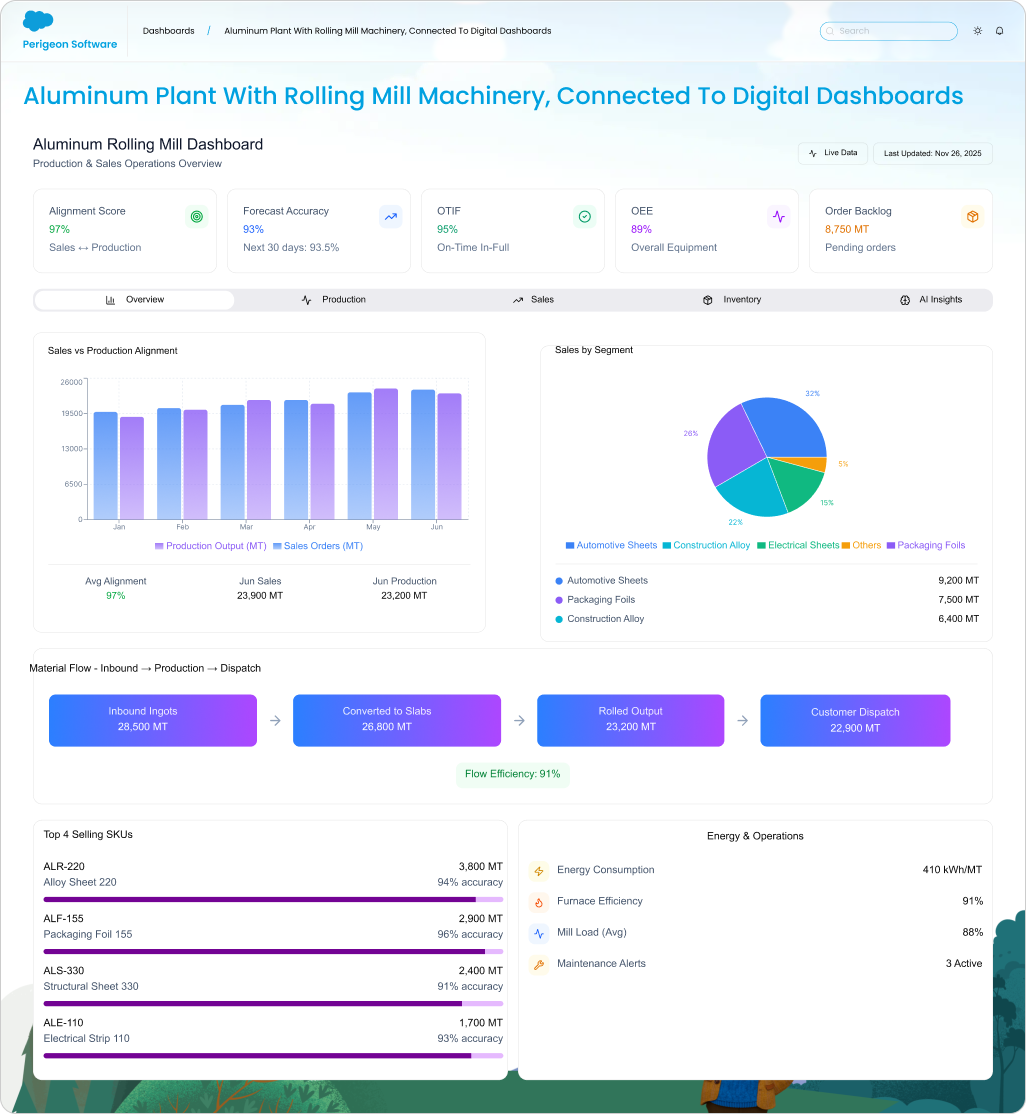
Monitor contracted vs. actual production and supply.
4. Price & Volume Adjustments
Automated updates to accommodate fluctuations in LME and energy costs.
5. ERP/MES Integration
Seamless sync with SAP, Oracle, or any legacy systems.
6. Collaboration Tools
Sales and operations teams collaborate in real time.
6. Benefits of Alignment Across Operations
Aluminum manufacturers see major benefits:
? Improved Forecast Accuracy (25–35%)
Better demand planning leads to efficient production cycles.
? Optimized Production Scheduling
Avoid bottlenecks and downtime with real-time data.
? Higher On-Time Delivery Rates
Meet customer commitments with confidence.
? Reduced Margin Leakage
Prevent errors caused by outdated agreement data.
? Lower Inventory Costs
Produce based on accurate demand—not assumptions.
? Stronger Customer Relationships
Customers receive consistent supply and transparent communication.
7. Real-World Use Cases
Use Case 1: Automotive Industry Supply
A large aluminum producer syncs long-term commitments with production to ensure steady output for automotive OEMs.
Use Case 2: Beverage Can Sheet Production
Sales agreements dictate monthly sheet demand; automated forecasting improves rolling mill planning.
Use Case 3: Extrusion Profile Manufacturing
Real-time alignment reduces waste and optimizes scrap recycling cycles.
8. Conclusion
Aligning sales agreements with production is no longer optional for aluminum manufacturers—it’s essential for efficiency, cost control, and customer satisfaction. Salesforce Manufacturing Cloud creates a unified operational ecosystem where sales commitments, forecasts, and production capacity work in harmony.
With real-time visibility and intelligent forecasting, aluminum manufacturers unlock smoother operations and more predictable revenue.
Want to align your aluminum manufacturing operations for maximum efficiency?
Perigeon Software specializes in implementing Salesforce Manufacturing Cloud for metals producers.
? Contact us today to get started.