


Table of content
Introduction
Why Forecast Accuracy Is Harder in Telecom Manufacturing
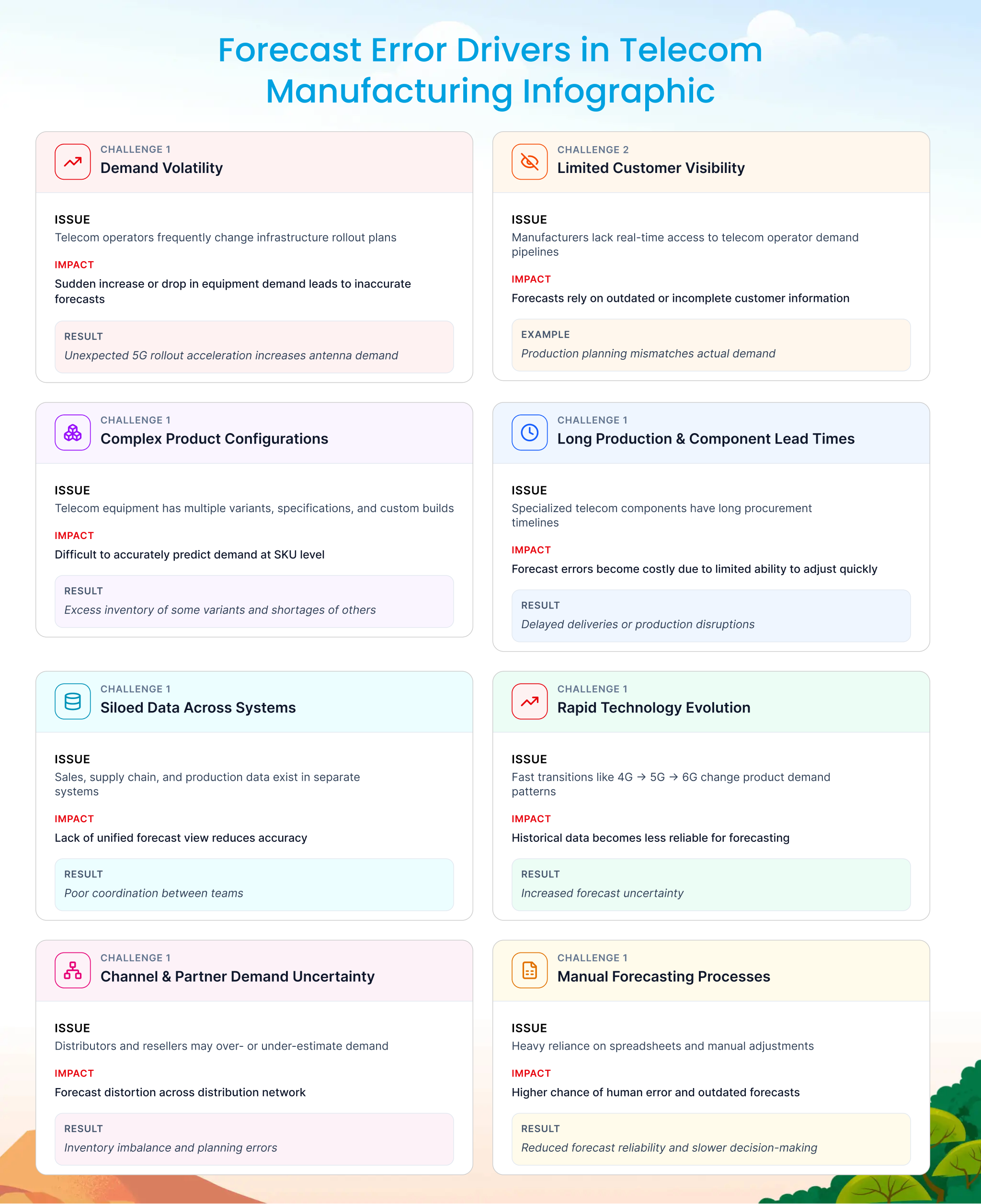
Key Forecasting Challenges in Telecom Equipment Production
How Salesforce Manufacturing Cloud Improves Forecast Accuracy
Case Study
The Future of Forecasting in Telecom Manufacturing
Conclusion
Frequently Asked Questions (FAQs)
1. Introduction
Telecom manufacturing demand doesn’t follow smooth curves — it arrives in waves. National rollouts, spectrum auctions, and regulatory deadlines create sharp ramps and sudden pauses.
During major expansion phases, forecast deviations of 30%+ are common. Traditional monthly forecasting struggles to keep pace, leading to overcapacity during slowdowns and shortages during peaks.
Salesforce Manufacturing Cloud improves forecast accuracy by anchoring plans to projects, contracts, and rollout phases — supported by AI-driven insights.
2. Why Forecast Accuracy Is Harder in Telecom Manufacturing
- Project-Based Demand – Milestone-driven deliveries replace steady replenishment
- Technology Churn – 4G, 5G, and future 6G overlap
- Long Lead-Time Components – RF, optics, and chipsets require early commitments
- Operator Approvals – Certifications affect shipment timing
- Disconnected Planning – No single owner across sales, supply, and deployment
3. Key Forecasting Challenges in Telecom Equipment Production
1. Project-Driven, Lumpy Demand
Large rollout orders land together, followed by gaps — aggregate forecasts mislead capacity decisions.
2. Technology Transitions (4G → 5G → 6G)
Parallel generations complicate production planning and inventory allocation.
3. Long Lead-Time Components
Specialized components demand early accuracy to avoid shortages or excess.
4. Operator & Regulatory Dependencies
Approvals, funding, and compliance requirements shift schedules late in the cycle.
5. Disconnected Planning Across Sales, Supply & Deployment
Forecasts, procurement, and site schedules drift without system alignment.
4. How Salesforce Manufacturing Cloud Improves Forecast Accuracy
1. Project- & Operator-Level Forecasting
Forecast by operator, geography, technology, and rollout phase for higher precision.
2. Contract-Driven Demand Commitments
Separate committed contract volumes from pipeline estimates.
3. Rollout-Phase–Aware Planning
Align production to build, test, ship, and deploy milestones.
4. ERP, SCM & Project System Integration
Synchronize CRM with manufacturing, procurement, and deployment systems.
5. AI-Powered Demand Sensing & Risk Alerts
Einstein AI flags schedule slippage, supplier constraints, and demand cliffs before impact.
5. Case Study
A telecom OEM delivering nationwide fiber and 5G programs achieved:
- 29% improvement in forecast accuracy
- Reduced last-minute capacity reallocations
- Improved on-time delivery during peak rollout phases
6. The Future of Forecasting in Telecom Manufacturing
- AI-driven rollout simulations
- Digital twin networks & factories
- Real-time operator demand feeds
- Sustainability-aware capacity planning
7. Conclusion
Accurate forecasting in telecom manufacturing requires:
- Project context
- Contract discipline
- AI-driven intelligence
Salesforce Manufacturing Cloud transforms volatility into controlled execution — improving accuracy, reducing risk, and protecting margins during expansion cycles.