


Table of content
Introduction
Why Network Alignment Is Critical in Telecom Manufacturing
Common Gaps Across Distributor & Supplier Networks
How Salesforce Manufacturing Cloud Aligns Networks
Case Study
The Future of Network Collaboration in Telecom
Conclusion
Frequently Asked Questions (FAQs)
1. Introduction
Telecom manufacturing depends on tight coordination across suppliers, distributors, integrators, and deployment partners. When demand signals don’t propagate quickly, shortages appear in one region while inventory piles up in another.
Salesforce Manufacturing Cloud creates a single collaboration layer—so suppliers see what’s coming, distributors know what’s allocated, and manufacturers stay in control.
2. Why Network Alignment Is Critical in Telecom Manufacturing
- Supplier readiness for specialized RF and optical components
- Regional allocation during multi-country rollouts
- Logistics timing aligned to site deployment schedules
- Quality & compliance consistency across global partners
Poor alignment increases rollout delays, excess inventory, and expedite costs.
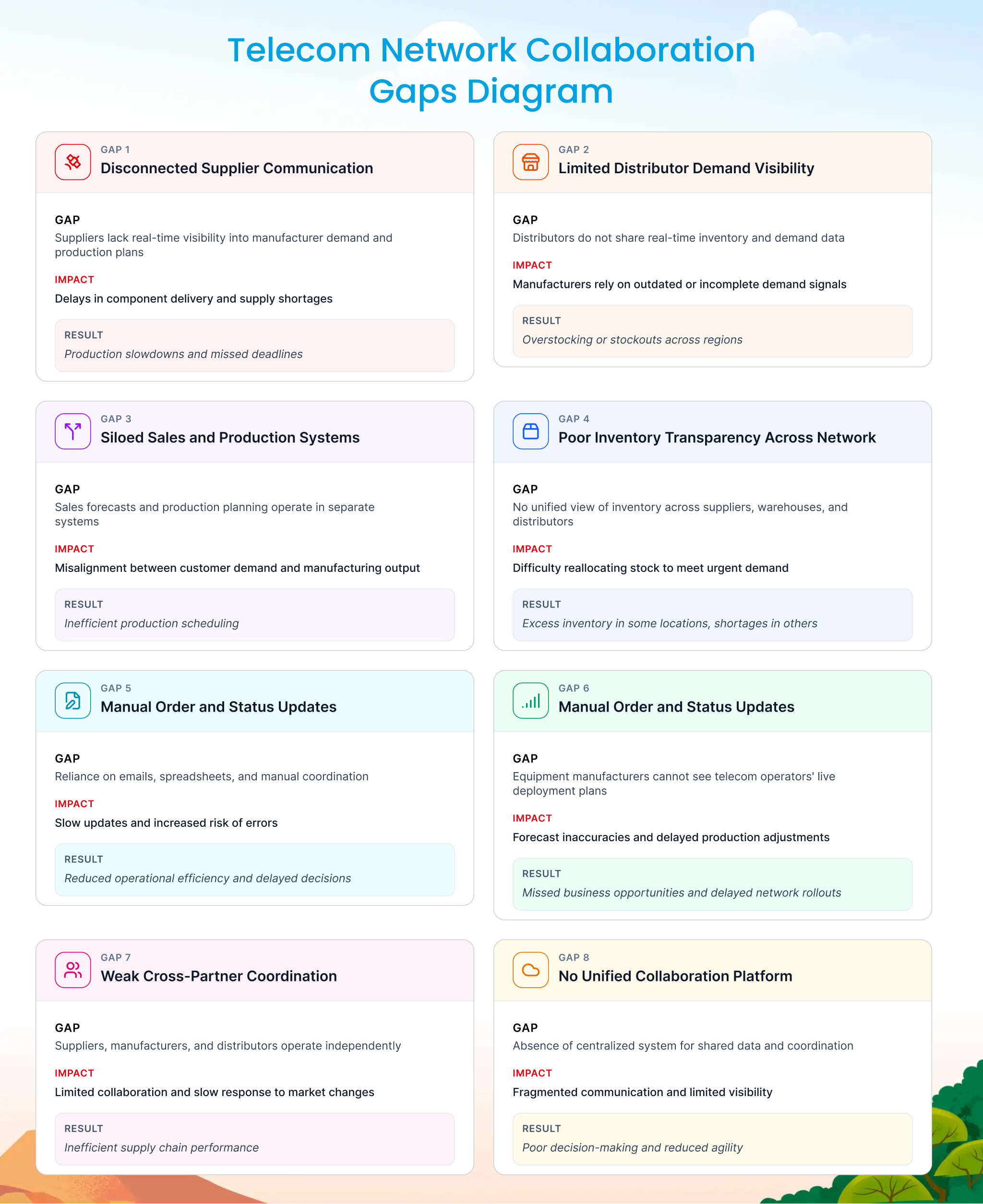
3. Common Gaps Across Distributor & Supplier Networks
1. Supplier Capacity & Allocation Conflicts
Multiple OEMs compete for constrained semiconductor and RF components.
2. Distributor Inventory & Regional Demand Gaps
Inventory often sits in the wrong geography while rollout zones face shortages.
3. Long Lead-Time Materials & Logistics
Late visibility forces costly expedite shipping and reactive planning.
4. Limited Real-Time Visibility
Email threads and spreadsheets slow coordination and decision-making.
5. Risk & Disruption Management
Geopolitical risks, single-source dependencies, and logistics disruptions go unnoticed until impact.
4. How Salesforce Manufacturing Cloud Aligns Networks
1. Partner Collaboration Portals
Secure portals provide suppliers, distributors, and integrators access to shared demand and allocation data.
2. Shared Forecasts, Capacity & Inventory Views
A single plan visible to all partners reduces bullwhip effects and confusion.
3. Supplier Commitments & Distributor Allocation
Capacity reservations ensure fair and predictable regional allocation.
4. ERP, Logistics & Quality Integration
Orders, shipments, inspections, and returns stay synchronized across systems.
5. AI-Powered Network Risk Insights
Einstein AI predicts shortages, supplier delays, and allocation conflicts early—before they disrupt deployments.
5. Case Study
A telecom manufacturer supporting multi-country rollouts achieved:
- 25% reduction in supplier-related delays
- Improved regional inventory balance
- Higher operator satisfaction during deployments
6. The Future of Network Collaboration in Telecom
- AI-driven allocation optimization
- Digital twin supply networks
- Blockchain traceability
- Carbon-aware logistics planning
7. Conclusion
Network alignment determines success in telecom manufacturing. Salesforce Manufacturing Cloud enables:
- Shared planning across suppliers and distributors
- Synchronized execution across regions
- AI-driven risk detection and mitigation
- Reduced delays and optimized inventory
When collaboration becomes centralized, telecom deployments become faster, more predictable, and more profitable.

8. Frequently Asked Questions (FAQs)
- Supplier capacity conflicts
- Regional inventory imbalance
- Long lead-time components
- Limited real-time visibility
- Disruption and geopolitical risks
These issues slow deployments and increase operational costs.
- Sharing real-time forecasts
- Reserving supplier capacity
- Integrating ERP and logistics systems
- Using AI to detect allocation conflicts
Organizations typically see measurable delay reductions when collaboration becomes centralized.