


Table of content
Introduction
Why Demand–Supply Planning Is Harder in Energy Storage
Key Demand–Supply Planning Challenges
How Salesforce Manufacturing Cloud Strengthens Planning
Case Study
The Future of Demand–Supply Planning
Conclusion
Call to Action
Frequently Asked Questions (FAQs)
1. Introduction
Energy storage manufacturing is project-centric. Grid-scale and C&I storage systems are sold as engineered solutions with defined delivery milestones, site readiness constraints, and regulatory approvals. Demand is lumpy and deadline-driven.
Misalignment between demand and supply leads to idle lines during permitting delays or material shortages when projects accelerate. Industry benchmarks show 15–25% capacity inefficiency due to poor synchronization.
Salesforce Manufacturing Cloud connects projects, contracts, suppliers, and production into one unified planning loop.
2. Why Demand–Supply Planning Is Harder in Energy Storage
- Project schedules shift due to permitting and grid readiness
- Configurations vary by power, duration, and chemistry
- Materials are globally sourced and constrained
- Utilities & EPCs control timelines
- Execution systems are siloed
3. Key Demand–Supply Planning Challenges
1. Project-Based, Milestone-Driven Demand
Orders depend on site readiness and grid interconnect approvals.
2. Chemistry- & Configuration-Specific Capacity
Production lines cannot switch chemistries or pack designs quickly.
3. Long Lead-Time Materials & Components
Cells, inverters, BMS, and power electronics require early commitments.
4. Grid, Utility & EPC Dependencies
Third-party delays distort production schedules.
5. Disconnected Planning Across Sales, Supply & Operations
Sales forecasts, procurement, and line planning lack unified ownership.
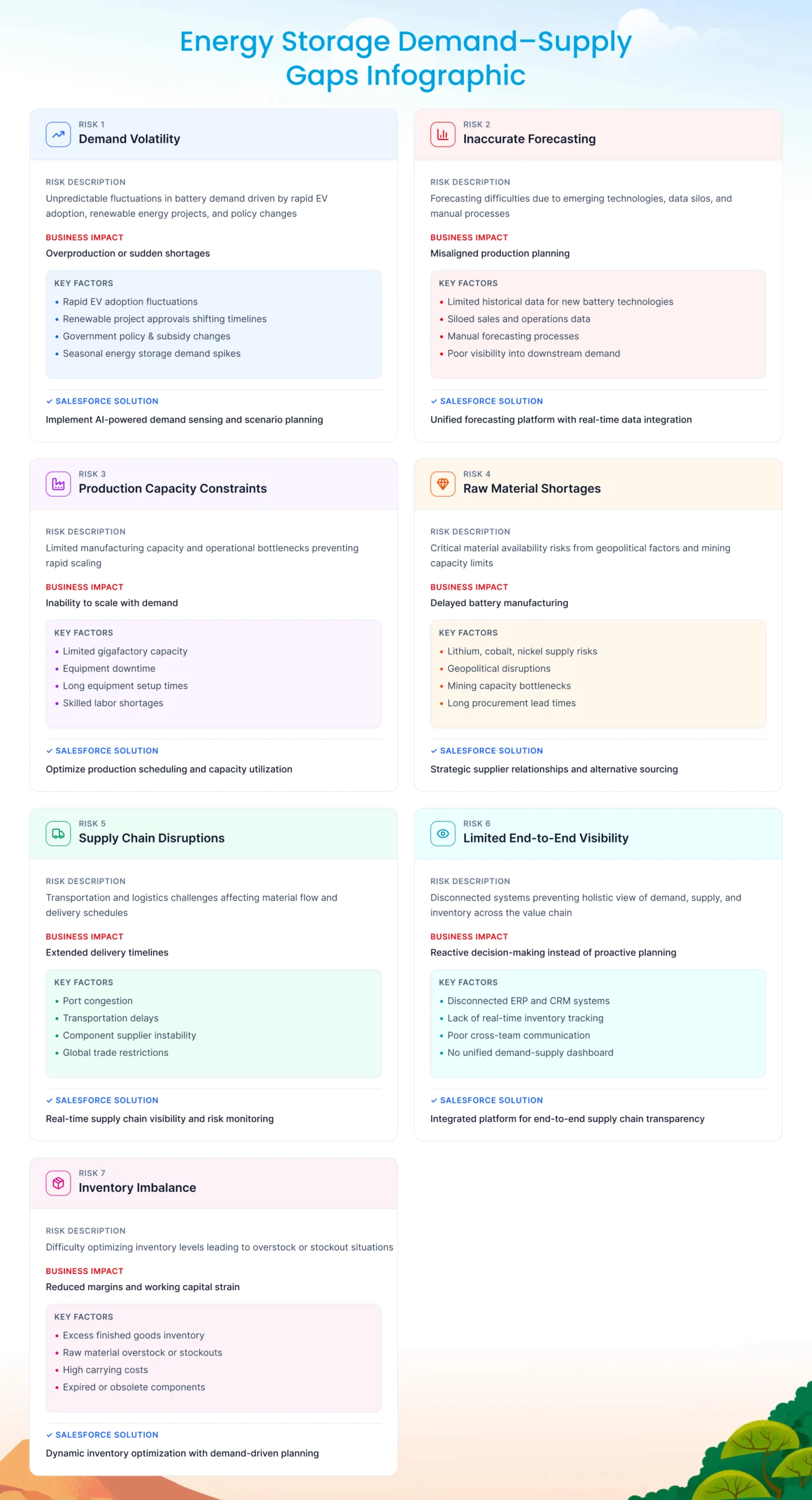
4. How Salesforce Manufacturing Cloud Strengthens Demand–Supply Planning
1. Program- & Project-Level Planning
Plan demand by project, EPC, site, chemistry, and delivery milestone.
2. Contract-Driven Supply Commitments
Convert signed contracts into firm material and capacity reservations.
3. Supplier-Aware Capacity Planning
Link forecasts to supplier constraints to prevent surprises.
4. ERP, MES & Logistics Integration
Synchronize materials, yields, capacity, and shipments.
5. AI-Powered Shortage & Delay Prediction
Einstein AI flags project slippage, material shortages, and bottlenecks early.
5. Case Study
A grid-scale storage OEM delivering multi-MWh projects achieved:
- 26% improvement in plan adherence
- Reduced material expedites
- Better alignment with EPC milestones
6. The Future of Demand–Supply Planning in Energy Storage
- AI milestone simulations
- Digital twin plants & projects
- Real-time EPC updates
- Sustainability-aware material planning
7. Conclusion
Energy storage success depends on project-accurate planning. Salesforce Manufacturing Cloud aligns demand, supply, and execution—enabling on-time, scalable delivery.
8. Call to Action
⚡ Ready to improve demand–supply synchronization in energy storage?

9. Frequently Asked Questions (FAQs)
- Project-based, milestone-driven demand
- Chemistry- and configuration-specific capacity constraints
- Long lead-time materials (cells, inverters, BMS)
- Utility and EPC-controlled timelines
- Disconnected sales, procurement, and production planning
These factors often create 15–25% capacity inefficiencies.