


Table of Content
Introduction
Contract Complexity in Oilfield Equipment Manufacturing
Key Contract Management Challenges
Why Traditional Contract Management Fails
How Salesforce Manufacturing Cloud Improves Contract Management
AI & Automation in Contract Management
Use Case: Oilfield Equipment Manufacturer
Business Benefits of Salesforce Manufacturing Cloud
Best Practices for Implementation
Future Trends in Contract Management
Conclusion
FAQs
Introduction
The global oil and gas sector relies heavily on specialized equipment manufacturers that supply drilling rigs, subsea systems, valves, pumps, compressors, and safety equipment.
These products are typically delivered through large, multi-year contracts involving complex pricing, delivery schedules, and compliance requirements.
Without a robust contract management system, manufacturers face fragmented data, delayed approvals, and revenue leakage.
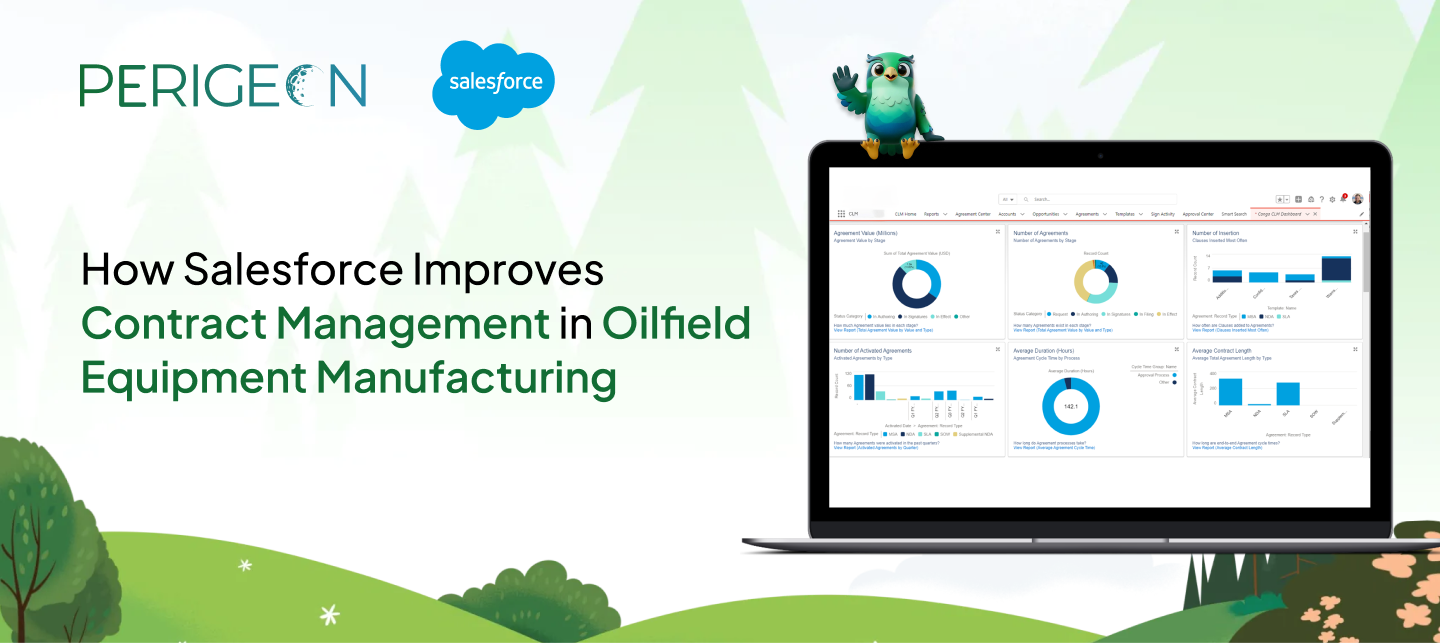
Salesforce Manufacturing Cloud provides a centralized platform to manage contracts, track commitments, and align sales with production planning.
Contract Complexity in Oilfield Equipment Manufacturing
- Long-Term Supply Agreements: Multi-year contracts across projects
- Project-Based Delivery Milestones: Linked to drilling timelines
- Performance Guarantees: Uptime and service commitments
- Custom Engineering: Equipment varies per project
- Compliance Requirements: Strict industry regulations
Managing these variables manually leads to inefficiencies and risks.
Key Contract Management Challenges
- Fragmented Data: Contracts stored across emails, spreadsheets, and systems
- Complex Pricing: Tiered pricing, rebates, and discounts
- Limited Visibility: Difficulty tracking contract performance
- Sales–Operations Gaps: Lack of coordination
- Renewal Challenges: Missed upsell opportunities
Why Traditional Contract Management Fails
- Manual approval workflows
- No real-time tracking
- Disconnected systems
- Poor collaboration
This results in delays, disputes, and revenue leakage.
How Salesforce Manufacturing Cloud Improves Contract Management
- Centralized Contract Visibility: Single source of truth
- Sales Agreements: Structured long-term contracts
- Pricing & Rebates: Automated calculations
- Performance Monitoring: Real-time tracking
- ERP Integration: Aligns production and supply chain
AI & Automation in Contract Management
- Predictive Forecasting: Demand prediction using AI
- Risk Identification: Detect delays and compliance risks
- Automated Workflows: Faster approvals and renewals
Use Case: Oilfield Equipment Manufacturer
A global manufacturer struggled with contract complexity and lack of visibility.
Results after implementation:
- 30% improvement in contract visibility
- Faster approvals
- Reduced revenue leakage
- Better sales–operations alignment
Business Benefits of Salesforce Manufacturing Cloud
- Improved contract transparency
- Reduced revenue leakage
- Better alignment between teams
- Faster decision making
- Stronger customer relationships
Best Practices for Implementation
- Standardize contract templates
- Integrate CRM with ERP
- Train teams effectively
- Use analytics for insights
Future Trends in Contract Management
- AI-powered contract intelligence
- Predictive demand planning
- Blockchain validation
- Automated compliance tracking
Conclusion
Contract management is critical in oilfield equipment manufacturing due to complex pricing, long-term agreements, and project-based deliveries.
Salesforce Manufacturing Cloud enables centralized data, real-time tracking, and alignment between sales and operations.
The result is improved efficiency, reduced risk, and stronger customer relationships.
Ready to Transform Contract Management?
Perigeon helps manufacturers implement Salesforce Manufacturing Cloud to streamline contracts, improve visibility, and drive growth.