
Many companies believe that buying Salesforce and completing a successful “implementation” is enough. They go live, train users, and expect dramatic business results. Months later, they realize something is missing — adoption is low, processes haven’t changed, and the ROI is far below expectations.
This is the critical difference between a Salesforce Implementation and a true CRM Transformation.
At Perigeon, we’ve seen this gap repeatedly. A technical implementation gets the system running, but only a well-planned CRM Transformation delivers lasting business impact.
What Is a Salesforce Implementation?
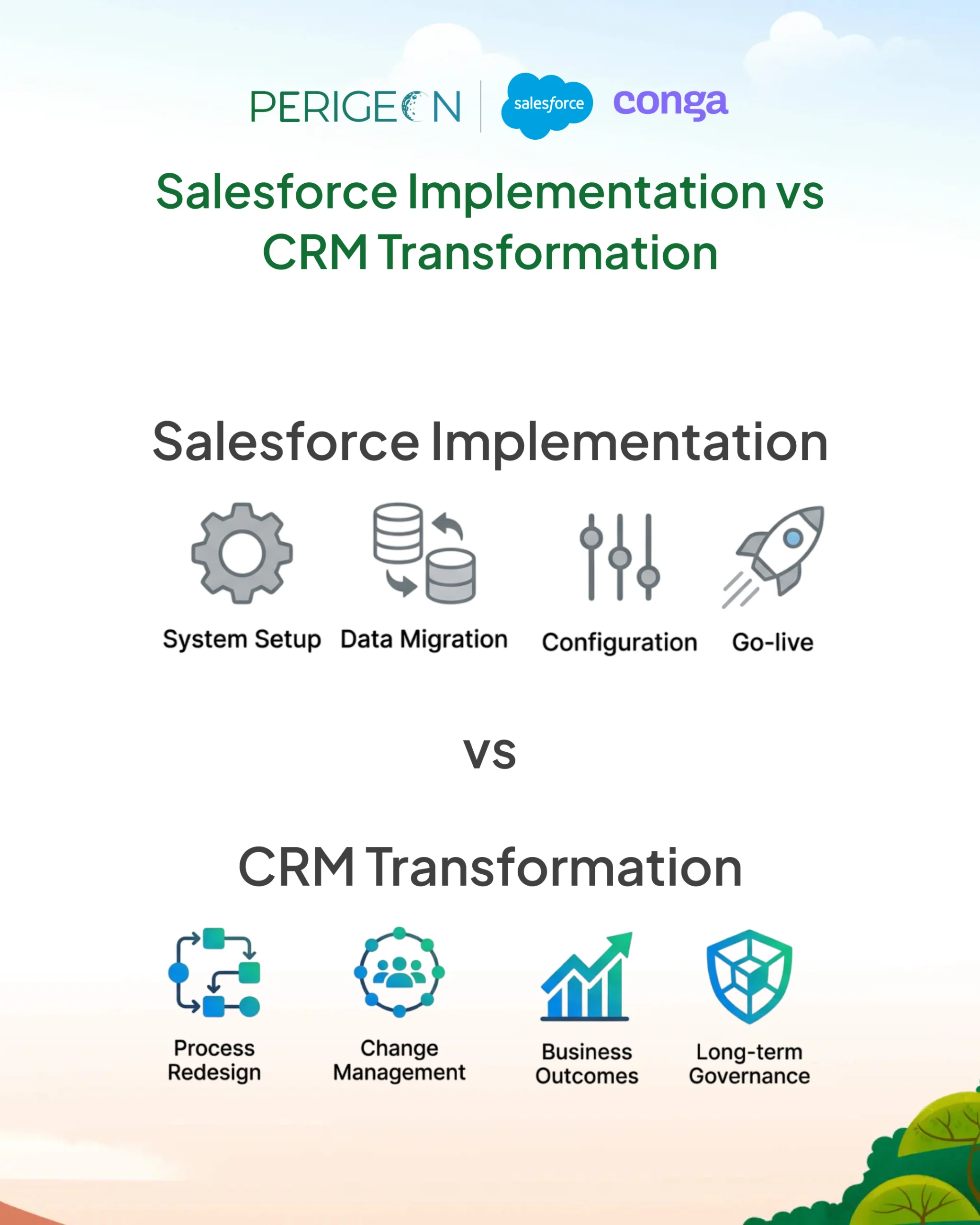
A typical Salesforce Implementation focuses on technical delivery:
-
Installing the platform
-
Configuring objects, fields, and page layouts
-
Building basic reports and dashboards
-
Migrating some data
-
Training users on how to use the system
It’s project-based, often time-bound, and mainly handled by IT or a systems integrator. The goal is “go-live.”
What Is a CRM Transformation?
A CRM Transformation is a strategic business initiative that uses Salesforce as the enabling technology. It includes:
-
Redesigning core business processes (sales, service, marketing, revenue operations)
-
Changing how people work and collaborate
-
Aligning technology with company goals and customer experience
-
Driving user adoption and behavior change
-
Measuring and improving business outcomes (revenue, efficiency, customer satisfaction)
It’s people + process + technology working together.
Salesforce Implementation vs CRM Transformation: Key Differences
| Aspect | Salesforce Implementation | CRM Transformation |
|---|---|---|
| Primary Focus | Technology setup and deployment | Business outcomes and operational change |
| Goal | Go-live of the system | Measurable ROI (revenue, efficiency, CX) |
| Approach | Project-based | Strategic, ongoing initiative |
| Ownership | IT / System Integrator | Business + IT leadership |
| Process Design | Often replicates existing processes | Redesigns and optimizes processes |
| User Adoption | Basic training | Continuous change management and adoption strategy |
| Data Strategy | Migration-focused | Governance, quality, and long-term value |
| Success Metrics | System usage, go-live completion | KPIs like win rate, retention, productivity |
| Time Horizon | Short-term (3–6 months) | Long-term (6–12 months + continuous improvement) |
| Post Go-Live | Limited support | Ongoing optimization and innovation |
| Business Impact | Incremental improvement | Transformational growth |
What Most Companies Miss When They Focus Only on Implementation
Here are the biggest gaps we see:
1. Process Redesign Is Ignored
Companies configure Salesforce to match their old, inefficient processes instead of using the project as an opportunity to improve them.
2. Change Management Is Underestimated
Users receive basic training but aren’t guided through the “why” behind the change. Resistance grows, and adoption suffers.
3. Business Outcomes Are Not Clearly Defined
Success is measured by “system is live” instead of metrics like shorter sales cycles, higher win rates, or improved customer retention.
4. Data Quality Is Treated as an Afterthought
Poor data migration and ongoing governance lead to low trust in reports and AI features.
5. Long-Term Governance Is Missing
No Center of Excellence, no ongoing optimization plan, and no strategy for future releases or new capabilities like Agentforce.
6. Organizational Alignment Is Weak
Sales, Marketing, Service, Finance, and IT often work in silos instead of as one unified revenue team.
How Perigeon Approaches CRM Transformation
We believe every Salesforce project should be treated as a CRM Transformation, not just an implementation.
Our approach includes:
-
Discovery & Strategy Phase — Aligning Salesforce with your business goals and customer journey
-
Process Optimization — Redesigning workflows before configuration
-
Change Management & Adoption — Comprehensive training, communication, and reinforcement plans
-
Data Strategy — Cleansing, migration, and long-term governance
-
Phased Delivery — Delivering quick wins while building toward full transformation
-
Post-Go-Live Support — Managed services, continuous optimization, and governance framework
This ensures technology actually drives measurable business value.
Key Questions to Ask Before Starting Your Project
-
Are we just implementing software, or transforming how we operate?
-
Have we redesigned our processes, or are we automating old ones?
-
Do we have a clear change management plan and success metrics?
-
Who will own the platform after go-live?
-
Are we prepared for long-term governance and optimization?
Transform How Your Business Operates With Salesforce.

Ready for Real CRM Transformation?
If you’ve had a Salesforce implementation that didn’t deliver the expected results — or if you’re planning a new project — it’s time to think bigger.
Stop treating Salesforce as “just another system.” Turn it into a true CRM Transformation that drives revenue growth, operational efficiency, and better customer experiences.