

Introduction: Why Manufacturing Needs AI Now
Manufacturing today is no longer just about production. It’s about speed, precision, and adaptability.
Rising costs, supply chain disruptions, and unpredictable demand have exposed a critical gap: most manufacturing systems still operate in silos. Sales teams lack visibility into operations, service teams struggle with incomplete data, and decision-making becomes reactive instead of proactive.
This is where Salesforce Agentforce comes into play in the manufacturing industry bringing AI-powered agents into core business processes to drive efficiency, reduce costs, and improve decision-making at scale.
For any manufacturing company uses Agentforce, the goal is simple: unify operations, automate workflows, and enable smarter, faster decisions.
What is Agentforce for Manufacturing?
Agentforce for Manufacturing is an agentic AI solution for manufacturing that empowers organizations with intelligent, ready-to-deploy AI agents across every team. It helps streamline operations, boost productivity, and accelerate time to market. By improving collaboration and strengthening relationships with customers and partners, it enables manufacturers to operate more efficiently while driving innovation and sustainable growth.
Why Manufacturing Companies Need Agentforce
Manufacturers face unique challenges compared to other industries:
1. Complex Sales Cycles
B2B manufacturing deals often involve multiple stakeholders, long timelines, and customized pricing.
2. Disconnected Systems
ERP, CRM, and service tools often don’t communicate effectively, leading to data gaps.
3. Service Delays
Field service teams lack real-time access to customer and product data.
4. Demand Fluctuations
Without accurate forecasting, inventory and production planning suffer.
Agentforce addresses these issues by creating a connected ecosystem where information flows seamlessly.
Key Benefits of Agentforce for Manufacturing
1. Unified Customer and Operational View
Teams across sales, service, and operations access the same real-time data reducing errors and improving collaboration.
2. Faster Sales Execution
Automated workflows and better insights help sales teams close deals faster and handle complex pricing efficiently.
3. Improved Service Efficiency
Service teams gain full visibility into product history, warranties, and past interactions—leading to faster resolution times.
4. Better Demand and Production Planning
Real-time insights help align sales forecasts with production capacity and inventory.
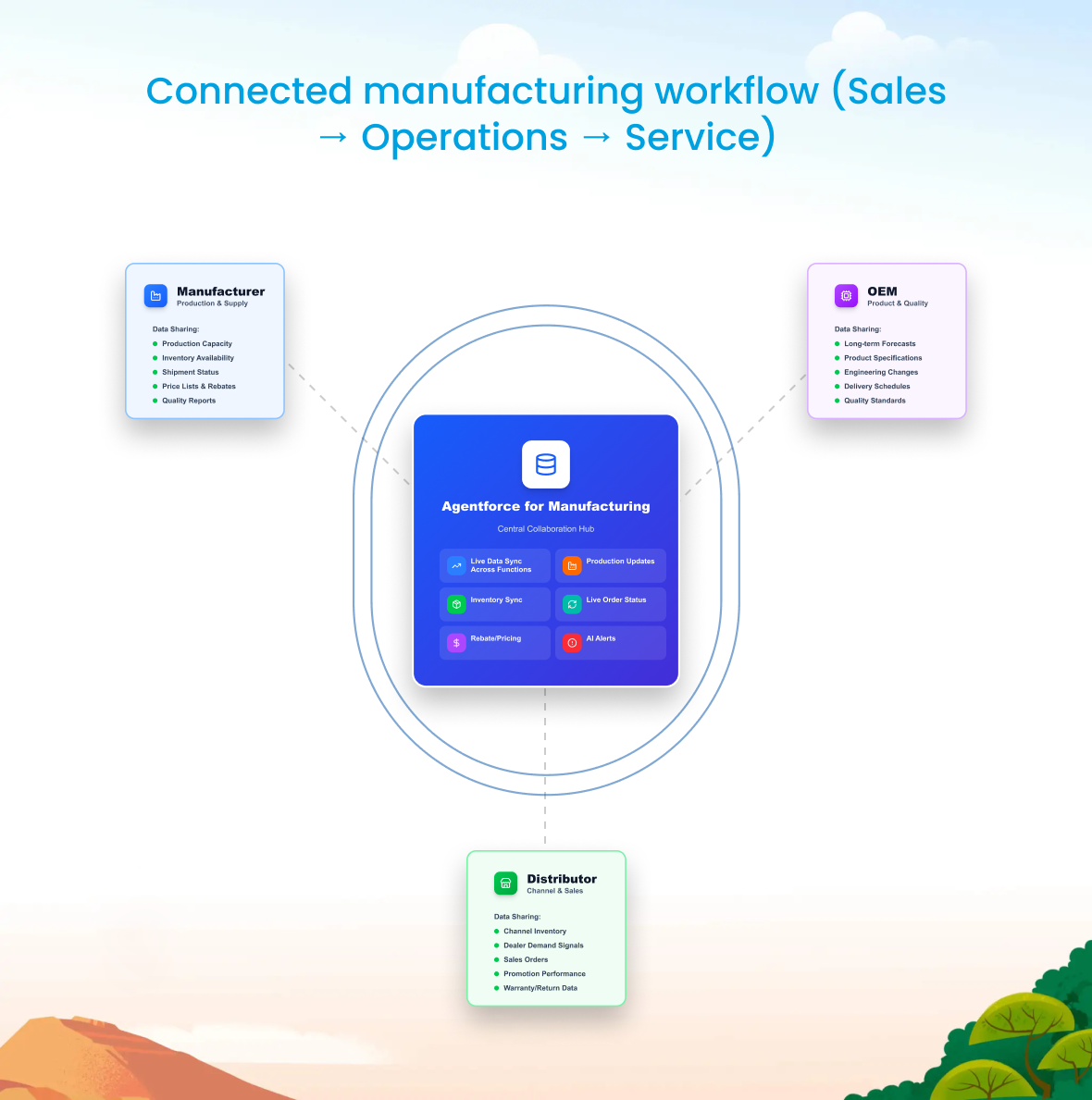
How Agentforce Works Across Manufacturing Processes
Unlike traditional tools that focus on isolated tasks, Agentforce for manufacturing operates across interconnected workflows.
Unified Data Foundation
Agentforce leverages data from:
- Orders and sales agreements
- Inventory and supply chain signals
- Service cases and warranties
- Asset and equipment history
It can also integrate with systems like Manufacturing Cloud to create a centralized data layer.
Real-Time Decision Support
In manufacturing, one issue often impacts multiple areas.
For example:
- A delayed shipment affects customer commitments
- It impacts production schedules
- It creates service escalations
Agentforce identifies these connections, surfaces insights, and recommends actions—helping teams respond faster with full context.
Top Real-World Use Cases of Agentforce for Manufacturers
1. Sales Forecasting & Demand Planning
Agentforce continuously compares forecasts with real-time order data and constraints.
Result:
- More accurate planning
- Faster response to demand changes
2. Order Management & Customer Service
Customers often ask about order status, delays, or changes.
Agentforce:
- Retrieves real-time order data
- Detects issues proactively
- Prepares accurate responses
3. Field Service & Asset Management
Service teams get:
- Complete asset history
- Warranty details
- Parts availability
This improves first-time fix rates and reduces repeat visits.
4. Production & Inventory Alignment
By connecting demand signals with inventory and production data, Agentforce helps avoid:
- Overstocking
- Production delays
Agentforce vs Traditional Manufacturing Systems
| Feature | Traditional Systems | Agentforce for Manufacturing |
|---|---|---|
| Data Visibility | Limited, siloed | Unified, real-time |
| Decision-Making | Reactive | Proactive |
| Workflow Automation | Manual | Intelligent automation |
| System Integration | Complex | Seamless |
| Customer Experience | Inconsistent | Connected |
How to Implement Agentforce Successfully
Successful Agentforce implementation follows a structured approach:
- Assess Current Processes — Identify high-volume, repetitive, or exception-heavy workflows (e.g., service triage, inventory checks).
- Start with Pre-built Agents — Leverage Salesforce’s manufacturing-specific templates for quick wins.
- Integrate with Existing Systems — Connect to ERP, MES, PLM, and IoT data sources using MuleSoft or native connectors.
- Customize & Govern — Use low-code tools in Agent Builder to tailor agents to your workflows while setting clear approval thresholds.
- Pilot & Scale — Begin with one department (e.g., service or sales), measure results, then expand.
- Monitor & Optimize — Use analytics dashboards to track agent performance and refine actions.
Partnering with an experienced Salesforce Agentforce services provider ensures smooth integration, custom development, change management, and maximum ROI tailored to your unique manufacturing environment.
Final Thoughts
Agentforce is not just another tool. It’s a strategic enabler for manufacturing businesses looking to modernize their operations.
By connecting sales, service, and operations, manufacturers can:
- Improve efficiency
- Enhance customer experiences
- Drive sustainable growth
In a competitive market, the ability to act on real-time insights and streamline processes can make a significant difference. Agentforce provides that foundation—when implemented with the right strategy and expertise.
Let’s Design a Smarter Manufacturing Ecosystem with Agentforce

FAQs
+
+
+
+