


Table of content
Introduction
Why Traditional Pharma Manufacturing Needs a Better Approach
What is Salesforce Manufacturing Cloud and Why It Matters for Pharma
How Does Manufacturing Cloud Improve Pharma Forecasting Accuracy?
How Does Manufacturing Cloud Connect Commercial Forecasts to Global Pharma Supply Chains?
Streamlining Distributor, Wholesaler & Retailer Networks in Pharma
How These Capabilities Work Together: End-to-End Value in Pharma
Real-World Benefits & Expected Outcomes
Implementation Tips: Key Features to Enable First
Challenges & How to Overcome Them
Conclusion
Introduction
You are navigating a perfect storm. Patent cliffs loom, demand volatility is extreme, cold chain logistics are under constant pressure, and your distributor rebate processes are still tangled in spreadsheets. Traditional ERP-centric planning can’t keep up. Forecast errors of 20-30% lead to $50M+ in write-offs or lost revenue.
Salesforce Manufacturing Cloud solutions (increasingly enhanced by Agentforce AI) unifies your commercial, operational, and channel data into a single platform. It delivers account-based forecasting tied to actual sales agreements, provides real-time visibility across global supply chains, and digitizes distributor collaboration—all within a compliant, auditable framework.
Key Takeaways
- Forecasting improves by 15-25% by replacing aggregate guesses with account-based forecasts driven by sales agreement data and AI.
- Global supply chain resilience increases when you bridge the gap between commercial demand signals and production planning, reducing both stockouts and expiry waste.
- Distributor networks become collaborative via self-service portals, automated rebate management, and real-time inventory visibility.
- Compliance is built in with audit trails, version-controlled sales agreements, and role-based data access suitable for GxP environments.
- Agentforce AI automates forecast adjustments based on real-world events (e.g., raw material delays or sudden demand spikes).
Why Traditional Pharma Manufacturing Needs a Better Approach
Before exploring the solution, let’s acknowledge the specific friction points you face daily.
The Forecasting Problem
You rely on aggregated historical shipments, but new product launches, generic erosion, and payer formulary changes make history unreliable. Sales reps manually adjust numbers. Operations sees one forecast. Distributors operate with another.
The Supply Chain Visibility Gap
Your ERP tells you what happened yesterday. You need to know, in real time, how a port closure in Rotterdam or a quality issue at an API supplier in India will impact fill rates to your German wholesaler by week 3.
The Distributor Inefficiency
Each wholesaler has unique rebate agreements, chargeback rules, and ordering cycles. Managing this manually creates disputes, delays, and compliance risks. You lack a single source of truth for channel performance.
Traditional solutions treat these as separate problems. Manufacturing Cloud treats them as one integrated challenge.
What is Salesforce Manufacturing Cloud and Why It Matters for Pharma
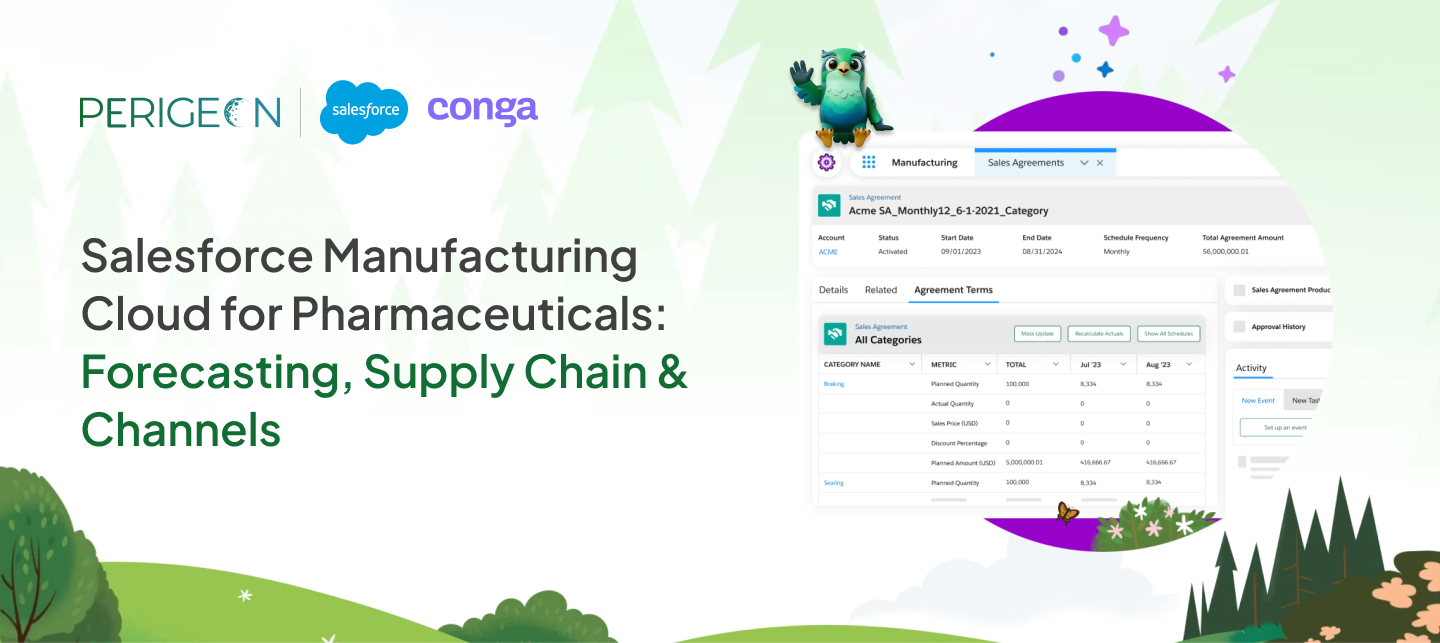
Salesforce Manufacturing Cloud is a native Salesforce platform that connects commercial sales agreements, demand forecasts, production planning, and channel operations into a single, real-time system. For pharma, it transforms how you align commercial commitments with manufacturing reality.
Unlike generic ERP or standalone forecasting tools, Manufacturing Cloud is built for collaborative planning. It enables:
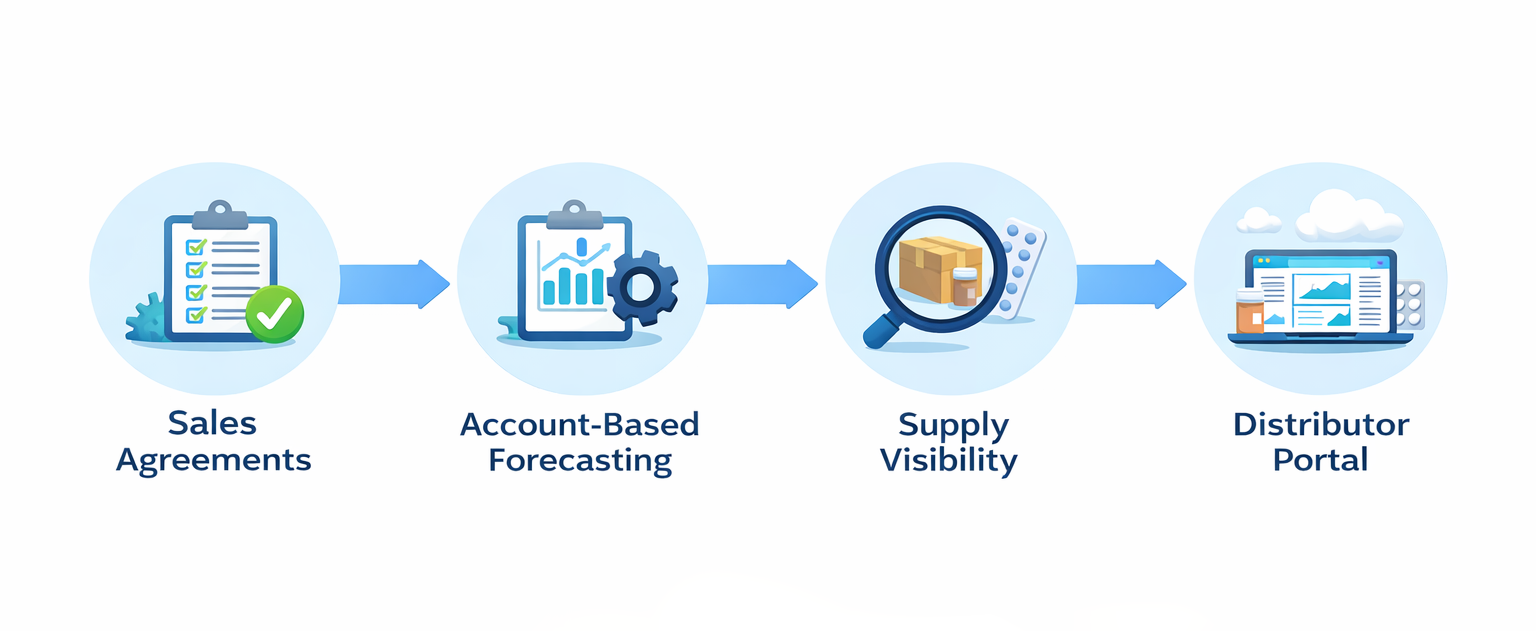
- Sales Agreements that link customer (or distributor) commitments directly to forecast lines.
- Account-Based Forecasting that rolls up from individual sales agreements, not just historical averages.
- Partner and Experience Cloud portals for distributor self-service and performance tracking.
- Agentforce AI to predict demand shifts and recommend inventory adjustments.
Because it runs on Salesforce, it inherits enterprise-grade security, audit trails, and compliance capabilities (including support for 21 CFR Part 11 when properly validated). To see how this applies across industries, explore how Manufacturing Cloud improves forecast accuracy
How Does Salesforce Manufacturing Cloud Improve Pharma Forecasting Accuracy?
Manufacturing Cloud replaces siloed, spreadsheet-based forecasting with account-based forecasting (ABF) tied directly to sales agreements. Every forecast line is traceable to a specific customer, product, territory, and time period—giving you a live, auditable, and AI-enhanced demand signal.
Sales Agreements as the Foundation
You create a Sales Agreement for each key account—whether that’s a national wholesaler (e.g., McKesson, AmerisourceBergen), a specialty pharmacy, or a hospital group. The agreement includes:
- Products and pricing (list, net, rebate-eligible)
- Expected volumes by month or quarter
- Contract terms and compliance conditions
Account-Based Forecasting (ABF)
Instead of asking “what do you think we’ll sell?”, you ask “what is committed or likely based on the agreement?”. Manufacturing Cloud generates a forecast that distinguishes between:
- Run-rate business (steady, contract-backed volume)
- New business (opportunities in the pipeline)
- At-risk volume (where a competitor or formulary change threatens)
AI-Enhanced Adjustments
Salesforce Agentforce Services help enterprises transform forecasting from a reactive process into a proactive one. Agentforce AI continuously monitors distributor performance, inventory positions, and broader market signals, including competitor product recalls. When patterns emerge, such as a distributor ordering 15% below agreement for two months, the platform flags the issue and recommends forecast revisions to better reflect expected demand.
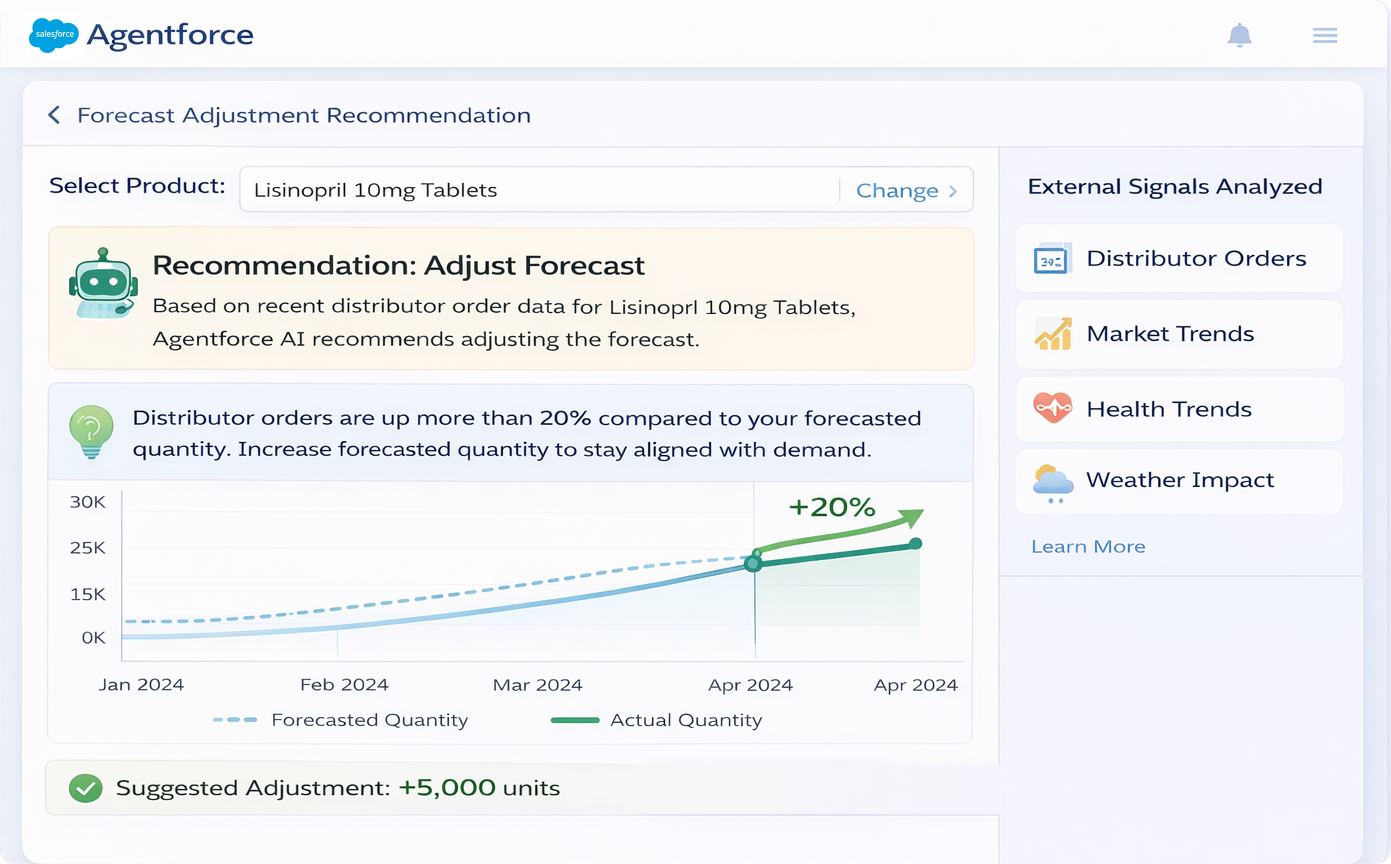
Pharma-specific example: You launch a new oncology drug. The sales agreement with your three largest specialty distributors includes launch quantities. Manufacturing Cloud rolls those commitments into the forecast, while Agentforce monitors early uptake rates against plan. When week-1 orders exceed forecast by 40%, the system alerts supply planners to expedite production—preventing a stockout before it happens.
Key benefit for you: Forecast accuracy improves from 70-75% to 85-90% for established products, and launch stockouts decrease significantly.
How Does Manufacturing Cloud Connect Commercial Forecasts to Global Pharma Supply Chains?
Manufacturing Cloud acts as the bridge between your commercial demand signals (forecasts, sales agreements, distributor orders) and your operational supply plan (ERP, MES, WMS). It provides real-time visibility into inventory positions, production status, and material availability—enabling rapid response to disruptions.
Real-Time Supply Visibility
You define supply definitions (production lines, lead times, capacity constraints, batch release schedules). Manufacturing Cloud then shows, for any product and any time period, whether committed demand exceeds available supply. This is not a periodic report—it’s a live view.
Bridging Commercial and Operational Data
Via native connectors or middleware (e.g., MuleSoft), Manufacturing Cloud integrates with your ERP. The ERP handles transactions (orders, shipments, invoices). Manufacturing Cloud handles collaborative planning. When a distributor submits a purchase order, you see instantly if it aligns with the forecast and available inventory. For a deeper technical look, review these Salesforce integration patterns for enterprise systems.
Cold Chain and Expiry Management
For temperature-sensitive or short-dated products, you can build expiry tracking into the planning process. Manufacturing Cloud can prioritize allocation of near-expiry inventory to high-turnover channels, reducing write-offs.
Pharma-specific example: A quality issue at a supplier of a key excipient delays production of a cardiovascular drug by three weeks. With Manufacturing Cloud, the delay automatically updates available supply in the planning view. Commercial operations sees the impact on committed customer orders within hours, not days, and proactively communicates revised delivery dates to distributors.
Key benefit for you: Reduce stockouts by 20-30% and reduce excess/expiry inventory by 10-15% through better alignment of supply with actual demand.
Streamlining Distributor, Wholesaler & Retailer Networks in Pharma
Using Salesforce Partner Relationship Management (PRM) and Experience Cloud alongside Manufacturing Cloud, you create a unified digital hub for every distributor. They gain self-service ordering, real-time inventory visibility, automated rebate tracking, and collaborative forecasting—while you gain end-to-end channel performance data.
Distributor Portals for Self-Service
Each distributor logs into a branded portal where they can:
- View real-time product availability and expected ship dates
- Submit and track purchase orders
- Access their sales agreement, including rebate tiers and terms
- See their forecast commitments and submit updates
- Download compliance documentation (certificates of analysis, etc.)
Automated Rebate and Chargeback Management
Salesforce can be configured to track distributor purchases against agreement terms, calculate earned rebates, and surface disputes for resolution—all in one system. This eliminates months of reconciliation.
Collaborative Forecasting with Distributors
Instead of pushing a forecast to distributors via Excel, you invite them to collaborate within Manufacturing Cloud. Distributors submit their expected purchases, which roll up into your demand plan. Variances are visible in real time.
Channel Performance Analytics
Dashboards show, for each distributor:
- Order fill rates and on-time delivery
- Adherence to forecast (did they order what they committed?)
- Inventory turns and days-on-hand (if shared)
- Rebate accruals and payments
Pharma-specific example: You have a national wholesaler agreement with tiered rebates based on quarterly volume. With Manufacturing Cloud + Experience Cloud, the distributor sees their progress toward each tier in real time, submits purchase orders against the forecast, and receives automated rebate statements. Disputes drop by 60%.
Key benefit for you: Improve distributor relationships, reduce channel friction, and gain real-time visibility into distributor inventory and ordering behavior.
How These Capabilities Work Together: End-to-End Value in Pharma
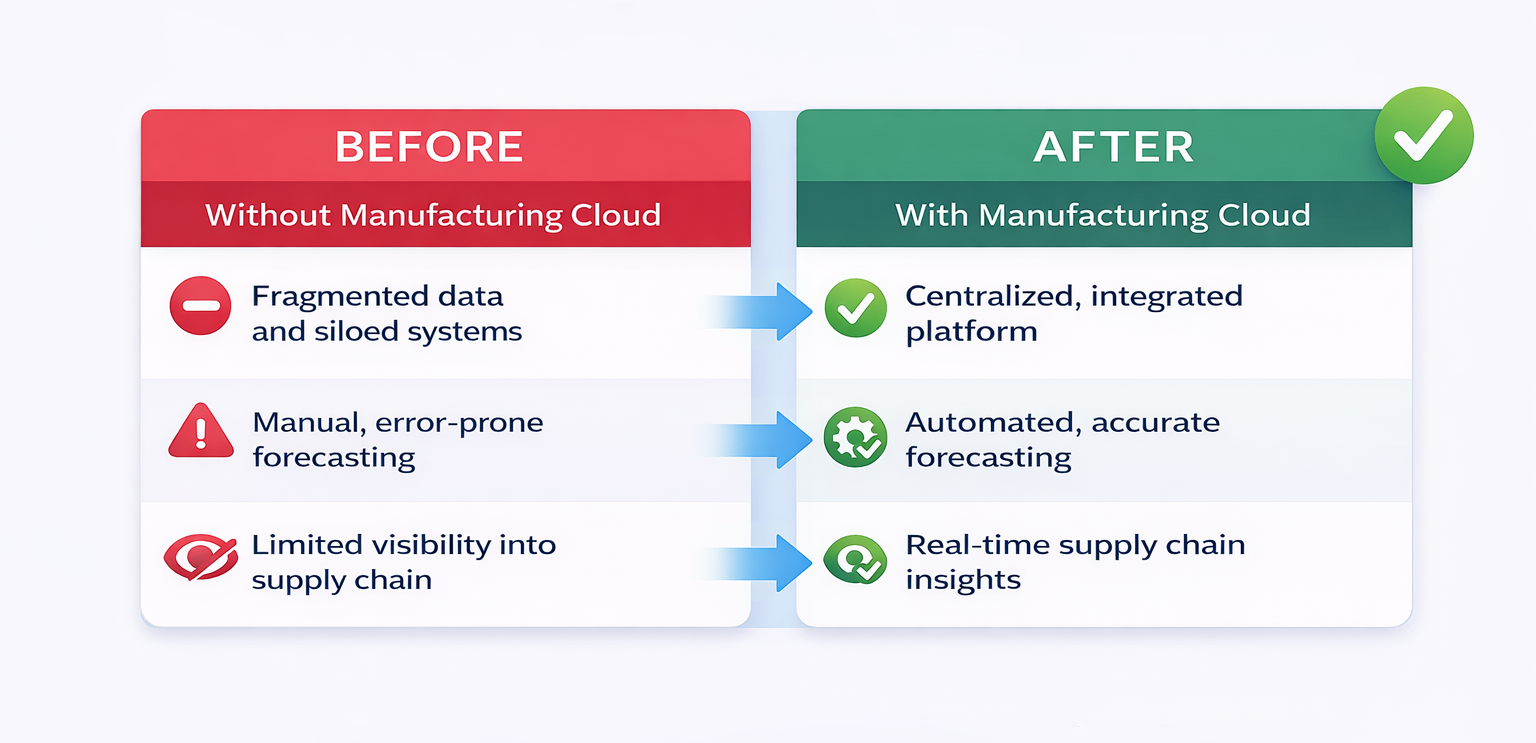
These three pillars—forecasting, supply chain visibility, and distributor collaboration—are not separate features. They are a unified system.
| Capability | Without Manufacturing Cloud | With Manufacturing Cloud |
|---|---|---|
| Forecast | Aggregate, Excel-based, monthly | Account-based, tied to agreements, live |
| Supply visibility | ERP reports, lagging indicators | Real-time bridge between demand and supply |
| Distributor collaboration | Email, spreadsheets, manual rebates | Self-service portal, automated tracking |
| Response to demand shift | Days to weeks | Hours to days |
| Auditability | Fragmented | Complete, with version control |
The unified workflow in action:
- A specialty distributor submits a revised forecast through their portal, increasing expected orders for a rare disease drug by 25% due to new patient diagnoses.
- Manufacturing Cloud automatically updates the account-based forecast and checks against available supply definitions.
- The system identifies a potential shortage in week 6 and alerts supply planning.
- Supply planning initiates an expedited production run and updates the distributor with revised lead times.
- The distributor acknowledges the update, and all changes are logged for compliance.
This closed-loop process from distributor signal to production adjustment to communication happens in days, not weeks. For companies scaling similar capabilities globally, explore global supply chain transformation with Salesforce.
Real-World Benefits & Expected Outcomes
While specific results depend on your baseline, pharma manufacturers implementing Manufacturing Cloud typically achieve:
- 15-25% improvement in forecast accuracy for established products
- 20-30% reduction in stockouts for key SKUs
- 10-15% reduction in inventory write-offs (expiry, overstock)
- 40-60% faster response to demand or supply disruptions
- 50-70% reduction in rebate dispute resolution time
- Audit-ready traceability from sales agreement to forecast to shipment
Compliance advantage: Because Manufacturing Cloud runs on Salesforce, every forecast change, agreement update, and distributor interaction is timestamped and user-stamped. This supports GxP validation efforts and provides clear evidence during regulatory inspections.
Implementation Tips: Key Features to Enable First
For pharma organizations, prioritize these Manufacturing Cloud capabilities:
- Sales Agreements – Start with your top 20 distributors and key accounts. Model their actual contracts.
- Account-Based Forecasting – Enable product and territory hierarchies. Train sales and commercial ops on ABF.
- Partner/Experience Cloud – Launch a pilot portal with 2-3 distributors. Include order visibility and agreement terms.
- Data Cloud – Connect external signals (e.g., IQVIA data, distributor POS) for AI-enhanced forecasting.
- Agentforce AI – Configure forecast adjustment recommendations and anomaly alerts.
Integration roadmap: Connect Manufacturing Cloud to your ERP (SAP, Oracle, etc.) via MuleSoft or an API-led approach. Start with product master, inventory positions, and order history. Add production schedules and material availability in phase two.
Validation note: For GxP environments, work with your quality and IT teams early. Salesforce provides documentation and tools to support computer system validation.
Challenges & How to Overcome Them
Challenge: Data silos between commercial and manufacturing teams
Solution: Manufacturing Cloud is not just a tool—it’s a process change. Establish a cross-functional governance team (commercial, supply chain, IT) to define shared KPIs and workflows.
Challenge: Distributor adoption of new portals
Solution: Co-create the portal experience with your top distributors. Focus on value to them: faster order visibility, automated rebate tracking, less manual work.
Challenge: Integration complexity with legacy ERP
Solution: Use middleware (MuleSoft, Boomi, etc.) and start with a focused scope—e.g., real-time inventory visibility for top 50 SKUs—before expanding.
Challenge: Change management for sales and planning teams
Solution: Provide role-specific training. Sales needs to understand how agreements drive forecasts. Planners need to trust the new demand signals. Celebrate quick wins.
Conclusion
Pharmaceutical manufacturing is too complex, too regulated, and too critical to rely on disconnected spreadsheets and siloed systems. Salesforce Manufacturing Cloud—now enhanced with Agentforce AI—offers a unified platform that transforms forecasting, supply chain visibility, and distributor collaboration into a single, auditable, real-time system.
You already have the agreements. You already have the demand. The question is whether you have the visibility and agility to turn that potential into reliable, compliant, profitable supply.