

Introduction
Revenue leakage, siloed billing data, manual quoting errors, and disconnected financial systems are costing businesses millions every year. Companies that are serious about protecting margin and accelerating growth are turning to Salesforce Revenue Cloud the enterprise-grade platform purpose-built to unify the entire revenue process.
Whether you are a fast-scaling SaaS company wrestling with subscription complexity, a manufacturer managing intricate pricing tiers, or a financial services firm navigating strict compliance requirements, deploying the right salesforce revenue optimization software is the single most impactful transformation you can make to your revenue operations.
This guide covers everything: what Salesforce Revenue Cloud is, why integration is non-negotiable, every major integration service category, how to select a qualified salesforce revenue cloud implementation partner, and best practices that ensure your rollout delivers lasting ROI.
What Is Salesforce Revenue Cloud?
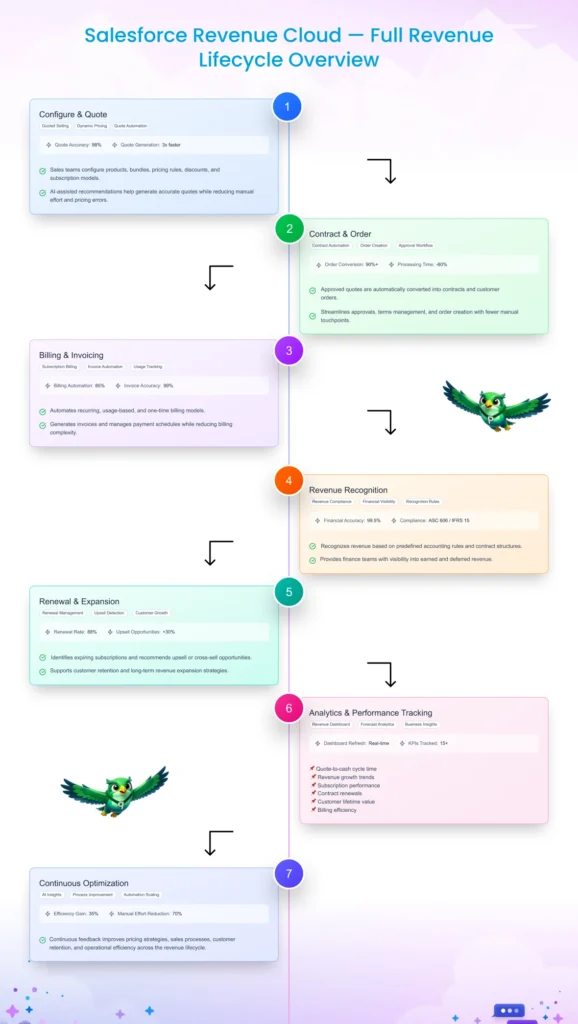
Salesforce Revenue Cloud is a unified platform that manages the full revenue lifecycle from initial product configuration and quoting through billing, revenue recognition, contract management, and renewals. Built natively on the Salesforce Customer 360 platform, it eliminates the fragmentation that comes from running disconnected CPQ tools, billing platforms, and ERP systems.
At its core, Revenue Cloud connects four critical business functions that were historically siloed:
- Sales (quoting and product configuration)
- Finance (billing, invoicing, and revenue recognition)
- Operations (order management and fulfillment)
- Customer Success (renewals, subscriptions, and contract changes)
By unifying these functions under a single data model, Revenue Cloud eliminates the manual handoffs, reconciliation errors, and reporting blind spots that erode margin and delay cash collection.
Core Components of Salesforce Revenue Cloud
Salesforce CPQ (Configure, Price, Quote)
CPQ automates the complex process of generating accurate, compliant quotes across thousands of product configurations, pricing rules, and discount thresholds. Sales reps go from hours of manual spreadsheet work to producing polished, approved quotes in minutes.
Automated Billing & Invoicing
Manual billing is one of the most common sources of revenue leakage. Revenue Cloud automates invoice generation, payment collection, dunning workflows, and reconciliation ensuring every dollar earned is captured accurately and on time.
Subscription & Renewal Management
For businesses with recurring revenue models, Revenue Cloud provides automated renewal workflows, co-terming, upsell triggers, and churn risk alerts, protecting your Annual Recurring Revenue (ARR) and enabling proactive account management.
Revenue Recognition & Compliance
Revenue Cloud includes built-in support for ASC 606 and IFRS 15 compliance, automating revenue recognition schedules and giving finance teams real-time visibility into deferred and recognized revenue without manual spreadsheet maintenance.
Contract Lifecycle Management (CLM)
From contract creation and redlining through approval, execution, and amendment, Revenue Cloud’s CLM capabilities ensure every agreement is trackable, compliant, and linked to the revenue it generates.
Why Your Business Needs Salesforce Revenue Cloud Integration Services
Deploying Revenue Cloud in isolation delivers only a fraction of its potential value. The true power of this platform emerges when it is deeply integrated with your existing technology stack, your ERP, CRM, payment gateways, e-commerce systems, and analytics tools. Here is why integration is essential:
Break Down Revenue Silos
When your CRM, billing system, and ERP operate as separate islands, your revenue data is fragmented and unreliable. Integration creates a single source of truth, so your CFO, VP of Sales, and Operations team are all working from the same numbers at the same time.
Eliminate Manual Processes That Cause Errors
Manual data entry between systems is the primary driver of billing errors, quote inaccuracies, and delayed invoicing. Every manual step is a risk. Integration automates the handoffs between systems, reducing human error and freeing your team to focus on strategic work.
Achieve Real-Time Revenue Visibility
Without integration, getting an accurate picture of your revenue performance requires manual data pulls and reconciliation that takes days. Integrated systems surface real-time dashboards so leadership can make faster, better-informed decisions.
Accelerate the Quote-to-Cash Cycle
Every day a deal sits waiting for approval, billing setup, or manual invoicing is a day your cash conversion is delayed. Integrated Revenue Cloud workflows collapse the quote-to-cash timeline sometimes from weeks to hours.
Scale Without Friction
As your business grows more products, more markets, more billing complexity, a manual or disconnected revenue stack breaks down. A properly integrated salesforce revenue optimization solution scales with you, handling higher transaction volumes and greater complexity without adding operational headcount.
Complete List of Salesforce Revenue Cloud Integration Services
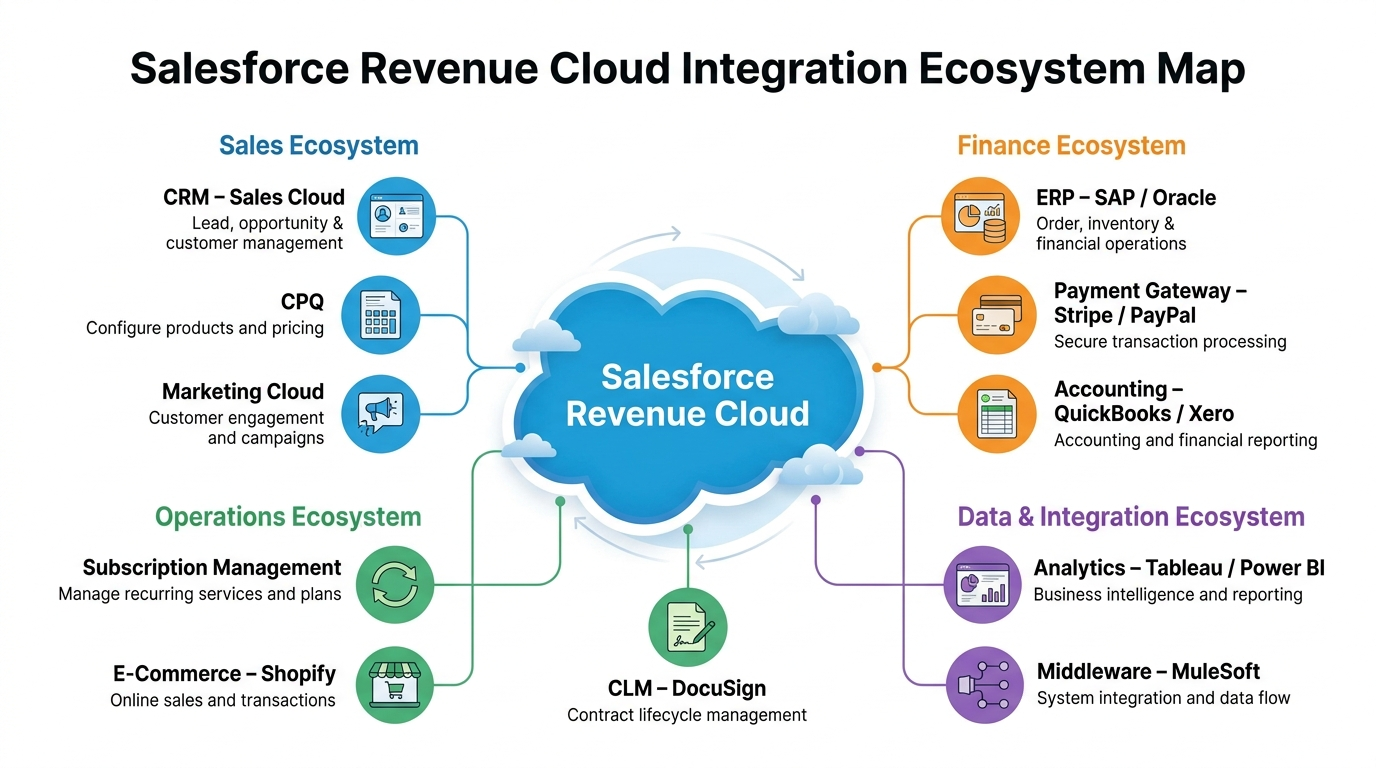
1. CRM Integration (Sales Cloud & Service Cloud)
The foundation of any Revenue Cloud deployment is deep integration with Sales Cloud and Service Cloud. This integration ensures that opportunity data, account history, service interactions, and customer entitlements flow seamlessly into the quoting and billing engine.
- 360-degree customer data available at every revenue touchpoint
- Opportunity-to-quote handoff is automated and error-free
- Service entitlements and contract terms are visible to support agents in real time
- Renewal triggers are generated automatically based on contract end dates
2. ERP Integration (SAP, Oracle, Microsoft Dynamics)
Your ERP is the backbone of your financial operations. Integrating Revenue Cloud with your ERP ensures that every quote, order, invoice, and payment is reflected accurately in your general ledger without manual re-entry or batch syncing delays.
- Bi-directional sync of order and invoice data between Salesforce and ERP
- Automated revenue recognition entries posted directly to the general ledger
- Inventory and fulfillment data visible within the quoting workflow
- Eliminates month-end reconciliation nightmares between sales and finance
3. Payment Gateway Integration (Stripe, PayPal, Adyen, Authorize.net )
A frictionless payment experience is critical for both B2B and B2C revenue models. Payment gateway integration with Revenue Cloud enables automated billing runs, self-service payment portals, dunning management, and real-time payment status visibility all within a single platform.
- Automated payment collection for recurring and one-time charges
- Configurable dunning workflows to recover failed payments proactively
- Multi-currency and multi-payment-method support
- Automatic reconciliation of payments to invoices
4. Accounting System Integration (QuickBooks, Xero, Sage)
For mid-market and growing businesses, integrating Revenue Cloud with cloud accounting platforms ensures that your revenue data flows cleanly into your books without manual intervention. This integration is particularly valuable for businesses transitioning from legacy accounting setups.
- Automated journal entry creation from Revenue Cloud billing events
- Real-time sync of customer, invoice, and payment data
- Tax calculation and remittance automation
- Simplified audit trail for financial compliance
5. Subscription Management Integration
For SaaS, media, and service businesses with complex recurring revenue models, subscription management integration is critical. This connects Revenue Cloud’s subscription engine to customer portals, provisioning systems, and entitlement platforms ensuring customers get what they pay for, and you get paid for what customers use.
- Automated proration calculations for mid-cycle upgrades and downgrades
- Usage data ingestion for consumption-based billing models
- Renewal and churn propensity signals fed into CRM workflows
- Self-service subscription modification portals connected to billing
6. Contract Lifecycle Management (CLM) Integration
CLM integration ensures that every contract executed in your legal and CLM platform whether DocuSign CLM, Ironclad, or Conga is linked to the corresponding revenue record in Salesforce. This eliminates the common problem of contract terms and billing terms falling out of sync.
- Automated contract generation from approved quotes
- Digital signature workflows triggered directly from Revenue Cloud
- Compliance tracking and renewal alerts tied to contract milestones
- Centralized contract repository with revenue visibility
7. CPQ Integration Services
Even within Revenue Cloud, CPQ often needs to be integrated with external product catalogs, pricing engines, and configurators particularly in industries with highly complex product hierarchies. Expert CPQ integration ensures that your pricing logic, discount rules, and approval workflows are accurately reflected in every quote.
- Integration with external product catalog and PIM systems
- Custom pricing engine connections for dynamic and AI-driven pricing
- Multi-level approval routing based on deal size and discount thresholds
- Guided selling flows that reduce quote errors and shorten sales cycles
8. Data & Analytics Integration (Tableau, Power BI, Salesforce Data Cloud)
Your revenue data is only as valuable as the insights you can extract from it. Connecting Revenue Cloud to your analytics stack whether Tableau, Power BI, or Salesforce Data Cloud transforms raw transactional data into strategic intelligence.
- Real-time revenue performance dashboards for leadership
- Cohort analysis for subscription churn and expansion revenue
- Forecasting models powered by historical booking and billing data
- Cross-functional reporting that unites sales, finance, and operations metrics
9. E-Commerce Platform Integration (Shopify, Magento, Salesforce B2B Commerce)
For businesses that sell online whether direct-to-consumer or through a self-service B2B portal, e-commerce integration with Revenue Cloud ensures that every web transaction flows seamlessly into your revenue management system.
- Real-time order sync from e-commerce platform to Revenue Cloud
- Automated billing and fulfillment triggered by online purchases
- Consistent product catalog and pricing across all sales channels
- Customer purchase history unified across digital and direct sales
10. Marketing Automation Integration (Salesforce Marketing Cloud, Pardot, HubSpot)
Connecting revenue data with marketing automation closes the loop between marketing spend and revenue outcomes. This integration gives your marketing team visibility into which campaigns, channels, and messages are actually driving closed revenue not just leads.
- Lead-to-opportunity-to-revenue attribution across all campaigns
- Automated customer lifecycle journeys triggered by billing and renewal events
- Upsell and cross-sell campaigns powered by revenue and usage data
- Account-based marketing precision fueled by contract and expansion data
11. API & Middleware Integration (MuleSoft, Dell Boomi, Azure Integration Services)
For organizations with complex, multi-system architectures, API and middleware integration services ensure that Revenue Cloud can communicate with any system legacy or modern through robust, scalable integration layers. This is where a skilled salesforce revenue cloud implementation partner delivers exceptional value.
- Custom API development for proprietary or legacy system connectivity
- Event-driven architecture for real-time data propagation
- Error handling, retry logic, and integration monitoring
- Scalable middleware that grows with your transaction volume
Key Benefits of Salesforce Revenue Cloud Integration
| Benefit | Business Impact |
|---|---|
| Faster Quote-to-Cash | Automates approvals, billing, and invoicing to collapse deal cycle times |
| Improved Forecasting Accuracy | Real-time pipeline and billing data enables precise revenue projections |
| Reduced Operational Cost | Eliminates manual data entry, reconciliation, and error correction overhead |
| Better Customer Experience | Accurate billing, faster responses, and consistent communication build trust |
| Compliance & Audit Readiness | Automated ASC 606/IFRS 15 compliance reduces financial and legal risk |
| Scalable Revenue Operations | Handles growing transaction volume without proportional headcount growth |
How to Choose the Right Salesforce Revenue Cloud Implementation Partner
Selecting the right salesforce revenue partner is arguably more important than the technology itself. The best platform in the world delivers poor results when implemented by a team lacking deep domain expertise. Here is what to evaluate:
Deep Salesforce Revenue Cloud Certification & Experience:
Ensure the partner has Salesforce CPQ Specialist, Revenue Cloud Accredited Professional, and Billing Specialist certifications. Also check how many Revenue Cloud implementations they’ve delivered and ask for relevant client references in your industry.
Cross-Functional Business Understanding:
They should understand end-to-end revenue operations across sales, finance, legal, and operations. A strong partner translates business needs (especially CFO and RevOps priorities) into system design—not just technical requirements.
Integration Architecture Expertise:
Revenue Cloud success depends heavily on integrations. Evaluate their experience with MuleSoft, REST APIs, event-driven architecture, and enterprise systems like SAP, Oracle, or NetSuite. Ask for real architecture examples from past projects.
Industry-Specific Knowledge:
Revenue models vary widely (SaaS subscriptions, manufacturing pricing tiers, telecom usage billing, etc.). Choose a partner with hands-on experience in your industry’s revenue complexity.
Post-Implementation Support Model:
Go-live is just the start. Check their managed services, optimization support, SLA commitments, and how they help continuously improve Revenue Cloud after deployment.
Transparent Methodology & Project Governance:
Look for a structured implementation approach with clear phases, milestones, executive governance, and change management. Most failures happen due to weak governance, not technology.
→ Pro Tip: Request a partner’s average time-to-go-live for projects of comparable scope, their post-go-live defect rate, and at least three customer references you can speak with directly before signing any engagement.
Best Practices for a Successful Salesforce Revenue Cloud Integration
1. Start With a Revenue Operations Audit
Before configuring anything, document your current quote-to-cash workflow in detail. Map every system, every manual step, every data handoff, and every failure point. This audit becomes the foundation of your integration architecture and ensures no critical process is overlooked.
2. Align Business Stakeholders Before Technical Build Begins
Revenue Cloud integrations fail when technical teams build in isolation and present the finished product to business stakeholders. Engage your CFO, RevOps leader, Sales Operations team, and Finance team in requirements workshops before any code is written. Their alignment on business outcomes drives architectural decisions that actually work in practice.
3. Invest in Data Cleansing and Migration Planning
Garbage in, garbage out. If your customer master, product catalog, or historical billing data is messy, those problems will be amplified by integration. Invest in data quality assessment, deduplication, and cleansing before migrating data into Revenue Cloud. Define data governance policies that prevent the problem from recurring.
4. Implement in Phased Waves
Trying to integrate every system simultaneously in a single “big bang” deployment is the fastest path to project failure. The best salesforce revenue optimization solutions are implemented in phases — typically starting with CPQ and CRM integration, followed by billing and ERP, then analytics and advanced automation — with each wave validated before the next begins.
5. Design for the Exception, Not Just the Happy Path
Your integration architecture must handle errors, retries, partial failures, and data conflicts gracefully. Design exception handling, alerting, and manual override capabilities into every integration. Integration health monitoring dashboards should be built alongside the integrations themselves.
6. Build a Continuous Optimization Cadence
Revenue Cloud is not a set-and-forget implementation. As your product catalog evolves, pricing models change, and new systems are added, your integration layer must evolve with them. Establish a quarterly review cadence with your implementation partner to assess performance metrics, identify optimization opportunities, and plan incremental enhancements.
Industry-Specific Use Cases for Salesforce Revenue Cloud Integration
Software & SaaS
SaaS companies use Revenue Cloud to manage complex subscription tiers, usage-based billing, freemium-to-paid conversion workflows, and multi-year contract structures. Integration with provisioning platforms and customer portals enables self-service subscription management at scale a core requirement for any salesforce revenue optimization apps deployment in this sector.
Manufacturing
Manufacturers leverage Revenue Cloud to manage complex channel pricing, multi-tier distributor discounts, configure-to-order quoting, and warranty billing. Integration with ERP and supply chain systems ensures that quotes reflect real-time inventory and production capacity eliminating the costly problem of quoting products that cannot be delivered on time.
Financial Services
Financial services firms use Revenue Cloud to automate fee billing, manage complex advisory service agreements, and ensure strict regulatory compliance in revenue recognition. Integration with regulatory reporting systems and banking platforms ensures that every revenue event is captured accurately and in compliance with applicable standards.
Telecommunications
Telecoms deal with some of the most complex billing scenarios in any industry usage-based charges, bundled services, mid-cycle changes, and regulatory surcharges. Revenue Cloud integration with network usage data platforms and customer self-service portals is essential for accurate, timely billing at scale.
Healthcare & Life Sciences
Healthcare organizations use Revenue Cloud to manage payer contracts, patient billing workflows, and complex multi-party revenue arrangements. Integration with EHR systems, payer portals, and government reporting platforms ensures compliance and revenue integrity in a highly regulated environment.
Ready to Transform Revenue Management with Salesforce Revenue Cloud?
Salesforce revenue cloud integration service empowers businesses to handle end-to-end revenue processes including billing, quoting, and contracts with greater efficiency and accuracy. It ensures compliance while reducing operational complexity. Salesforce Agentforce revenue management connects finance and operations within the Salesforce ecosystem, enabling smarter decision-making and improved collaboration.
With the right implementation strategy, businesses can unlock long-term value and modernize their revenue operations.