

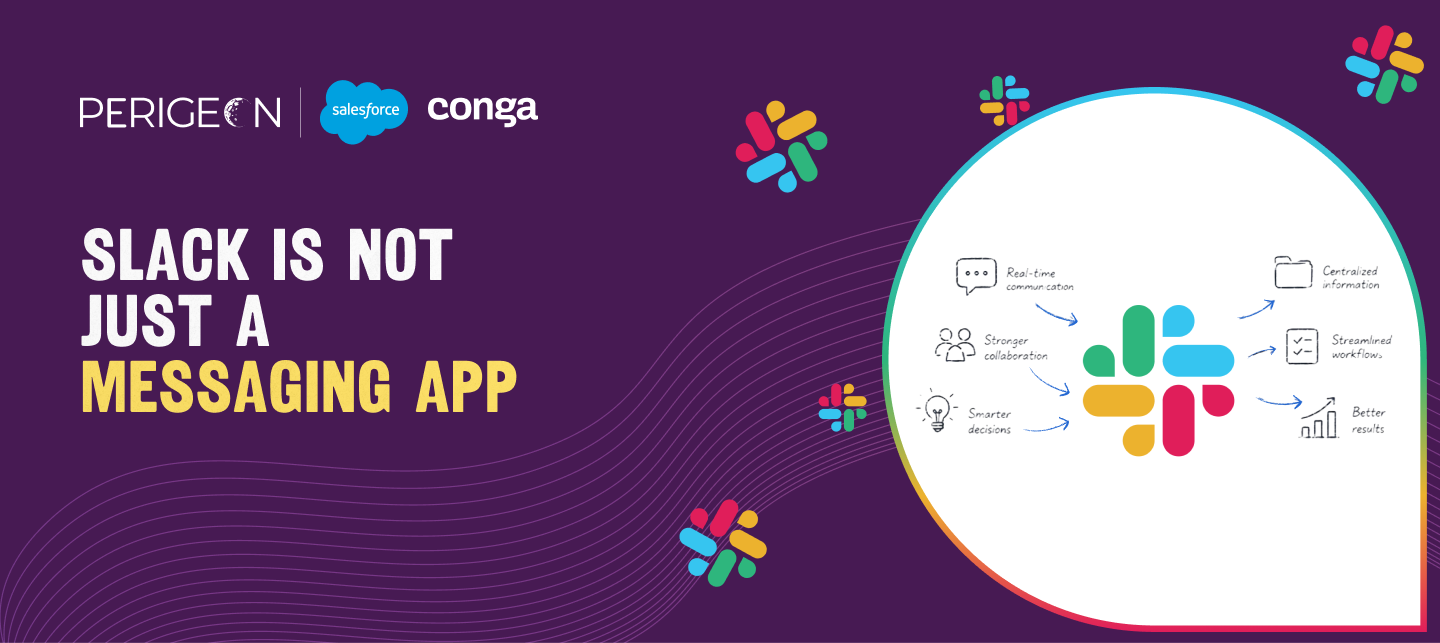
Why High-Performing Companies Use Slack as a Business Platform, Not a Chat Tool
For many organizations, Slack started as a simple team messaging tool a faster alternative to email and group chats. However, in 2026, Slack has evolved into something much bigger.
Today, businesses use Slack as a centralized workspace where communication, workflows, automation, customer data, AI-powered insights, and business applications come together. Salesforce itself now positions Slack as a work operating system that connects people, data, applications, workflows, and AI agents in a single workspace.
At Perigeon Software, we help organizations unlock the full potential of Slack through Salesforce Slack integration service, workflow automation, and collaboration solutions that improve productivity across departments.
Key Takeaways
- Slack is no longer just a messaging platform.
- Businesses use Slack for workflow automation, approvals, and operational collaboration.
- Slack integrates with Salesforce to bring CRM data directly into conversations.
- AI-powered capabilities help teams summarize discussions, automate tasks, and find information faster.
- Organizations can reduce context switching by centralizing work inside Slack.
- Salesforce and Slack together create a connected digital workplace.
The Evolution of Slack
When Slack first gained popularity, most teams used it primarily for internal communication. While messaging remains a core function, the platform has expanded significantly.
Modern Slack workspaces now support:
- Workflow automation
- Cross-functional collaboration
- AI-powered productivity
- Customer relationship management
- Business process approvals
- Project management
- Enterprise search
- Application integrations
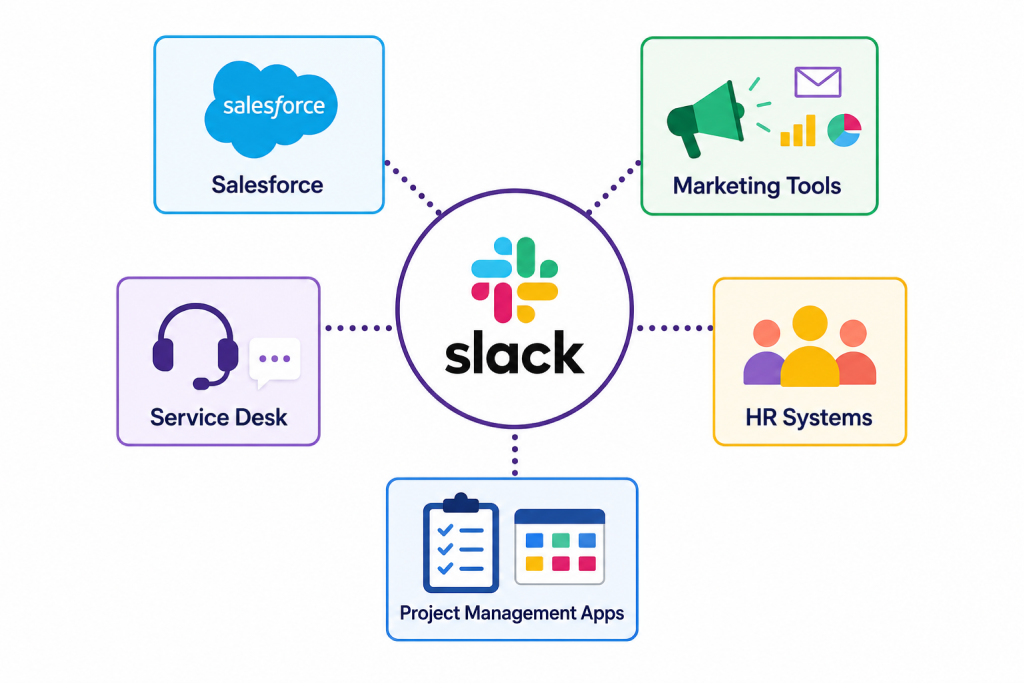
Slack now connects thousands of business applications and increasingly serves as the operational hub where work gets done. Recent platform enhancements have introduced AI-driven summaries, workflow generation, enterprise search, and deeper Salesforce connectivity.
Slack Is a Collaboration Platform, Not Just a Chat Tool
The biggest misconception about Slack is that it exists solely for messaging.
In reality, Slack acts as a collaboration layer across the entire organization.
Teams use Slack to:
Sales Collaboration
- Discuss opportunities
- Share customer updates
- Track pipeline changes
- Coordinate deal strategy
Customer Support
- Escalate critical issues
- Collaborate on service cases
- Resolve incidents faster
Marketing Operations
- Review campaign assets
- Approve content
- Coordinate launches
Leadership Communication
- Monitor business metrics
- Receive operational alerts
- Review performance updates
Instead of switching between multiple tools, employees can collaborate where information already exists.
Slack Workflow Automation Saves Time
One of Slack’s most powerful capabilities is workflow automation.
Organizations use Slack to automate repetitive tasks such as:
- Employee onboarding
- Approval requests
- IT support tickets
- Lead assignment notifications
- Customer escalation processes
- Daily status reporting
Automation reduces manual effort while ensuring processes remain consistent across teams.
Recent Slack enhancements have expanded AI-powered workflow creation and automation capabilities, helping organizations accelerate routine business processes.
Slack AI Is Transforming Workplace Productivity
Artificial intelligence is becoming a major part of the Slack experience.
New AI capabilities include:
- Conversation summaries
- Thread recaps
- Meeting note generation
- Enterprise search
- Writing assistance
- Workflow recommendations
Slack’s AI tools help employees quickly understand discussions, locate information, and take action without searching through hundreds of messages. Recent updates have positioned Slack as an AI-powered work operating system where conversations, applications, and business data work together.
Salesforce Slack Integration: Bringing CRM Data into Conversations
One of the most valuable capabilities for growing businesses is Salesforce Slack integration.
Traditionally, sales teams constantly switch between CRM systems and communication platforms. This creates delays, missed updates, and fragmented collaboration.
Salesforce and Slack solve this challenge by connecting customer data directly to workplace conversations. Salesforce reports that millions of CRM records are shared and acted upon inside Slack every week.
With Salesforce Slack integration, teams can:
Access CRM Records in Slack
Users can view customer information, accounts, opportunities, and service records without leaving Slack.
Receive Real-Time Alerts
Teams receive instant notifications for:
- New leads
- Opportunity updates
- Closed deals
- Service escalations
Collaborate Around Opportunities
Sales, service, and management teams can discuss customer accounts within dedicated channels while maintaining visibility into Salesforce data.
Improve CRM Adoption
Employees are more likely to engage with CRM data when it is available directly within their daily workflow.
Recent Salesforce enhancements continue to deepen Slack’s role as a conversational interface for CRM data, workflows, and AI-powered business processes.
Why Businesses Are Moving Toward a Digital Headquarters
Modern work environments require more than communication.
Organizations need a platform where:
- Teams collaborate
- Processes run automatically
- Data is accessible
- Decisions happen quickly
- AI assists productivity
This is why Slack is increasingly described as a digital headquarters rather than a messaging application.
Instead of managing disconnected tools, businesses create a centralized environment where communication and action happen together.
How Perigeon Helps Businesses Maximize Slack
We help organizations transform Slack into a business productivity platform through:
- Slack consulting services
- Salesforce Slack integration services
- Slack workflow automation
- Slack implementation services
- Custom Slack integrations
- Enterprise collaboration solutions
Our team helps businesses connect Slack with Salesforce and other critical systems, enabling faster collaboration, better visibility, and improved operational efficiency.
Conclusion
Slack is no longer just a messaging app. It has become a powerful platform for collaboration, automation, AI-driven productivity, and business operations. When integrated with Salesforce, Slack helps teams work smarter, respond faster, and stay connected with the data that matters most.