

Retail has evolved far beyond simply selling products. Today’s customers expect personalized recommendations, seamless omnichannel experiences, and instant support whether they’re shopping online, in-store, or through a mobile app.
However, many retailers still struggle with fragmented customer data spread across multiple systems such as CRM platforms, eCommerce websites, loyalty programs, POS systems, marketing automation tools, and customer service applications. Without a unified customer view, delivering personalized experiences becomes difficult.
This is where Salesforce Data 360 for Retail becomes a competitive advantage.
Formerly known as Salesforce Data Cloud, Salesforce Data 360 helps retailers unify customer information from multiple sources into a single trusted profile, enabling AI-powered personalization, better decision-making, and measurable revenue growth. It connects structured and unstructured data, supports real-time insights, and powers Customer 360 experiences across Salesforce applications.
In this guide, you’ll learn how Salesforce Data 360 works, its benefits for retail businesses, and how it transforms customer data into increased sales and long-term customer loyalty.
What is Salesforce Data 360?
Salesforce Data 360 is Salesforce’s enterprise data platform designed to collect, unify, harmonize, and activate customer data across multiple channels.
Instead of storing customer information in disconnected systems, Data 360 creates a real-time unified customer profile that every department can use from marketing and sales to customer support and commerce. It supports batch and streaming data ingestion, identity resolution, governance, and analytics to deliver a complete customer view.
Retailers can combine information from:
- Online stores
- Physical stores
- Mobile applications
- CRM
- Loyalty programs
- POS systems
- Marketing platforms
- Customer support systems
- Third-party applications
The result is a complete 360-degree customer view.
Why Retail Businesses Need Salesforce Data 360
Modern shoppers use multiple touchpoints before making a purchase.
For example, a customer might:
- Browse products on a mobile app
- Read reviews online
- Visit a physical store
- Abandon their shopping cart
- Return later through an email campaign
- Complete the purchase using a loyalty coupon
Without connected customer data, these interactions remain isolated.
Salesforce Data 360 connects every interaction into one profile, allowing retailers to understand customer behavior and deliver highly personalized experiences.
Key Challenges Faced by Retailers
Many retail businesses experience common data challenges:
- Customer information stored in different systems
- Duplicate customer records
- Inconsistent product recommendations
- Generic marketing campaigns
- Poor customer segmentation
- Limited visibility into buying behavior
- Low customer retention
These issues directly impact revenue and customer satisfaction.
How Salesforce Data 360 Turns Customer Data into Revenue
1. Creates a Unified Customer Profile
The biggest advantage of Salesforce Data 360 is identity resolution.
Instead of having separate customer records across various systems, it intelligently combines them into a single profile.
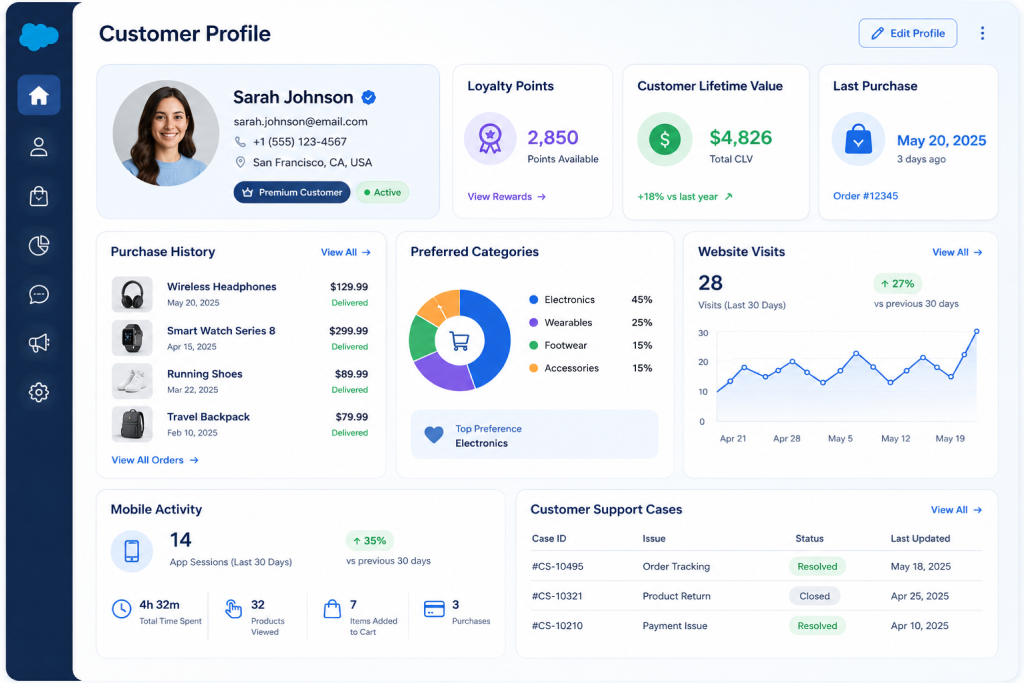
A unified profile can include:
- Purchase history
- Browsing behavior
- Loyalty points
- Email engagement
- Customer support interactions
- Product preferences
- Store visits
- Demographics
With a complete customer profile, retailers can make smarter business decisions.
2. Enables Personalized Shopping Experiences
Personalization drives higher conversion rates.
Using Salesforce Data 360, retailers can recommend products based on:
- Previous purchases
- Browsing history
- Seasonal interests
- Customer preferences
- Purchase frequency
- Real-time behavior
Examples include:
- Personalized homepage content
- Dynamic email campaigns
- Product recommendations
- Location-based offers
- Personalized promotions
Customers receive relevant experiences instead of generic marketing messages.
3. Improves Customer Segmentation
Traditional segmentation relies on static customer lists.
Salesforce Data 360 enables dynamic audience segmentation using:
- Purchase frequency
- Average order value
- Cart abandonment
- Loyalty status
- Geographic location
- Product interests
- Customer lifetime value
Marketing teams can automatically create targeted campaigns for high-value customers, first-time buyers, inactive customers, and seasonal shoppers.
4. Supports AI-Powered Recommendations
Salesforce AI capabilities become significantly more powerful when fueled by unified customer data.
Retailers can leverage AI for:
- Product recommendations
- Predictive buying behavior
- Customer churn prediction
- Personalized promotions
- Cross-selling
- Upselling
- Demand forecasting
Instead of relying on assumptions, retailers make data-driven decisions.
5. Enhances Omnichannel Experiences
Today’s shoppers expect consistency across every channel.
Salesforce Data 360 connects customer journeys across:
- Website
- Mobile app
- Social media
- Physical stores
- Customer support
- Live chat
Customers enjoy a seamless experience regardless of where they interact with the brand.
6. Reduces Customer Churn
Customer retention costs less than acquiring new customers.
Salesforce Data 360 helps identify customers likely to stop purchasing.
Retailers can proactively:
- Send personalized offers
- Launch re-engagement campaigns
- Recommend relevant products
- Provide loyalty rewards
- Offer exclusive discounts
These actions improve retention while increasing customer lifetime value.
Real-World Retail Use Cases
Personalized Product Recommendations
Customers receive product suggestions based on:
- Purchase history
- Browsing activity
- Similar customer behavior
Cart Abandonment Recovery
Automatically trigger:
- Reminder emails
- Discount offers
- Product recommendations
- SMS notifications
Loyalty Program Optimization
Retailers can identify:
- VIP customers
- Frequent buyers
- At-risk members
- High-spending customers
This enables smarter loyalty campaigns.
Seasonal Marketing Campaigns
Instead of sending one campaign to everyone, retailers can personalize offers based on customer interests and buying history.
Benefits of Salesforce Data 360 for Retail
Businesses implementing Salesforce Data 360 can achieve:
- Higher customer retention
- Increased average order value
- Better customer insights
- Faster decision-making
- Improved campaign performance
- Personalized shopping experiences
- Enhanced customer satisfaction
- Better inventory planning
- Increased marketing ROI
- Revenue growth
Best Practices for Successful Implementation
To maximize the value of Salesforce Data 360:
Define Clear Business Goals
Identify measurable objectives such as:
- Increase customer lifetime value
- Improve retention
- Reduce cart abandonment
- Boost conversion rates
Integrate All Customer Data Sources
Connect:
- CRM
- POS
- eCommerce
- Marketing platforms
- Customer service
- Loyalty systems
Maintain Data Quality
Regularly remove duplicate records, validate customer information, and enforce governance practices.
Use AI Responsibly
Combine AI recommendations with human oversight and comply with privacy regulations and customer consent requirements.
Measure Success
Track KPIs such as:
- Customer Lifetime Value (CLV)
- Customer Acquisition Cost (CAC)
- Average Order Value (AOV)
- Repeat Purchase Rate
- Customer Retention Rate
- Marketing ROI
- Revenue per Customer
Why Salesforce Data 360 Is the Future of Retail
Retail competition is becoming increasingly data-driven.
Customers expect:
- Personalized recommendations
- Faster service
- Consistent experiences
- Relevant offers
- Seamless omnichannel shopping
Retailers relying on disconnected systems will struggle to meet these expectations.
Salesforce Data 360 provides the unified data foundation that powers personalization, analytics, AI, and connected customer experiences across the Salesforce ecosystem. It integrates data from commerce, marketing, sales, and service to support real-time decision-making.
Conclusion
Customer data is one of the most valuable assets a retailer owns—but only when it is connected, accurate, and actionable.
Salesforce Data 360 helps retailers transform fragmented customer information into a unified, real-time view that supports smarter marketing, personalized shopping experiences, improved customer loyalty, and increased revenue.
Whether you’re looking to optimize customer engagement, enhance omnichannel experiences, or unlock AI-driven insights, Salesforce Data 360 provides the foundation needed to compete in today’s customer-centric retail landscape.
Organizations that invest in unified customer data today will be better positioned to deliver exceptional experiences and drive sustainable growth in the years ahead.