
Salesforce and Anthropic have announced Claudeforce, an expanded strategic partnership that combines Anthropic’s Claude AI with Salesforce’s CRM data, workflows, business logic, actions, and governance. Here’s what Claudeforce means for sales teams, AI agents, and the future of enterprise software.
What Is Claudeforce?
Claudeforce is the name Salesforce and Anthropic have given to their expanded strategic partnership, announced on August 26, 2026.
At its core, Claudeforce brings together Anthropic’s Claude reasoning capabilities with Salesforce’s enterprise data, CRM workflows, business logic, actions, and governance.
But Claudeforce is more than another AI assistant added to a CRM.
The partnership is moving in three directions:
- Salesforce inside Claude — Salesforce capabilities become accessible directly from Claude.
- Claude inside Salesforce Agentforce — Claude becomes a core reasoning model for Salesforce’s AI agent platform.
- Claude inside Slack — Claude becomes deeply integrated into the workplace environment where teams communicate and act.
Salesforce describes the strategy as bringing together the “#1 AI” and the “#1 AI CRM.” The more important takeaway, however, is architectural: AI is increasingly becoming the interface through which employees interact with enterprise software.
Why Is Claudeforce Important?
For years, enterprise software has largely worked the same way.
A salesperson opens Salesforce, searches for an account, reviews opportunities, checks activity, updates records, and moves between different screens to complete a workflow.
AI changes that model.
Instead of navigating through multiple CRM screens, an employee can potentially tell an AI agent what they want to accomplish and allow the agent to retrieve the necessary information, reason over it, and perform approved actions.
That is where Claudeforce becomes interesting.
Salesforce provides the system of record, business rules, data, workflows, and governance, while Claude provides advanced reasoning and agentic capabilities.
The result is an attempt to combine the strengths of both platforms rather than forcing businesses to choose between their CRM and their AI assistant.
Salesforce in Claude: The First Major Claudeforce Experience
The first major product experience from the partnership is Salesforce in Claude.
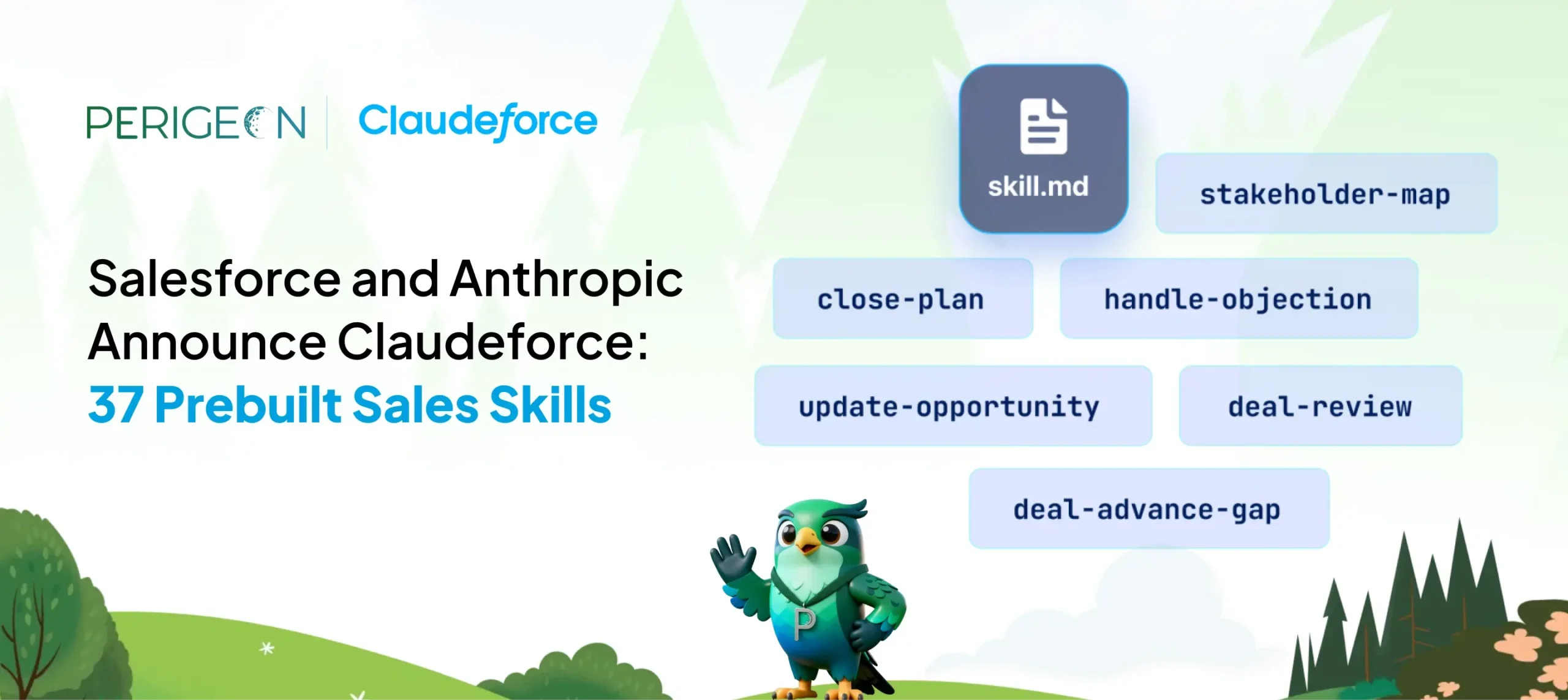
Salesforce says the plugin launches with 37 prebuilt sales skills designed around common sales workflows.
These capabilities allow sellers and agents to work with live Salesforce revenue context directly from Claude.
Examples include:
- Preparing for customer meetings
- Reviewing account information
- Analyzing deal health
- Reviewing sales pipelines
- Identifying opportunities that need attention
- Updating pipeline information
- Taking governed actions inside Salesforce
The important distinction is that Claude is not simply answering questions about Salesforce data.
The integration is designed to allow Claude to reason over Salesforce information and take approved actions through Salesforce.
That moves the experience from a traditional chatbot toward an AI agent capable of executing enterprise workflows.
37 Prebuilt Sales Skills: Why They Matter
The 37 prebuilt sales skills are one of the more practical parts of the announcement.
Enterprise AI adoption often struggles because organizations have to start from scratch.
A company may have Salesforce data, an AI model, APIs, security policies, and workflows—but connecting everything into useful employee experiences can still require significant development work.
Prebuilt skills reduce that initial barrier.
For example, instead of asking a sales representative to build a complicated workflow for meeting preparation, the system can understand the seller’s Salesforce context and generate the information needed for the meeting.
The broader implication is significant:
Enterprise AI is moving from “ask the AI a question” toward “give the AI a business objective.”
That is a much more powerful model for enterprise productivity.
♦ Learn more about 37 prebuilt sales skills: https://www.salesforce.com/claudeforce/
Planning and Pipeline
- Daily Briefing
- Deal Signals
- Pipeline Review
- Team Pipeline
- Forecast Narrative
- Deal-Slip Scenarios
- Weekly Recap
- Calendar Events
Deal Strategy
- Deal Review
- Stakeholder Map
- Close Plan
- Objection Handling
- Deal-Advance Gap Analysis
- Opportunity Updates
Prospecting and Account Growth
- Prospect Research
- Lead Triage
- Account Tiering
- Account Planning
- Outreach Drafting
- Customer Voice Analysis
- Customer Health
- Renewal Radar
- Expansion Whitespace
- SDR Target Assignment
Meetings and Communication
- Call Preparation
- Call Follow-Up
- Meeting Scheduling
- Inbox Sweep
- Representative Context
- Conversation Transcript Summaries
CRM Intelligence and Governance
- Win-Loss Review
- Activity Logging
- Activity-History Queries
- Internal Answer Discovery
- Salesforce Data-Hygiene Checks
- Most-Prepared Analysis
Claude Inside Salesforce Agentforce
The partnership also moves in the opposite direction.
Claude is being integrated into Salesforce’s Agentforce ecosystem as a reasoning model.
According to Salesforce, Claude will power the Atlas Reasoning Engine, as well as Agentforce Vibes and Agentforce Coworker by default, while also being available through Agent Builder.
This matters because the underlying AI model is one of the most important components of an autonomous agent.
An agent needs to do more than retrieve information.
It needs to:
- Understand context
- Break down complex tasks
- Decide what information it needs
- Select appropriate tools
- Follow business rules
- Reason through ambiguity
- Determine what action should happen next
By bringing Claude into Agentforce, Salesforce is effectively combining its enterprise agent infrastructure with Anthropic’s frontier AI capabilities.
Claude and Slack: Bringing AI Into the Flow of Work
The third part of Claudeforce involves Slack.
Salesforce says Claude will become the default model in Slack, powering experiences such as Slackbot, Claude Tag, and Slack Code. This development highlights the growing importance of Salesforce slack integration in connecting AI, communication, and enterprise workflows.
This is strategically important because Slack sits between communication and execution.
Employees already discuss:
- Customers
- Deals
- Projects
- Problems
- Approvals
- Business decisions
If AI can understand those conversations and connect them to enterprise systems, the traditional boundary between communication, analysis, and action starts to disappear.
Imagine a sales team discussing a struggling account in Slack.
Instead of someone manually opening Salesforce, searching for the account, reviewing opportunities, checking activity, and updating the record, an AI agent could potentially connect the conversation to the underlying CRM data and initiate an approved workflow.
That is the larger vision behind Claudeforce.
The Real Innovation: AI Becomes the Interface
One of the most interesting ideas behind the Salesforce-Anthropic partnership is the shift from software as a destination to software as infrastructure for AI agents.
Traditional enterprise software puts the user interface at the center.
The employee interacts with menus, dashboards, forms, reports, and applications.
The emerging AI model is different.
The employee communicates an objective.
The AI understands the objective, accesses the necessary enterprise systems, reasons over the information, and coordinates the workflow.
In this model, Salesforce does not necessarily become less important because people use its interface less.
Instead, Salesforce becomes more important as the system that contains the trusted data, permissions, workflows, and business logic behind the AI experience.
This is one of the biggest strategic ideas behind Claudeforce.
AI Reasoning + Enterprise Governance
There is an important problem with enterprise AI: intelligence alone isn’t enough.
An AI model might be capable of producing a sophisticated answer, but businesses also need to know:
- What data can the AI access?
- Which actions can it perform?
- Who authorized the action?
- What business rules apply?
- Can the action be audited?
- What happens when the AI makes a mistake?
This is where Salesforce’s enterprise infrastructure becomes particularly important.
Claudeforce is designed to combine Claude’s reasoning with Salesforce’s existing data, workflows, permissions, and governance mechanisms.
That distinction could become increasingly important as AI agents move from generating information to taking real business actions.
Claudeforce and Data Security
Security and data governance are especially important for enterprises adopting AI.
Salesforce says Claude can be made available within the Salesforce Trust Boundary through Amazon Bedrock, allowing customers to use Claude while maintaining Salesforce’s enterprise security architecture.
This is particularly relevant for industries with strict regulatory requirements, including financial services, healthcare, cybersecurity, and other highly regulated sectors.
The message to enterprise buyers is clear:
The future of AI isn’t only about which model is smartest. It’s also about which model can operate safely inside an organization’s existing governance framework.
Claudeforce vs. Traditional CRM AI
Traditional CRM AI often works as a feature layered onto existing software.
For example:
“Summarize this account.”
or:
“Write an email to this customer.”
Those features are useful, but they remain relatively narrow.
Claudeforce points toward something broader.
Instead of simply generating content, an AI agent can potentially:
- Access enterprise context.
- Understand the business objective.
- Analyze CRM information.
- Reason about the next step.
- Ask for approval when necessary.
- Execute an action.
- Update the underlying system.
That is a fundamentally different interaction model.
The AI is no longer simply assisting the user inside the application.
The AI becomes a layer through which the user can operate the application.
What Does Claudeforce Mean for Sales Teams?
For sales professionals, the biggest potential benefit is reducing the amount of administrative work required to maintain CRM data.
Sales representatives spend significant amounts of time:
- Preparing for meetings
- Searching for account information
- Reviewing opportunity history
- Updating CRM records
- Checking pipeline health
- Writing follow-up communications
- Looking for missing information
An AI interface connected to live CRM data could bring many of these tasks into a single conversational workflow.
A seller might ask:
“Prepare me for my meeting with this account.”
The AI could potentially combine account information, opportunity data, recent activity, communications, and other connected context into a single briefing.
After the meeting, the seller could ask the system to update the opportunity based on the discussion.
The value isn’t just saving a few clicks.
The bigger opportunity is reducing the friction between human decision-making and CRM execution.
What Does Claudeforce Mean for Salesforce?
Claudeforce also represents an important strategic decision for Salesforce.
The company could have attempted to keep users entirely inside Salesforce’s own AI ecosystem.
Instead, Salesforce is allowing its CRM capabilities to become accessible through Claude while simultaneously bringing Claude deeper into Salesforce.
That creates a more open, interconnected AI strategy.
It also reinforces Salesforce’s argument that its value comes from the enterprise data, workflows, business logic, and governance that sit underneath the user experience.
In other words:
If AI becomes the interface, the underlying system of record may become even more important.
What Does Claudeforce Mean for Anthropic?
For Anthropic, the partnership provides something equally valuable: deeper access to enterprise workflows.
Claude can be extremely capable at reasoning, but enterprise customers need access to trusted business data and systems before AI can become an operational layer.
Salesforce gives Anthropic access to one of the most important categories of enterprise data: customer and revenue information.
That creates a powerful combination:
Claude provides intelligence; Salesforce provides enterprise context and execution.
The partnership also places Claude directly inside workflows where businesses already operate.
Is Claudeforce a New Product or a Partnership?
This distinction is important.
Claudeforce is best understood as the name for the expanded Salesforce-Anthropic strategic partnership rather than a single standalone application.
The partnership encompasses multiple integrations:
- Salesforce in Claude
- Claude in Agentforce
- Claude in Slack
- Additional integrations planned across the Salesforce and Anthropic ecosystems
The first major customer-facing experience is Salesforce in Claude, which includes 37 prebuilt sales skills.
When Will Claudeforce Be Available?
Salesforce says Salesforce in Claude is available to select pilot customers, with an open beta planned for September 2026.
The companies also plan to introduce additional prebuilt skills and expand integrations across Claude, Salesforce, and Slack.
That means the August 2026 announcement should be viewed as the beginning of a broader product rollout rather than the final version of Claudeforce.
Claudeforce and the Future of Enterprise Software
Perhaps the biggest question is what this means for enterprise software itself.
For decades, SaaS companies built applications around human users.
People opened applications, navigated menus, entered data, generated reports, and completed workflows.
AI agents introduce another possibility.
Software can increasingly become a system that agents operate on behalf of humans.
In that world, the user interface may matter less than:
- Data quality
- APIs
- Permissions
- Business logic
- Governance
- Security
- Agent interoperability
Salesforce’s AIforce strategy and Anthropic’s Claude ecosystem are moving in this direction.
The Model Context Protocol, or MCP, also becomes important because standardized ways for AI systems to interact with external tools and data can make these integrations easier to build and scale.
Claudeforce is therefore part of a much larger transition from SaaS applications to agent-powered enterprise systems.
The Biggest Challenge: Trust
Despite the excitement around Claudeforce, businesses shouldn’t assume that connecting an AI model to CRM data automatically creates value.
The quality of an AI agent depends heavily on the quality of the underlying enterprise environment.
Organizations will still need to address:
- Poor or duplicated CRM data
- Incorrect permissions
- Unclear ownership
- Inconsistent business processes
- Overly broad AI access
- Human approval requirements
- Auditability
- Security policies
In other words, AI cannot fix a broken enterprise foundation by itself.
Companies considering Claudeforce should start with a clearly defined business problem rather than simply deploying AI everywhere.
A good first use case might be meeting preparation, pipeline analysis, customer research, or another workflow where the business impact can be measured.
Should Businesses Pay Attention to Claudeforce?
Yes—but not simply because two major technology companies announced a partnership.
Claudeforce is significant because it represents a broader shift in how enterprise software may work.
The old model looks like this:
Human → Application → Data → Action
The emerging agentic model looks more like:
Human → AI Agent → Enterprise Systems → Governed Action
Salesforce provides the enterprise foundation.
Anthropic provides advanced AI reasoning.
Claude becomes an interface to Salesforce.
Salesforce becomes an execution layer for Claude.
And Slack connects the experience to where employees already communicate.
That combination could significantly change how people interact with CRM systems.
Final Thoughts
Claudeforce is more than Salesforce adding Claude to its product suite.
It represents an attempt to combine frontier AI reasoning with the enterprise infrastructure required to actually run a business.
Salesforce brings customer data, workflows, business logic, governance, and enterprise trust.
Anthropic brings Claude’s reasoning and agentic capabilities.
Together, they are building toward a world where employees don’t always need to open a CRM application to use the CRM.
They can simply ask an AI what they need, allow it to reason over trusted business information, and—where authorized—let it take action.
That may ultimately be the most important idea behind Claudeforce:
The future of enterprise software may not be about making applications easier to navigate. It may be about making applications increasingly invisible while their data, logic, and capabilities become accessible to intelligent agents.
And if that vision becomes reality, the Salesforce-Anthropic partnership could be an important milestone in the transition from traditional SaaS to agentic enterprise software.