


The insurance industry is becoming increasingly digital, but many insurers still face challenges such as fragmented customer data, repetitive service requests, complex sales processes, and growing customer expectations. Customers want quick answers, personalized recommendations, and convenient digital experiences, while insurance teams need to manage sales, policy servicing, claims, and customer relationships efficiently.
This is where AI agents can make a meaningful difference.
Agentforce from Salesforce is an AI agent platform designed to help organizations deploy autonomous agents that can work alongside employees and interact with customers. Agentforce can use trusted business data, reason through requests, and take actions through configured workflows and integrations.
For insurance companies, this creates opportunities to automate repetitive sales and service activities while allowing human insurance professionals to focus on complex decisions and higher-value customer interactions.
What Is Agentforce for Insurance?
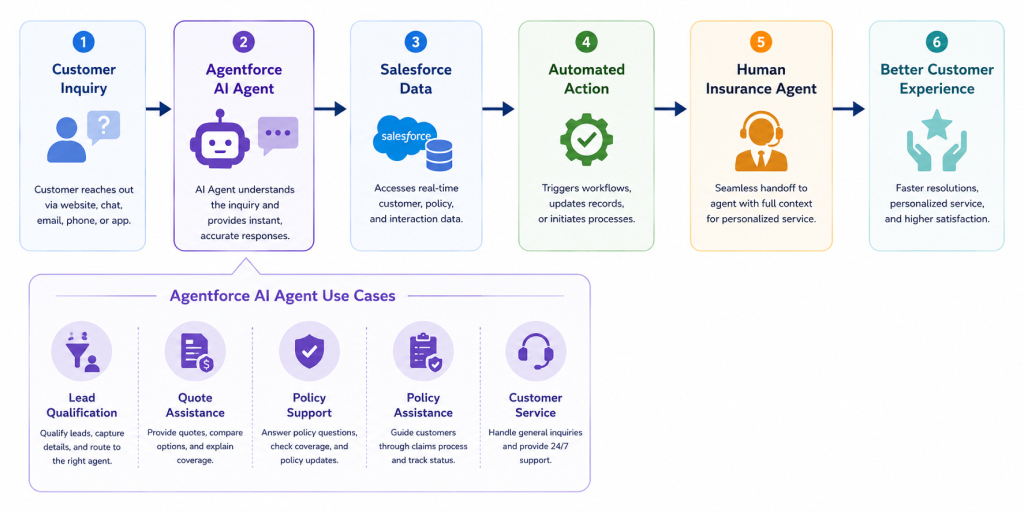
Agentforce is Salesforce’s platform for creating and deploying AI agents. Unlike a traditional chatbot that primarily responds to predefined questions, an AI agent can understand a customer’s request, retrieve relevant information, determine the next step, and perform configured actions within defined guardrails.
In an insurance environment, an Agentforce-powered experience could potentially help a customer understand a policy, assist with a quote-related conversation, collect information for a service request, provide claims-related assistance, or route a complex issue to a human representative. For organizations planning to adopt these capabilities, working with an experienced Agentforce implementation partner can help align AI agents with existing insurance workflows, customer data, integrations, and business requirements.
The value comes from connecting AI, customer data, business processes, and actions rather than treating AI as a standalone conversational interface. Salesforce describes these core capabilities as data, reasoning, and actions.
This makes Agentforce relevant across multiple stages of the insurance customer journey, from lead qualification and sales assistance to policy servicing, claims support, and customer engagement.
Why Insurance Sales and Support Need AI Automation
Insurance sales and customer service involve many repetitive activities.
Sales professionals may spend time:
- Qualifying leads
- Responding to initial inquiries
- Gathering customer information
- Preparing for conversations
- Following up with prospects
- Answering product questions
- Identifying additional product opportunities
Customer service teams may handle:
- Policy questions
- Coverage inquiries
- Billing requests
- Renewal questions
- Claims-related inquiries
- Document requests
- Policy updates
- Routine service requests
When these activities are handled manually, employees can spend significant time searching for information or completing repetitive tasks.
At the same time, customers increasingly expect businesses to provide fast and convenient support across digital channels.
Agentforce can help bridge this gap by providing AI-powered assistance that operates continuously and can be configured to perform specific business tasks. Salesforce also provides insurance-specific capabilities designed around policy, quote, claims, customer, and service processes.
How Agentforce Can Simplify Insurance Sales
1. Automating Insurance Lead Qualification
Lead qualification is an important part of the insurance sales process, but it can also be repetitive.
An Agentforce agent can engage with prospects, understand their questions and requirements, collect relevant information, and help determine the appropriate next step within the workflows and rules configured by the organization.
Instead of requiring a sales representative to manually handle every initial inquiry, AI can help manage early-stage interactions and surface qualified opportunities for the sales team.
This allows insurance professionals to spend more time on prospects that require human expertise.
2. Providing Faster Quote Assistance
Insurance customers often want to understand their options before deciding whether to move forward.
AI-powered assistance can help customers navigate quote-related conversations, gather required information, and provide relevant information based on the systems and processes available to the agent.
Salesforce’s insurance capabilities include quote and policy-related data, while its insurance service assistance capabilities can help representatives access and summarize quote information.
The goal isn’t necessarily to remove humans from the quoting process. Instead, AI can reduce the amount of manual information gathering and searching that sales and service representatives need to perform.
3. Personalizing Insurance Recommendations
Insurance customers have different needs based on their circumstances, existing coverage, preferences, and life or business requirements.
A connected AI agent can use authorized customer and business information to make interactions more relevant.
For example, during a conversation, an AI agent could help identify whether a customer may need information about:
- Additional coverage
- Policy upgrades
- Bundled insurance products
- Renewal options
- Complementary policies
This creates a more personalized experience than presenting every customer with the same generic information.
4. Supporting Cross-Selling and Upselling
Insurance companies often have opportunities to expand relationships with existing policyholders.
An AI-powered sales experience can help identify relevant conversations around additional products or coverage. For example, an existing customer asking about home insurance might also be interested in learning about related coverage options, depending on their circumstances and eligibility.
The important point is that recommendations should be relevant and grounded in authorized customer and business data, rather than simply pushing additional products.
5. Automating Sales Follow-Ups
Following up with prospects is another area where automation can support sales teams.
AI agents can assist with tasks such as:
- Preparing follow-up information
- Responding to common prospect questions
- Summarizing previous interactions
- Helping sales representatives prepare for conversations
- Triggering configured follow-up workflows
This can reduce the risk of prospects being left without a timely response.
How Agentforce Can Simplify Insurance Customer Support
Sales is only one side of the insurance customer journey. Policyholders also need support throughout the life of their policies.
Agentforce can support service interactions by combining conversational AI with relevant business data and configured actions.
1. Providing 24/7 Customer Assistance
Customers do not always have questions during traditional business hours.
Agentforce is designed to support always-on customer interactions across channels such as websites, phones, and applications.
For insurers, this can provide customers with another way to get answers to routine questions without waiting for a service representative.
For example, customers may ask about:
- Policy information
- Coverage details
- Renewal dates
- General claims processes
- Required documents
- Service requests
When an issue requires human expertise, the interaction can be escalated according to the organization’s configured processes.
2. Answering Policy and Coverage Questions
Insurance policies can be difficult for customers to understand because they contain specialized terminology, conditions, exclusions, limits, and other details.
AI agents can help customers navigate approved insurance information using natural-language conversations.
Instead of searching through multiple pages or documents, a policyholder could ask a question conversationally and receive an answer grounded in the information available to the agent.
This can make insurance support easier to navigate while reducing the volume of repetitive questions reaching service representatives.
3. Supporting Claims-Related Inquiries
Claims are often among the most important interactions between an insurer and a policyholder.
Customers may want to know:
- How to initiate a claim
- What information is required
- Which documents they need
- What happens after submission
- How to check claim progress
- When they can expect the next update
Agentforce can support these interactions through configured insurance workflows and data. Salesforce’s current insurance capabilities include claims management and AI-driven automation across policy and claims processes.
For complex claims decisions, however, human professionals remain important. AI should assist with information gathering, communication, and workflow execution within appropriate boundaries rather than making unsupported decisions.
4. Automating Routine Service Requests
Many insurance service interactions are predictable and process-driven.
Depending on the organization’s implementation, AI agents can assist with routine tasks and requests by retrieving information and invoking configured actions.
This can help service teams reduce repetitive workloads and focus their attention on cases that require judgment, empathy, or specialized expertise.
5. Improving Policyholder Self-Service
Self-service can be particularly valuable for customers who want quick answers without contacting a call center.
A connected AI agent can provide conversational self-service while maintaining access to relevant business information.
Instead of navigating multiple menus, customers can explain what they need in natural language.
For example:
“I want to understand what my current policy covers.”
The agent can then use the available customer and policy information to provide an appropriate response or guide the customer toward the next step.
Agentforce Across the Insurance Customer Journey
One of the biggest advantages of an AI-agent approach is that it can support multiple stages of the insurance lifecycle.
| Insurance Customer Journey | Potential Agentforce Role |
|---|---|
| Discovery | Answer product and coverage questions |
| Lead Generation | Capture initial customer information |
| Lead Qualification | Understand customer needs and identify opportunities |
| Quoting | Assist with quote-related conversations |
| Purchase | Guide customers through next steps |
| Onboarding | Answer initial policy questions |
| Policy Servicing | Support routine service requests |
| Renewals | Provide renewal-related assistance |
| Claims | Support claims-related inquiries and workflows |
| Cross-Selling | Identify relevant additional product conversations |
| Customer Support | Provide conversational self-service |
| Human Escalation | Route complex interactions to employees |
This broader view demonstrates that Agentforce can be considered as part of an end-to-end insurance customer experience, rather than simply as a customer-service chatbot.
Agentforce vs. Traditional Insurance Chatbots
A major distinction is the difference between a traditional chatbot and an AI agent.
Traditional chatbots typically rely on predefined conversation flows and scripted responses. Salesforce describes Einstein Bots, for example, as rule-based systems designed to follow predefined processes, while agents can handle more goal-oriented tasks and interactions.
| Traditional Chatbot | Agentforce-Powered Approach |
|---|---|
| Predefined responses | Context-aware AI interactions |
| Rule-based conversations | Goal-oriented tasks |
| Limited actions | Can invoke configured actions |
| Often focused on FAQs | Can support broader workflows |
| Static conversation flows | Can reason through defined tasks |
| Separate from business processes | Connected to Salesforce processes and data |
| Escalates after limited flows | Can collaborate with human employees |
This doesn’t mean traditional chatbots have no value. Simple, predictable use cases can still benefit from them. The distinction is that AI agents can be designed to go beyond answering questions and actually help complete defined business tasks.
How Agentforce Works With Salesforce Data
The effectiveness of an insurance AI agent depends heavily on the quality and accessibility of the information it can use.
Salesforce describes Agentforce as combining data, reasoning, and actions. Agents can retrieve relevant information, create a plan, and use workflows, automation, or APIs to perform tasks.
For insurers, this can connect AI interactions with information such as:
- Customer profiles
- Policy information
- Quote information
- Claims information
- Customer interactions
- Service cases
- Insurance products
- Business workflows
Salesforce’s insurance platform is designed to provide a broader view of policyholders, including policies, claims, interactions, and other customer information.
This connected approach is important because an AI agent is only as useful as the information and actions available to it.
Key Benefits of Agentforce for Insurance Companies
When implemented appropriately, Agentforce can help insurers pursue several business objectives.
Faster Customer Responses
AI agents can provide assistance continuously, helping customers receive responses without always waiting for a human representative.
Improved Employee Productivity
Employees can spend less time on repetitive questions, information retrieval, and routine workflows.
Better Customer Experience
Conversational interactions can make it easier for customers to find information and complete routine tasks.
More Efficient Sales Processes
AI can support lead qualification, follow-ups, product conversations, and other sales activities.
Scalable Customer Support
AI agents can help organizations handle higher volumes of routine interactions without requiring every interaction to be handled manually.
More Personalized Engagement
When connected to appropriate customer data, AI can support interactions that are more relevant to an individual’s situation.
Better Human-AI Collaboration
The objective isn’t necessarily to replace insurance professionals. A stronger model is to let AI handle repetitive and defined tasks while humans focus on complex cases, relationship building, judgment, and situations requiring empathy.
Important Considerations Before Implementing Agentforce
AI adoption in insurance requires more than simply deploying an AI chatbot.
Organizations should consider:
Data Quality
AI responses depend on the quality and relevance of the information available to the agent.
Security and Access Control
Insurance organizations handle sensitive customer and policy information. Access should be appropriately controlled, and agents should operate within defined permissions and security policies. Salesforce states that Agentforce uses its security infrastructure and Trust Layer to protect data and control access.
Human Escalation
Not every interaction should be automated. Complex, sensitive, or exceptional cases may need to be routed to trained employees.
Governance and Guardrails
Organizations should clearly define what an AI agent can do, what information it can access, and which actions require human involvement.
Testing and Monitoring
Before deployment, insurers should test AI agents against realistic customer scenarios and monitor performance after launch.
Integration
The greatest value comes when AI can work with the systems and processes employees already use rather than operating as an isolated tool.
The Future of AI-Powered Insurance Sales and Support
The insurance industry is moving from traditional digital experiences toward increasingly intelligent and automated customer journeys.
The progression can be viewed as:
Traditional CRM → Workflow Automation → AI Assistance → AI Agents → Human + AI Collaboration
The difference is that AI agents are designed not only to generate responses but also to understand objectives, retrieve information, reason through defined tasks, and execute configured actions.
For insurance companies, this could mean AI becomes part of everyday sales, servicing, claims, and customer engagement processes.
The most effective implementations are unlikely to be about replacing people. Instead, they will focus on combining the speed and scalability of AI with the expertise, judgment, and empathy of insurance professionals.
Conclusion
Agentforce has the potential to simplify insurance sales and support by bringing AI-powered conversations, customer data, business processes, and automation together.
From lead qualification and quote assistance to policy questions, customer self-service, claims support, and routine service requests, AI agents can help insurers automate repetitive interactions while creating more responsive customer experiences.
The bigger opportunity is to look beyond the idea of an AI chatbot.
With the right data, workflows, permissions, governance, and human escalation processes, Agentforce can become an intelligent layer across the insurance customer journey—helping sales teams engage prospects, helping service teams resolve routine requests, and giving customers faster access to the information they need.
Ultimately, the goal is simple: let AI handle more of the repetitive work while insurance professionals focus on the conversations and decisions where human expertise matters most.