

Forecast accuracy has always been important in manufacturing. But for U.S. manufacturers dealing with changing customer demand, long sales cycles, complex product portfolios, and pressure to control inventory, it has become a business priority.
A forecast that is too high can lead to excess inventory, unnecessary production, and tied-up working capital. A forecast that is too low can result in shortages, delayed deliveries, missed revenue, and unhappy customers.
The challenge is that manufacturing forecasts are rarely based on one simple data point. Sales teams have information from customers and opportunities. Operations teams understand production capacity and inventory. Finance teams have revenue targets. Distributors have visibility into market demand.
When these signals remain disconnected, forecast reviews often become a manual exercise of comparing spreadsheets and trying to understand which numbers are reliable.
Salesforce Agentforce Manufacturing formerly known as Manufacturing Cloud—offers a more connected approach. Salesforce describes Agentforce Manufacturing as a manufacturing-specific platform that brings sales, operations, finance, channel partners, and customer service together around customer information, forecasts, and business processes. For U.S. manufacturers, this can create a stronger foundation for improving forecast accuracy and making better decisions about production, inventory, and customer commitments.
Why Forecast Accuracy Matters for U.S. Manufacturers
Manufacturing forecasts influence decisions across the business.
A forecast affects how much material a company purchases, how production capacity is allocated, how much inventory is maintained, and how customer commitments are managed.
Consider a manufacturer supplying components to several industrial customers.
If the business expects demand to increase by 20%, operations may prepare additional production capacity and inventory. But if that expected demand does not materialize, the company may be left with excess stock and unused capacity.
The opposite can be just as costly.
If demand is underestimated, the manufacturer may not have enough products available when customers place orders. Production teams may need to make last-minute changes, while customers may experience longer lead times.
That is why forecast accuracy in manufacturing is not simply a sales metric. It can influence the entire operating model.
Why Traditional Manufacturing Forecasting Can Fall Short
Many manufacturers still depend on spreadsheets, email updates, historical sales reports, and manual forecast adjustments.
These tools can work when the business is relatively simple. But as manufacturers grow, the number of customers, products, locations, sales channels, and agreements increases.
The forecasting process becomes more difficult when:
- Sales and operations use different versions of the forecast.
- Customer commitments are not connected to current orders.
- Historical sales do not reflect current market conditions.
- Distributor demand is difficult to capture.
- Forecast adjustments are made manually without enough context.
- Leadership teams cannot quickly identify where forecasts are most inaccurate.
- Different product lines require different forecasting approaches.
The issue is not necessarily that manufacturers lack data.
The issue is that the data needed for forecasting may be spread across different processes and teams.
Agentforce Manufacturing is designed to address this type of disconnect by bringing manufacturing-specific sales, forecasting, and collaboration capabilities into Salesforce.
How Salesforce Agentforce Manufacturing Supports Better Forecasting
One of the key capabilities within Agentforce Manufacturing is Advanced Account Forecasting.
Salesforce describes Advanced Account Forecasting as a framework for creating configurable, multi-enterprise forecasts based on different business scenarios. Forecasts can be organized using dimensions such as products, locations, business units, and inventory locations.
This matters because manufacturers rarely have one forecasting requirement.
A manufacturer may want to forecast:
- Demand by product
- Revenue by customer
- Volume by region
- Orders by location
- Inventory requirements
- Demand across different business units
Instead of treating every forecast as the same, manufacturers can configure forecasting around the way their business operates.
Bringing More Demand Signals Into the Forecast
A strong forecast should reflect what is actually happening in the business.
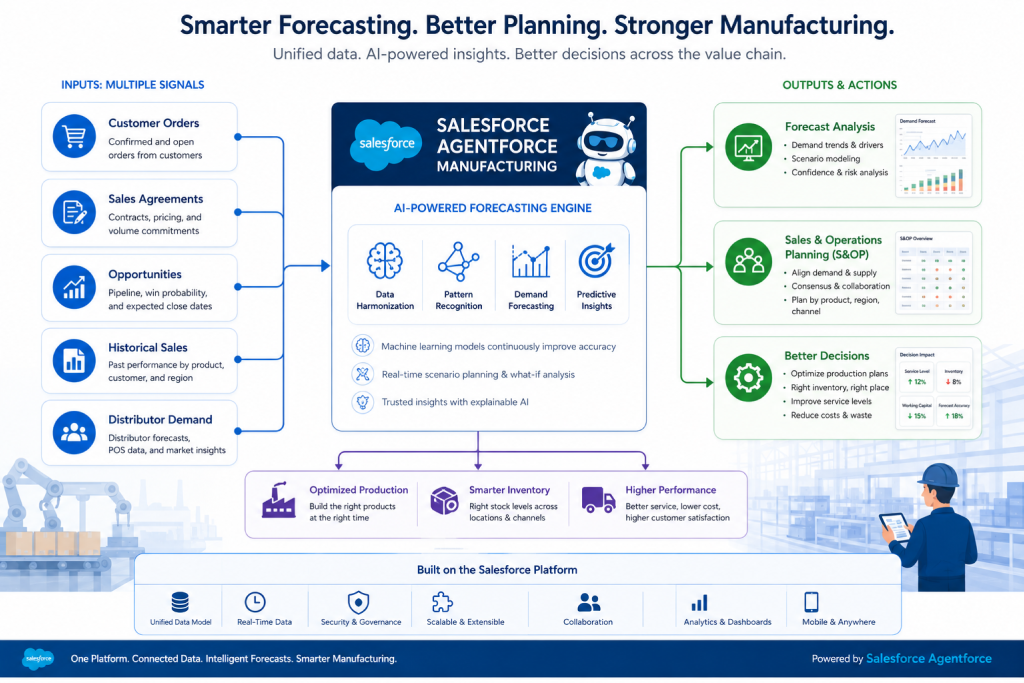
Salesforce’s manufacturing forecasting capabilities can use information such as opportunities, orders, sales agreements, historical orders, and custom measures when generating forecasts.
That gives manufacturers more context than relying on historical sales alone.
For example, imagine a U.S. manufacturer that has historically sold 10,000 units of a product each quarter.
Historical data might suggest that the next quarter will also be around 10,000 units.
But the business may now have:
- A new customer opportunity worth 2,000 units
- A long-term agreement with another customer
- Increasing orders from distributors
- A decline in demand from one existing account
Looking only at historical sales would miss much of this information.
A more connected forecasting process can bring these signals together and provide a more useful picture of expected demand.
Using Sales Agreements to Improve Forecast Visibility
Long-term customer agreements can be particularly valuable for manufacturers.
A sales agreement may contain planned quantities, pricing, products, and other commercial commitments. The challenge is making sure those commitments remain visible as actual orders develop over time.
Agentforce Manufacturing for Sales provides sales agreement capabilities that allow manufacturers to manage the agreement lifecycle and track metrics such as planned quantities, actual orders, price, cost, and margin.
This can give sales and operations teams more context when reviewing future demand.
For example, a U.S. manufacturer may have an annual agreement with a large customer for 100,000 units.
If the customer has ordered significantly less than expected during the first few months, that variance should not be ignored.
The manufacturer may need to ask:
Is the customer simply delaying orders, or is actual demand changing?
That distinction can affect production and inventory planning.
Sales agreements provide a way to compare planned business with actual performance and use that information in ongoing forecasting discussions.
Improving Forecast Accuracy Through Collaboration
Forecasting should not be the responsibility of one department.
Sales teams know what customers are saying.
Operations teams understand production constraints.
Finance teams understand revenue expectations.
Distributors may see changes in local market demand.
When these perspectives are combined, the business can develop a more complete understanding of what is likely to happen.
Salesforce highlights collaboration between sales, operations, finance, channel partners, and other teams as part of Agentforce Manufacturing’s approach.
This is important because forecast accuracy is not just about calculating a number.
It is also about understanding why the number is changing.
If sales expects demand to increase, operations should understand what is driving that expectation.
If operations believes the forecast is unrealistic, it should have an opportunity to provide context.
The forecast becomes a shared business conversation rather than a number produced by one team.
Measuring Forecast Accuracy Instead of Guessing
Manufacturers cannot improve forecast accuracy if they do not measure it.
Salesforce provides Advanced Account Forecasting Analytics with dashboards designed to compare forecasted, adjusted, and actual revenue and quantities. The Forecast Analysis dashboard can also show forecast variance and trends in accuracy over time.
This creates an important feedback loop.
Forecast → Actual Results → Variance → Analysis → Adjustment → Next Forecast
For example, a manufacturer might discover that forecasts are consistently too optimistic for one product family.
Instead of simply adjusting the next forecast manually, the business can investigate why the variance keeps occurring.
Perhaps customer demand is seasonal.
Perhaps the sales team is including opportunities too early.
Perhaps distributor inventory is affecting orders.
Perhaps the historical data being used does not represent the current market.
The purpose of measuring forecast accuracy is to uncover these patterns.
Connecting Forecast Accuracy With Inventory Planning
Forecast accuracy has a direct relationship with inventory.
If a manufacturer consistently overestimates demand, it may carry more inventory than necessary.
If it consistently underestimates demand, it may struggle to maintain sufficient stock.
Neither outcome is ideal.
Salesforce’s manufacturing forecasting capabilities are designed to help manufacturers plan demand and align sales and production teams around changing customer trends. Forecasts can be viewed using planned and actual business information and grouped by dimensions such as product and location.
This gives manufacturers a stronger basis for inventory discussions.
Instead of asking:
“How much inventory did we carry last year?”
teams can ask:
“What demand do we expect, what has changed, and what inventory level makes sense based on that demand?”
That is a much more forward-looking conversation.
From Better Forecasts to Better Production Planning
A more accurate forecast becomes valuable when it changes what the business does.
Suppose demand for a product is expected to rise significantly over the next two quarters.
With better visibility, operations can review production capacity earlier.
Procurement can consider material requirements.
Inventory teams can evaluate current stock.
Sales teams can communicate realistic availability to customers.
Leadership can determine whether additional capacity or resources are required.
This creates a connection between forecasting and sales and operations planning.
The process can look like:
Customer signals
↓
Sales agreements and opportunities
↓
Demand forecast
↓
Forecast review and adjustment
↓
Sales & operations planning
↓
Production and inventory decisions
↓
Actual orders
↓
Forecast performance analysis
↓
Next forecast
The process is continuous.
As new information arrives, the forecast can be reviewed and refined.
Supporting Distributor and Channel Visibility
Distributors can be an important source of market information for U.S. manufacturers.
They may know which products are moving faster, where customer demand is increasing, and where inventory is building up.
Agentforce Manufacturing includes capabilities for partner engagement and distributor performance visibility, while Salesforce’s manufacturing partner experience capabilities can support collaboration around forecasts and sales agreements.
Bringing relevant channel information into the forecasting process can give manufacturers another perspective on demand.
For example, if several distributors report increasing demand for a specific product in different regions, that information can help sales and operations teams review whether current forecasts still make sense.
The objective is not simply to collect more information.
It is to make useful information available before it becomes a supply or inventory problem.
How Manufacturing Leaders Can Improve Forecast Accuracy
Technology can support forecasting, but improving accuracy also requires the right process.
U.S. manufacturers considering Agentforce Manufacturing should focus on several areas.
Establish a single view of demand
Sales, operations, finance, and relevant channel partners should work from consistent information wherever possible.
Define what should influence the forecast
Not every opportunity or customer signal should automatically affect a forecast. Manufacturers should establish clear rules for which data sources and measures matter.
Track planned versus actual performance
A forecast should be evaluated after the period ends. Understanding variance is essential to improving the next forecast.
Involve the people closest to the customer
Sales teams and account managers often have information that is not visible in historical order data. Their input can add important context.
Review forecasts at the right level
A manufacturer may need to analyze demand by product, account, region, location, or business unit. Advanced Account Forecasting supports configurable dimensions for different business scenarios.
Focus on the reasons behind variance
A forecast being wrong is not enough information. Manufacturers should understand why it was wrong.
That is where continuous improvement begins.
What U.S. Manufacturers Can Gain From Better Forecast Accuracy
Improving forecast accuracy is not about achieving a perfect prediction.
Markets will always change.
Customers will change their plans. New opportunities will appear. Orders will be delayed. Economic conditions will shift.
The goal is to make forecasts more useful and more responsive to new information.
For manufacturers, that can support:
- Better production planning
- More informed inventory decisions
- Fewer surprises in customer demand
- Stronger sales and operations collaboration
- Better visibility into customer commitments
- More effective distributor collaboration
- Improved planning confidence
- Greater operational responsiveness
For senior leaders, the broader benefit is predictability.
When a business has a clearer view of demand, leadership can make decisions about capacity, inventory, revenue, and growth with greater confidence.
Why Agentforce Manufacturing Matters for the Future of Forecasting
The manufacturing industry is moving toward more connected and data-driven planning.
Agentforce Manufacturing brings together manufacturing-specific capabilities with Salesforce’s broader platform. Salesforce describes it as an agentic CRM for manufacturers that unifies sales, service, and back-office operations while using data, AI, and analytics to support decision-making.
For forecasting specifically, the important foundation is not simply AI.
It is connected data and a well-defined forecasting process.
If customer agreements, orders, opportunities, historical information, and business measures are disconnected, even sophisticated technology will have limited value.
But when those signals are brought together, manufacturers have a stronger foundation for analyzing demand and improving planning.
Conclusion
For U.S. manufacturers, forecast accuracy can have a significant impact on production, inventory, customer service, and business growth.
The challenge is that demand is influenced by many factors, and those factors often sit across different teams and systems.
Salesforce Agentforce Manufacturing can help bring these pieces closer together through sales agreements, advanced account forecasting, analytics, and collaboration capabilities designed for manufacturing.