


Real estate businesses manage more than properties. They manage relationships with tenants, buyers, owners, investors, contractors, maintenance teams, and other stakeholders. As portfolios grow, handling service requests, maintenance issues, customer inquiries, and communications through disconnected systems can become increasingly difficult.
This is where Salesforce Service Cloud for Real Estate can make a significant difference.
Salesforce Service Cloud provides a centralized platform for managing customer service interactions, cases, workflows, knowledge, automation, and reporting. Salesforce has also expanded its service strategy around Agentforce, bringing AI-powered capabilities into customer service and connecting human teams with AI agents across service touchpoints.
For real estate organizations, this creates an opportunity to move beyond basic CRM functionality and build a connected service operation.
From tenant inquiries and maintenance requests to field service and self-service portals, Salesforce can help real estate companies create faster, more consistent, and more personalized service experiences.
What Is Salesforce Service Cloud for Real Estate?
Salesforce Service Cloud is a customer service CRM platform that helps businesses manage customer interactions and service processes from a centralized system.
For a real estate organization, this can mean bringing information about customers, tenants, properties, service requests, cases, communications, and field operations together in one connected environment.
Instead of relying on separate spreadsheets, shared inboxes, phone calls, and disconnected applications, service teams can use Salesforce to capture and manage requests throughout their lifecycle.
For example, a tenant might report a maintenance issue through email or an online portal.
The request can become a Salesforce case.
The service team can then:
- Categorize the issue.
- Assign it to the appropriate team.
- Prioritize it based on urgency.
- Create or connect a work order.
- Schedule a technician or vendor.
- Track the resolution.
- Communicate updates to the tenant.
- Record the complete service history.
This creates a more connected service process while giving managers better visibility into performance.
Why Real Estate Companies Need Better Customer Service Management
Real estate organizations often deal with high volumes of customer and tenant interactions.
Common requests may include:
- Maintenance problems
- Property inquiries
- Lease-related questions
- Move-in and move-out requests
- Complaints
- Access or facility issues
- Billing questions
- Service appointments
- Vendor coordination
- Property-related emergencies
When these requests are managed manually, several problems can occur.
Missed Service Requests
Requests arriving through email, phone, websites, and other channels can easily become difficult to track.
Slow Response Times
Employees may need to search through multiple systems before understanding a customer’s history or current issue.
Poor Visibility
Managers may struggle to answer basic questions such as:
- How many open cases do we have?
- Which properties generate the most service requests?
- Which cases are overdue?
- How quickly are we responding?
- Which vendors are performing well?
- Which issues are recurring?
Disconnected Teams
Customer service representatives, property managers, maintenance teams, and external vendors may work from different systems.
Salesforce Service Cloud can help bring these processes together.
How Salesforce Service Cloud Can Help Real Estate Businesses
1. Centralized Case Management
Case management is one of the most important Service Cloud capabilities for real estate organizations.
Every service request can be captured as a case and assigned relevant information such as:
- Customer or tenant
- Property
- Unit
- Request type
- Priority
- Status
- Assigned team
- Due date
- Service history
- Communication history
This gives service teams a single view of what needs attention.
Perigeon’s Service Cloud implementation services include case configuration, routing, automation, testing, and user enablement.
2. Automated Case Routing
Not every service request should go to the same employee.
A maintenance emergency may require immediate escalation, while a general information request can follow a standard workflow.
Salesforce can use business rules and routing logic to direct cases based on factors such as:
- Request type
- Property
- Location
- Priority
- Customer type
- Agent availability
- Service level
This reduces manual assignment and helps teams respond more efficiently.
3. Omnichannel Customer Service
Today’s customers expect businesses to communicate through the channels they already use.
Real estate service teams may need to support:
- Phone
- Chat
- Web
- Social channels
- Self-service portals
Salesforce Service Cloud provides a centralized service environment for managing customer interactions across channels.
Instead of forcing customers to repeatedly explain their issue, service representatives can work from a unified view of the customer’s history.
4. Tenant Self-Service
Not every question requires an employee.
A self-service knowledge base or Experience Cloud portal can allow tenants and customers to find answers, submit requests, and access relevant information without contacting a service representative for every issue.
Examples include:
- Frequently asked questions
- Maintenance instructions
- Property information
- Service request status
- Community information
- Support articles
This can reduce repetitive requests and allow service teams to focus on more complex cases.
5. Maintenance Request Management
Maintenance is one of the most practical applications of Salesforce for property management.
A typical process could look like:
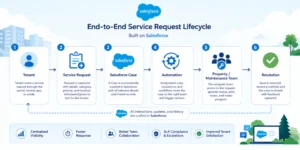
Tenant submits request → Case created → Issue categorized → Maintenance team notified → Work order created → Technician assigned → Appointment scheduled → Work completed → Customer notified → Case closed
When Service Cloud is combined with Salesforce Field Service, organizations can connect customer service processes with scheduling, dispatch, work orders, and field technicians.
Perigeon provides Service Cloud and Field Service implementation capabilities for organizations that need this connected approach.
6. Better SLA and Escalation Management
Different types of service requests may require different response times.
For example:
- Emergency maintenance: immediate response
- High-priority issue: same-day response
- Standard request: predefined service window
- General inquiry: standard support process
Salesforce can help automate escalation rules and provide visibility into service performance.
Managers can monitor metrics such as:
- First response time
- Resolution time
- Open cases
- Overdue cases
- SLA compliance
- Agent productivity
- Customer satisfaction
This makes service performance measurable rather than dependent on manual reporting.
Salesforce Service Cloud + Field Service for Real Estate
For organizations with significant maintenance or field operations, Service Cloud alone may not be enough.
This is where Salesforce Field Service can complement Service Cloud.
Service Cloud can manage the customer interaction and case.
Field Service can help manage the operational side of the job, including:
- Work orders
- Service appointments
- Scheduling
- Dispatch
- Technician assignments
- Mobile workforce
- Assets
- Service history
The combination creates an end-to-end process from customer request to field resolution.
For example:
Tenant → Service Request → Salesforce Case → Work Order → Technician → On-Site Visit → Resolution → Customer Follow-Up
Perigeon’s Service Cloud and Field Service offering is designed to connect contact-center and field operations, including case management, scheduling, dispatch, work orders, and mobile technician capabilities.
Salesforce Service Cloud for Property Management
Property management companies can use Salesforce to centralize service information across properties and tenants.
A property manager could potentially see:
- Property details
- Unit information
- Tenant information
- Open service requests
- Previous cases
- Maintenance history
- Communications
- Vendor activity
- Service performance
This creates a more complete picture of the customer and property relationship.
It can also help organizations move away from fragmented service processes as their property portfolio expands.
Salesforce for Real Estate Developers
Real estate developers have different requirements from traditional property managers.
They may need to manage customer relationships across the entire lifecycle:
Lead → Buyer → Property → Booking → Handover → Post-Sale Service
After a sale, customer service becomes an important part of the overall experience.
Service Cloud can help developers manage:
- Buyer inquiries
- Handover issues
- Defect reports
- Maintenance requests
- Complaints
- Post-sale support
- Case escalation
- Customer communications
This allows service data to become part of the broader customer relationship rather than remaining isolated from sales and marketing.
Salesforce Experience Cloud for Real Estate
Customer self-service is another important opportunity.
With Experience Cloud, real estate companies can create branded portals and digital experiences for customers, tenants, partners, or other stakeholders.
Potential use cases include:
- Submit service requests
- Check case status
- Access knowledge articles
- View relevant property information
- Communicate with support teams
- Access documents
- Collaborate with partners
The objective is simple: give customers more control while reducing unnecessary manual service interactions.
AI and Agentforce for Real Estate Customer Service
AI is becoming an increasingly important part of customer service.
Salesforce now positions Agentforce Service as the evolution of Service Cloud, combining human service representatives with AI agents and AI-powered capabilities.
For real estate organizations, AI could support service processes such as:
- Answering common questions
- Helping customers find information
- Summarizing cases
- Recommending next steps
- Automating repetitive service tasks
- Supporting service representatives
- Helping customers with self-service
However, successful AI implementation depends on having well-structured customer and service data.
That means organizations should establish a strong CRM and service foundation before attempting to automate everything with AI.
Key Benefits of Salesforce Service Cloud for Real Estate
Implementing Salesforce Service Cloud can provide several potential business benefits.
Faster Service Response
Automated routing and centralized customer information can help service teams respond faster.
Better Customer Experience
Customers can receive more consistent support across different channels.
Improved Visibility
Managers can monitor service operations through reports and dashboards.
Reduced Manual Work
Automation can reduce repetitive data entry and administrative processes.
Connected Field Operations
Service Cloud and Field Service can connect customer support with technicians and maintenance teams.
Scalable Operations
A standardized Salesforce service model can support organizations as customer and property volumes increase.
Better Decision-Making
Service data can reveal recurring problems, property-level trends, workload issues, and performance opportunities.
Salesforce Service Cloud Implementation for Real Estate
Every real estate company has different workflows, systems, and service requirements.
A successful implementation should therefore start with business processes rather than technology alone.
A typical implementation process can include:
Step 1: Discovery
Understand your current customer service process, systems, channels, users, and pain points.
Step 2: Solution Design
Define the Salesforce architecture, objects, workflows, integrations, permissions, and reporting requirements.
Step 3: Configuration
Configure cases, queues, routing, automation, service processes, knowledge, and dashboards.
Step 4: Integration
Connect Salesforce with relevant property management, ERP, telephony, field service, marketing, or other business systems.
Step 5: Data Migration
Move relevant customer, property, contact, case, and historical information into Salesforce.
Step 6: Testing
Validate workflows, integrations, permissions, routing, escalations, and user experiences.
Step 7: Training and Go-Live
Train service teams and launch the solution with appropriate support.
Step 8: Continuous Optimization
Continue improving automation, reporting, integrations, and AI capabilities as business requirements evolve.
Perigeon’s Salesforce implementation services follow an end-to-end model covering discovery, configuration, deployment, and ongoing support.
How Much Does Salesforce Service Cloud Cost for Real Estate?
There is no single implementation price for every real estate organization.
The overall investment depends on factors such as:
- Number of users
- Salesforce licenses
- Number of properties
- Case volume
- Customization requirements
- Integrations
- Data migration
- Portal requirements
- Field service requirements
- Automation
- AI requirements
- Ongoing support
For smaller or clearly defined service requirements, a packaged implementation can provide a faster path to Salesforce.
Perigeon’s Service Cloud Quickstart package, for example, includes case management, omnichannel configuration, knowledge, dashboards, data import, testing, and training within a defined implementation scope.
For larger real estate organizations, a more customized implementation may be appropriate.
Why Choose Perigeon for Salesforce Service Cloud Implementation?
Choosing the right Salesforce implementation partner is as important as choosing the platform.
Perigeon provides Salesforce consulting, implementation, customization, integration, optimization, and ongoing support services. Its Service Cloud offering covers case management, omnichannel engagement, knowledge and self-service, automation, analytics, and connected field operations.
For real estate organizations, this creates an opportunity to design Salesforce around actual business processes rather than deploying a generic CRM configuration.
Whether you are implementing Salesforce for the first time, migrating from another customer service platform, or optimizing an existing Salesforce environment, the implementation should focus on measurable business outcomes.
Is Salesforce Service Cloud Right for Your Real Estate Business?
Salesforce Service Cloud may be a strong fit if your organization is dealing with:
- Growing service volumes
- Multiple properties or locations
- Increasing tenant or customer expectations
- Manual service processes
- Disconnected customer data
- Complex maintenance workflows
- Multiple communication channels
- SLA requirements
- Field service operations
- A need for better service reporting
- Plans to introduce AI-powered service
The key question is not simply whether Salesforce can support your business.
It is whether Salesforce can be configured around your specific customer, property, service, and operational workflows.
Final Thoughts
Real estate customer service is becoming more complex as customers expect faster responses, convenient digital experiences, and consistent communication.
Salesforce Service Cloud for Real Estate can provide the foundation for a connected service operation—from case management and tenant support to self-service, automation, analytics, Field Service, and AI.
For property managers, developers, real estate operators, and organizations managing complex service operations, Salesforce can help replace fragmented processes with a centralized and scalable platform.
The most successful implementations, however, are not simply technology projects. They combine Salesforce capabilities with a clear understanding of the organization’s processes, customers, properties, employees, and business objectives.
Ready to Transform Your Real Estate Service Operations?
If you’re evaluating Salesforce Service Cloud for your real estate business, Perigeon can help you assess your current processes, identify automation opportunities, and design a Salesforce solution aligned with your business goals.
Talk to Perigeon’s Salesforce experts to discuss your real estate service requirements and explore the right implementation approach.