

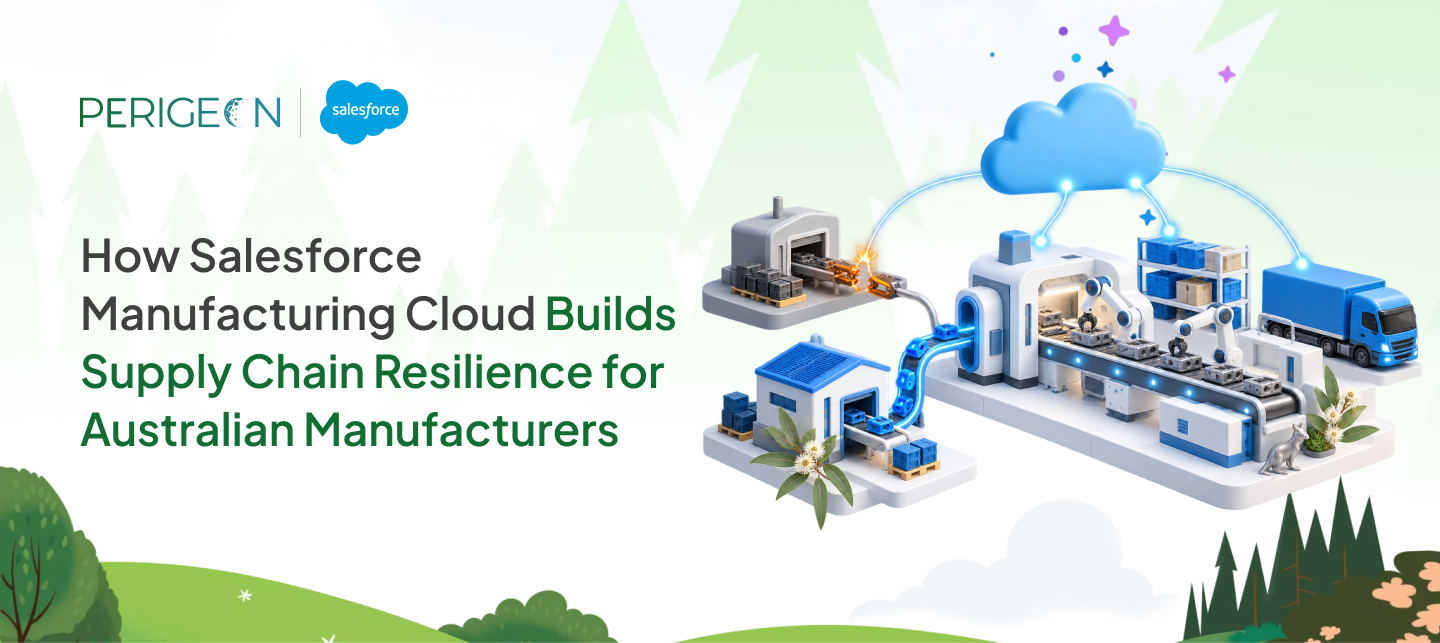
Salesforce Manufacturing Cloud helps Australian manufacturers build supply chain resilience by unifying sales forecasts, supplier collaboration, and real-time visibility on one platform. It reduces disruption risks, improves demand accuracy, and supports Australia’s push for sovereign capability and advanced manufacturing under programs like Future Made in Australia.
Australian manufacturers operate in one of the world’s most trade-exposed environments. Long distances, reliance on imported inputs, geopolitical tensions, and energy cost pressures make supply chains vulnerable. Recent industry reports show ongoing concerns about disruptions, tariffs, and the need for greater self-reliance.
Salesforce Manufacturing Cloud (now evolving into Agentforce Manufacturing) addresses these challenges directly. It connects commercial teams, operations, suppliers, and distributors so companies can anticipate risks earlier and respond faster.
Why Supply Chain Resilience Matters for Australian Manufacturing
Australian manufacturers face unique pressures:
- High dependence on global and regional supply chains
- Exposure to shipping delays and freight volatility
- Skills shortages and rising input costs
- Government focus on sovereign capability, critical minerals processing, clean energy manufacturing, and defence industry growth
Building resilience is no longer optional. It is essential for maintaining competitiveness and supporting national priorities such as the Future Made in Australia agenda and advanced manufacturing roadmaps.

How Salesforce Manufacturing Cloud Strengthens Resilience
1. Accurate Demand Forecasting and Sales Agreement Visibility
Manufacturing Cloud provides account-based forecasting and sales agreement management. Teams see committed demand alongside run-rate business in real time. This reduces the classic mismatch between sales promises and production capacity that often leads to shortages or excess inventory.
When forecasts improve, manufacturers can plan materials, production, and logistics more confidently — a critical advantage in Australia’s long-lead-time environment.
2. Better Supplier and Distributor Collaboration
Through partner portals and Experience Cloud capabilities, suppliers and distributors gain secure access to relevant forecasts, order status, and performance data. This shared visibility shortens response times and reduces the email-and-spreadsheet chaos that amplifies disruptions.
Australian manufacturers with multi-tier or interstate/international networks particularly benefit from this connected approach. Learn more about how Perigeon supports these capabilities on our Salesforce Manufacturing Cloud implementation page.
3. Integration with ERP and Existing Systems
Manufacturing Cloud sits on top of existing ERP and order management systems. It becomes the commercial and collaboration layer while ERP remains the system of record for inventory and production. This integration delivers a single source of truth without forcing a full system replacement.
4. Risk Visibility and Proactive Decision-Making
With unified data, teams can identify at-risk suppliers, track agreement compliance, and run scenario planning more effectively. AI-powered insights (via Einstein/Agentforce capabilities) further help surface potential delays before they cascade through the chain.
Real-World Benefits for Australian Manufacturers
Companies that implement Manufacturing Cloud typically see:
- Higher forecast accuracy
- Faster response to supply disruptions
- Improved on-time delivery
- Stronger relationships with key suppliers and distributors
- Better alignment between sales, operations, and finance
These outcomes support both day-to-day operational resilience and longer-term strategic goals such as scaling advanced manufacturing or participating in critical minerals and clean energy value chains.
For related insights on industry-specific applications, see how Manufacturing Cloud strengthens mining supply chains and supports broader Salesforce solutions for the manufacturing industry.
Getting Started with Salesforce Manufacturing Cloud in Australia
Successful Salesforce Manufacturing Cloud implementation in Australia should focus on clear business outcomes rather than technology for its own sake. Manufacturers should begin by mapping forecast and collaboration challenges, prioritising high-impact use cases, integrating existing ERP systems, and preparing teams for adoption.
Key steps include:
- Mapping current forecast and collaboration pain points
- Prioritising high-impact use cases (forecasting, supplier portals, sales agreements)
- Integrating with existing ERP systems
- Training commercial and operations teams together
Perigeon specialises in Salesforce Manufacturing Cloud implementations for manufacturers. Our team helps Australian and global clients design solutions that deliver measurable resilience and growth.