
Insurance claims are a critical moment in the customer relationship. When a policyholder reports an accident, property loss, or other covered event, they expect a process that is fast, clear, and easy to navigate. Claims teams, meanwhile, must gather accurate information, verify policy details, investigate the loss, communicate with customers, and move each claim toward resolution.
The challenge is that many of these activities still involve repetitive data entry, manual searches, disconnected systems, and frequent customer status requests.
Agentforce can help insurers modernize claims management by connecting AI agents with insurance data, workflows, and business processes.
Rather than treating AI as another chatbot, insurers can use Agentforce to assist with defined tasks across the claims lifecycle—from First Notice of Loss (FNOL) and claims intake to adjuster assistance, customer communication, and workflow automation.
The goal is not to remove claims professionals from the process. It is to reduce repetitive work so adjusters and claims teams can spend more time on complex cases, investigation, judgment, and customer relationships.
What Is Agentforce for Insurance Claims?
Agentforce is Salesforce’s platform for building and deploying AI agents. In insurance, these agents can be connected to relevant customer, policy, claims, and service information and can perform configured actions through Salesforce workflows and other integrations.
For example, Salesforce provides an insurance claims service-assistance capability that can guide representatives through FNOL activities, including identifying the customer, selecting the relevant policy, collecting incident information, creating the claim, and adding claim participants and items.
A claims-focused Agentforce implementation can bring together:
Customer data + Policy data + Claims data + AI reasoning + Workflows + Business actions + Human oversight
This connected approach allows insurers to apply AI where it can reduce repetitive work while keeping important claims decisions within appropriate human and organizational controls.
Why Insurance Claims Management Needs AI Automation
Claims teams often work across large amounts of information.
A single claim can involve:
-
Policy and coverage details
-
Customer information
-
Loss and incident details
-
Claim participants
-
Claim items
-
Documents and photos
-
Previous claims
-
Adjuster notes
-
Customer communications
-
Payment information
When this information is spread across systems, employees may spend more time finding and organizing information than acting on it.
Customer expectations create another challenge. Policyholders often want immediate answers to simple questions such as:
-
Has my claim been received?
-
What information do you need?
-
What happens next?
-
Has my claim been assigned?
-
What is the current status?
These requests may be straightforward, but at scale they can consume significant claims-team capacity.
AI automation can help by handling repetitive interactions and information-processing tasks while allowing employees to focus on cases that require expertise and judgment.
Salesforce specifically highlights AI-generated claim summaries and automated workflows as ways to improve claims-processing efficiency. Its claims-summary capability brings together information from Claims, Claim Participants, Claim Items, and Payment Details for adjusters.
How Agentforce Improves Insurance Claims Management
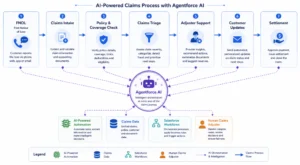
♦ Streamlines First Notice of Loss (FNOL)
The First Notice of Loss is the starting point for many claims.
A complete and accurate FNOL gives the claims team the information it needs to begin the next stage of the process. However, collecting that information manually can take time and may result in missing or inconsistent details.
Agentforce can guide a customer service representative—or, where appropriately configured, interact directly with a policyholder—to collect relevant information.
A claims agent can help with tasks such as:
-
Identifying the policyholder
-
Finding the relevant policy
-
Collecting loss details
-
Capturing incident information
-
Recording claim participants
-
Adding claim items
-
Creating the claim record
-
Preparing follow-up communication
Salesforce’s current claims capabilities specifically describe Agentforce assistance for guiding representatives through the FNOL process and creating structured claim records.
Why this matters
A structured intake process can help reduce repetitive data entry and give claims professionals a better starting point for the next stage of the claim.
♦ Automates Claims Intake and Information Gathering
Claims intake involves more than opening a claim.
Employees may need to collect information, check records, attach documentation, and determine which workflow should happen next.
Agentforce can assist with these repetitive steps through configured actions and workflows.
For example, an agent may retrieve available policy information, collect missing details, create records, or trigger a predefined workflow.
This can reduce the number of manual steps required to move a claim from initial reporting into the claims process.
The exact level of automation depends on the insurer’s Salesforce configuration, claims systems, integrations, permissions, and business rules.
♦ Gives Adjusters a More Complete View of the Claim
Claims adjusters need context before they can effectively work on a case.
Searching across multiple records for policy information, claim details, previous interactions, and payment information can slow down the process.
Agentforce can help surface relevant information through conversational queries and AI-generated summaries.
Salesforce’s insurance claims solution provides an Insurance Claim Summary that consolidates information across claims, claim participants, claim items, and payment details for adjusters.
Instead of manually reviewing every related record first, an adjuster can begin with a consolidated view and then investigate the underlying records as needed.
Example
An adjuster preparing for a customer conversation may need to understand:
Policy → Coverage → Claim → Claimant → Claim Items → Payments → Recent Activity
An AI-generated summary can bring those related details together into a more usable starting point.
♦ Supports Claims Triage and Routing
Not every claim requires the same level of attention.
Claims can vary based on factors such as:
-
Type of loss
-
Severity
-
Coverage
-
Customer circumstances
-
Claim complexity
-
Required documentation
-
Potential escalation needs
Agentforce can support configured triage workflows by helping classify information and route work to the appropriate team or queue.
This can help claims organizations move routine cases through the right workflow while directing exceptions or complex situations to experienced professionals.
The important distinction is that AI-assisted triage does not have to mean automated claim approval or denial.
The organization defines the rules, authority, and escalation path.
♦ Helps Validate Policy and Coverage Information
Claims often require information to be compared across a reported loss and the applicable policy.
An AI agent can help retrieve relevant policy information and surface details such as:
-
Coverage
-
Deductibles
-
Policy limits
-
Relevant policy terms
-
Missing information
-
Potential inconsistencies
This can help an adjuster find important information faster.
However, insurers should distinguish between surfacing information and making the final coverage determination.
AI can assist the review process, while decisions requiring professional judgment and regulatory accountability should remain within the organization’s approved decision-making process.
♦ Supports Fraud and Anomaly Detection Workflows
Fraud is another area where AI can support claims teams.
AI can analyze available information and help surface unusual patterns or inconsistencies for further review.
Potential signals might include:
-
Repeated claim patterns
-
Unusual timing
-
Inconsistent information
-
Related claim activity
-
Anomalous documentation
-
Unusual provider or participant patterns
But an AI-generated signal should be treated as a review trigger, not proof of fraud.
The claims organization or appropriate investigation team should determine whether further investigation is warranted.
This distinction is important because an incorrect fraud flag could unnecessarily delay a legitimate claim or negatively affect the customer experience.
♦ Reduces Repetitive Claims Status Inquiries
One of the most straightforward claims use cases is answering:
“Where is my claim?”
Policyholders may contact an insurer multiple times simply to understand the current status of a claim.
When the answer is available in connected claims data, an AI agent can help provide status-related information through a conversational experience.
It can potentially explain:
-
Current claim status
-
What step comes next
-
Whether additional information is required
-
What the customer should do next
-
When a human representative should become involved
This can reduce routine contact volume and allow claims employees to focus on cases that require direct attention.
MuleSoft highlights high-volume claims periods, such as natural disasters, as a scenario where scalable AI-assisted interactions can help manage increased demand.
♦ Improves Claims Communication
Claims communication needs to be timely and easy to understand.
Agentforce can assist representatives by retrieving relevant information and helping draft customer communications.
For example, a claims representative could use AI assistance to prepare a message explaining:
-
What information has been received
-
What information is still required
-
What happens next
-
The current claims status
-
A scheduled follow-up
Salesforce’s claims service capabilities include AI-assisted drafting of customer-facing communications as part of the FNOL workflow.
The employee can then review the communication before it is sent.
This human-review model can be particularly useful for sensitive or complex claims communications.
♦ Helps Claims Teams Summarize Large Files
Some claims can involve extensive documentation and long interaction histories.
Instead of asking an adjuster to manually review every record before a customer conversation, AI can help summarize relevant information.
A useful claims summary might bring together:
-
Claim overview
-
Policy information
-
Coverage
-
Claim participants
-
Claim items
-
Payment details
-
Recent interactions
-
Outstanding actions
Salesforce’s Insurance Claim Summary is specifically designed to provide adjusters with a consolidated snapshot of claim information distributed across multiple claims-related entities.
This is one of the strongest use cases because the AI is primarily helping an employee find and understand information, rather than making a high-impact decision.
♦ Supports Settlement and Payment Workflows
Settlement is one of the final stages of the claims lifecycle.
Agentforce can support configured workflows around settlement-related tasks, documentation, customer communication, and payment information.
However, insurers should clearly define which actions AI can perform automatically and which require human authorization.
For high-impact financial decisions, human review and appropriate controls remain essential.
Salesforce positions its insurance claims capabilities across the broader claims lifecycle, including intake, investigation, adjudication, and settlement.
How Integration Makes Agentforce More Useful for Claims
An AI agent is only as useful as the information and actions available to it.
Insurance organizations often have policy, claims, billing, customer, document, and other systems that were implemented at different times.
MuleSoft’s analysis emphasizes this connectivity challenge, describing how Agentforce can use integrations to access internal databases, knowledge sources, policyholder information, and other systems.
This means an effective Agentforce implementation may need to connect:
Agentforce → Salesforce → Claims Data → Policy Administration → Customer Data → Documents → External Systems
This connected architecture can help an AI agent provide more useful answers and execute relevant workflows without forcing employees to manually switch between systems.
Salesforce Customer 360 and Data Cloud can also contribute to a broader view of the policyholder when appropriately configured. MuleSoft specifically describes combining Agentforce with Financial Services Cloud for Insurance, Data Cloud, and other Salesforce capabilities to create a more complete policyholder profile.
How Agentforce Helps During High-Volume Claims Events
Claims volumes can rise sharply during events such as:
-
Hurricanes
-
Floods
-
Wildfires
-
Severe storms
-
Large-scale accidents
-
Other natural disasters
These events can create a sudden increase in:
-
FNOL submissions
-
Claims status requests
-
Documentation
-
Customer calls
-
Service cases
-
Adjuster workloads
MuleSoft specifically highlights natural-disaster scenarios where a surge in claims can overwhelm claims specialists and where scalable AI-assisted interactions can help manage increased request volumes.
Agentforce can help insurers absorb some of this repetitive demand by supporting digital conversations, information retrieval, and defined workflows.
For customers, this can mean fewer unnecessary waits. For claims teams, it can mean more time available for complex cases.
Key Benefits of Agentforce for Insurance Claims Management
→ Faster Claims Intake
AI-assisted FNOL and information collection can reduce repetitive manual steps.
→ Better Adjuster Productivity
AI-generated summaries and faster information retrieval can help adjusters spend less time searching records.
→ Improved Customer Experience
Policyholders can receive faster responses to routine questions and clearer information about what happens next.
→ Reduced Administrative Work
Routine information gathering, communication drafting, and workflow activities can be assisted by AI.
→ Greater Scalability
AI-assisted service can help insurers manage higher volumes of routine interactions during peak claims periods.
→ More Connected Claims Operations
Integrating customer, policy, claims, and service information can reduce information silos.
→ More Consistent Processes
Configured workflows can help employees follow standardized processes while still allowing human intervention.
What Insurers Should Consider Before Implementing Agentforce
Agentforce implementation should start with the claims process—not the technology.
Start With a Specific Claims Problem
Rather than attempting to automate the entire claims lifecycle immediately, identify a high-volume, clearly defined use case.
Good starting points can include:
-
Claims status inquiries
-
Internal claim summaries
-
FNOL assistance
-
Routine customer questions
These use cases can provide measurable outcomes without immediately automating high-risk claims decisions.
Assess Data Quality
AI agents need reliable information.
Before implementation, insurers should identify:
-
Where policy data lives
-
Where claims data lives
-
Which system is authoritative
-
How information is updated
-
Which data the agent can access
-
Which information should remain restricted
Define Human Escalation
Every AI agent should have a clear answer to:
“When should I stop and involve a human?”
Escalation rules should cover complex claims, sensitive situations, exceptions, complaints, and other cases requiring professional judgment.
Establish Security and Governance
Insurance claims involve sensitive personal, financial, and policy information.
Organizations should define:
-
Access controls
-
Data permissions
-
Authentication
-
Auditability
-
AI guardrails
-
Approved knowledge sources
-
Human review requirements
-
Monitoring processes
MuleSoft emphasizes security, secure data transfer, and compliance considerations when connecting Agentforce with insurance systems.
Measure the Results
A claims AI pilot should have measurable objectives.
Useful metrics can include:
-
Average handling time
-
FNOL completion time
-
Claims status contact volume
-
After-call work
-
Adjuster productivity
-
Customer satisfaction
-
Escalation rate
-
AI resolution rate
-
Data completeness
This allows insurers to determine whether an AI implementation is actually improving the claims operation.
The Future of AI-Powered Insurance Claims Management
The future of claims management is unlikely to be about AI replacing the entire claims organization.
A more realistic direction is:
Manual Processing → Workflow Automation → AI Assistance → AI Agents → Human + AI Claims Operations
AI can increasingly handle information retrieval, summarization, routine communication, and well-defined workflow actions.
Claims professionals can then focus on investigation, judgment, exceptions, complex customer situations, and decisions that require human accountability.
The result is a claims operation designed around automation where it makes sense and human expertise where it matters most.
Conclusion
Agentforce can simplify insurance claims management by connecting AI agents with policy data, claims records, workflows, and customer information. It can support FNOL, claims intake, triage, adjuster summaries, customer communication, status updates, and workflow automation.
The goal isn’t to automate every decision. It’s to automate repetitive work while keeping human oversight for complex claims and critical decisions.
With the right data, integrations, guardrails, and workflows, Agentforce can help insurers improve efficiency, support adjusters, and deliver a smoother policyholder claims experience.