


Table of content
Introduction
The Collaboration Challenge in Textile Manufacturing
Why Supplier–Retailer Alignment Is Key to Efficiency
Common Gaps in Traditional Textile Supply Chains
How Salesforce Manufacturing Cloud Bridges the Collaboration Divide
Case Study: Improved Supplier–Retailer Alignment in a Global Textile Brand
Measurable Business Impact
Future of Connected Textile Supply Chains
Why Partner with Perigeon Software
Conclusion
? Introduction
In the global textile industry, success depends on how well manufacturers, suppliers, and retailers work together as one connected ecosystem.
ut with scattered data, disconnected systems, and siloed communication, collaboration often becomes a bottleneck instead of a strength.
Salesforce Manufacturing Cloud is redefining how textile manufacturers align supplier and retailer networks — providing a single digital platform for forecasting, production planning, and communication across the supply chain.
“The key to textile success lies not just in manufacturing excellence, but in synchronized collaboration.”
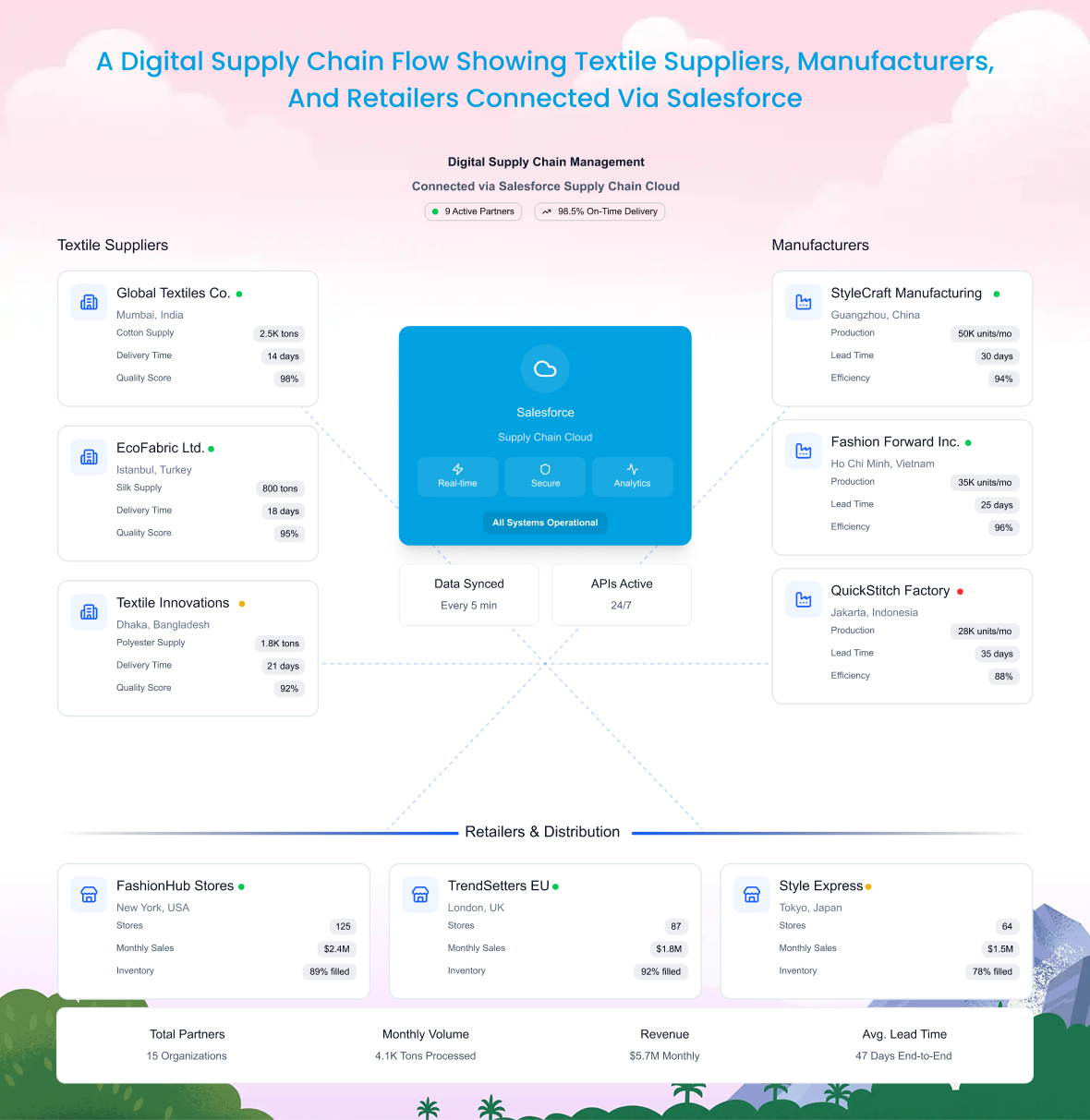
? The Collaboration Challenge in Textile Manufacturing
The textile value chain involves multiple moving parts: raw material suppliers, dyeing and finishing units, fabric producers, garment assemblers, and retail distributors.
This complex ecosystem creates challenges such as:
- Inconsistent communication between suppliers and manufacturers
- Retailers providing delayed sales feedback
- Disconnected systems for demand, supply, and inventory
- Lack of visibility into material readiness and order status
- Manual updates leading to delays or quality issues
Without digital synchronization, these gaps cause production delays, missed sales windows, and excess inventory.
⚙️ Why Supplier–Retailer Alignment Is Key to Efficiency
In a time-sensitive industry like textiles, supplier and retailer alignment directly determines profitability and agility.
Here’s why:
- ? Suppliers need timely demand forecasts to plan yarn, dyes, and fabric production.
- ? Manufacturers need accurate inputs and production schedules.
- ?️ Retailers need timely deliveries to meet seasonal demand.
When all three operate on shared data, the result is:
- ✅ Shorter production cycles
- ✅ Fewer stockouts or overages
- ✅ Faster response to market shifts
- ✅ Stronger business relationships
❌ Common Gaps in Traditional Textile Supply Chains
Even leading textile producers face these recurring issues:
- Siloed communication: Email-based coordination delays decision-making.
- Data discrepancies: Suppliers and retailers operate on outdated information.
- Manual processes: Forecasts and purchase orders are tracked on spreadsheets.
- Lack of end-to-end visibility: Retailers can’t see production status, and suppliers can’t anticipate changes.
- Reactive decision-making: Adjustments occur after delays, not before.
These gaps lead to inefficiency, mistrust, and lost opportunity.
? How Salesforce Manufacturing Cloud Bridges the Collaboration Divide
1️⃣ Unified Visibility Across the Value Chain
Manufacturing Cloud consolidates supplier, production, and retailer data on a single platform.
Manufacturers gain real-time visibility into:
- Supplier material readiness
- Retailer order trends
- Production progress across plants
This connected view eliminates blind spots and ensures that all stakeholders see the same version of truth.
2️⃣ Real-Time Order & Production Tracking
Suppliers and retailers can access shared dashboards showing:
- Live order statuses
- Material shipment updates
- Expected completion dates
With Salesforce Experience Cloud, suppliers and retailers can log in to dedicated portals to view, update, and confirm information — drastically reducing back-and-forth emails.
“Transparency reduces tension — and increases trust.”
3️⃣ Shared Forecasts for Suppliers & Retailers
Salesforce allows manufacturers to extend forecast visibility to suppliers and retailers.
This shared view helps:
- Suppliers plan raw materials based on confirmed forecasts
- Retailers prepare for promotions and inventory stocking
- Manufacturers balance production loads accordingly
Einstein Analytics adds predictive intelligence, helping the network anticipate demand spikes or slowdowns before they happen.
4️⃣ Improved Rebate & Contract Management
In textiles, contract terms — such as bulk discounts or supply rebates — often create confusion across partners.
Manufacturing Cloud simplifies this by centralizing contract details, rebate structures, and performance tracking.
Suppliers and retailers can see rebate eligibility, payment schedules, and compliance metrics in real time — fostering mutual accountability and transparency.
5️⃣ Streamlined Communication & Issue Resolution
Instead of relying on scattered email threads or manual updates, Salesforce provides integrated communication tools like:
- Collaborative case management
- Automated alerts for production or supply issues
- Approval workflows for schedule changes
This ensures that when disruptions occur — such as fabric delays or retailer order changes — all stakeholders are notified instantly and corrective action can begin immediately.
? Case Study: Improved Supplier–Retailer Alignment in a Global Textile Brand
Scenario:
A leading European textile manufacturer supplying fabric to global retailers struggled with misaligned production and sales forecasts.
Challenges:
- Retailers often changed orders last-minute
- Suppliers overproduced materials based on outdated forecasts
- Lack of unified visibility led to waste and excess inventory
Solution:
By implementing Salesforce Manufacturing Cloud and Experience Cloud:
- Suppliers gained access to live forecast dashboards
- Retailers tracked order fulfillment in real time
- Production planning adjusted dynamically to demand updates
Results:
- Forecast accuracy improved by 27%
- Order fulfillment cycle reduced by 30%
- Supplier–retailer disputes dropped by 40%
- Overall on-time delivery improved to 95%
? Measurable Business Impact
Manufacturers using Salesforce for textile collaboration report:
- 20–30% reduction in raw material waste
- 25% faster response to demand changes
- 35% improvement in order fulfillment rates
- 15% higher customer satisfaction scores
These metrics show how digital collaboration directly translates into measurable efficiency.
? Future of Connected Textile Supply Chains
The textile industry is evolving toward smart, data-driven ecosystems.
Salesforce will play a key role with innovations like:
- AI-based demand prediction using retail trend data
- IoT-enabled production monitoring for real-time quality control
- Blockchain for traceable sourcing, ensuring ethical textile production
- Sustainability dashboards tracking material impact
These technologies will make the textile supply chain not only connected but also intelligent and sustainable.
? Why Partner with Perigeon Software
Perigeon Software specializes in helping textile and apparel manufacturers unlock the full value of Salesforce Manufacturing Cloud through:
- Tailored solution architecture for supply chain collaboration
- Supplier and retailer portal design (Experience Cloud)
- Forecasting dashboards & analytics configuration
- Integration with ERP, inventory, and production systems
- Ongoing support for Salesforce optimization
As a Salesforce Consulting Partner, Perigeon ensures your manufacturing business achieves real-time visibility, operational agility, and long-term scalability.
? Conclusion
In today’s dynamic textile landscape, collaboration isn’t optional — it’s essential.
Salesforce Manufacturing Cloud enables textile manufacturers to unify suppliers and retailers under one digital platform — ensuring accuracy, speed, and trust across the value chain.
With Perigeon Software as your Salesforce implementation partner, you can transform your textile operations into a synchronized, data-driven ecosystem — ready for the future of smart manufacturing.