


Table of content
Introduction
The Battery & Energy Storage Manufacturing Landscape
Why Forecast Accuracy Is Mission-Critical
Key Forecasting Challenges
How Salesforce Manufacturing Cloud Improves Forecast Accuracy
Case Study
The Future of Forecasting
Conclusion
Frequently Asked Questions (FAQs)
1. Introduction
Battery manufacturing sits at the center of the global energy transition. From electric vehicles (EVs) and stationary energy storage systems (ESS) to consumer electronics and industrial backup power, demand is expanding rapidly—but unevenly.
Forecast deviations of 25–35% are common, leading to raw material shortages, idle production lines, or excess finished inventory.
Salesforce Manufacturing Cloud helps battery manufacturers boost forecast accuracy by aligning customer programs, long-term contracts, production capacity, and AI-driven insights into a unified planning system.
2. The Battery & Energy Storage Manufacturing Landscape
Product Segments
- EV battery cells, modules, and packs
- Stationary energy storage systems (grid & C&I)
- Consumer & industrial batteries
Customer Types
- Automotive OEMs
- Utilities & EPCs
- Energy solution providers
- Industrial & consumer brands
Production Characteristics
- Capital-intensive gigafactories
- Chemistry-specific lines (LFP, NMC, NCA, solid-state)
- Tight yield and quality constraints
👉 Forecast accuracy directly impacts material availability, line utilization, and margins.
3. Why Forecast Accuracy Is Mission-Critical for Battery Manufacturers
- Raw Material Procurement – Lithium, nickel, cobalt, and graphite have volatile prices and long lead times.
- Capacity & Line Planning – Cell lines cannot quickly switch chemistry without cost.
- Customer Program Commitments – EV and ESS programs depend on assured volumes.
- Inventory & Cash Flow Control – Overproduction ties up capital; underproduction risks customers.
- Margin & Yield Protection – Rush production and rework erode profitability.
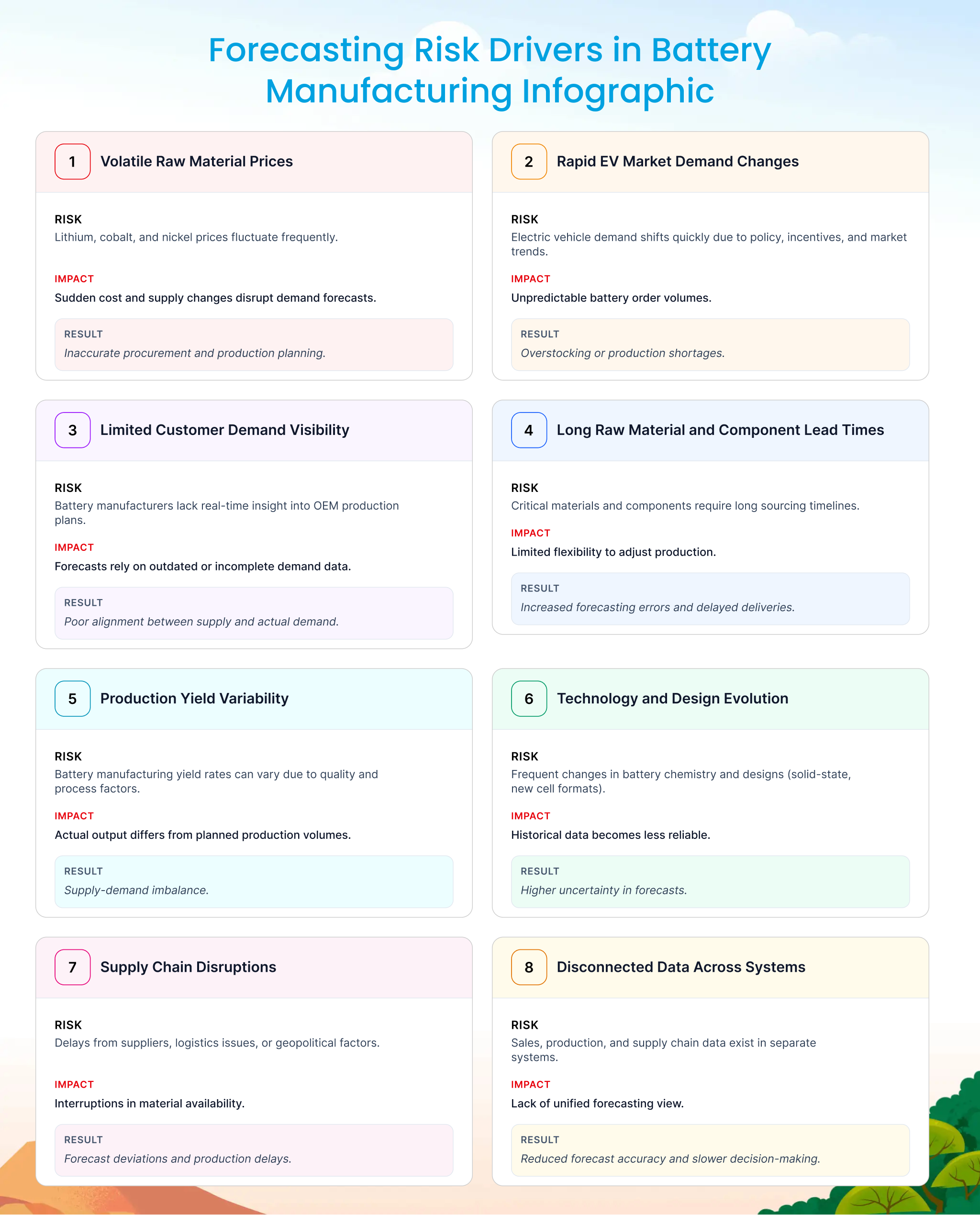
4. Key Forecasting Challenges in Battery Manufacturing
1. EV & Grid Storage Demand Volatility
EV demand fluctuates with incentives and model launches; grid projects depend on approvals and funding cycles.
2. Chemistry, Form-Factor & SKU Complexity
Multiple chemistries and pack designs increase line-level risk hidden by aggregate forecasts.
3. Long Lead-Time Raw Materials
Mining, refining, and logistics introduce multi-month lead times that amplify forecast errors.
4. Policy, Subsidy & Customer Program Dependency
Policy shifts and program delays distort timing and volume assumptions.
5. Disconnected Sales, Supply & Production Planning
Sales programs are tracked separately from procurement and capacity decisions.
5. How Salesforce Manufacturing Cloud Improves Forecast Accuracy
1. Program- & Customer-Level Forecasting
Forecast demand by OEM program, ESS project, chemistry, and form factor — increasing accountability and precision.
2. Contract-Driven Demand Commitments
Convert long-term supply agreements into committed volumes and separate firm orders from pipeline projections.
3. Supplier-Aware Planning & Visibility
Link forecasts with supplier capacity constraints to reduce raw material surprises.
4. ERP, MES & Supply Chain Integration
Align forecasts with ERP (materials & inventory), MES (capacity & yield), and SCM systems (logistics & procurement).
5. AI-Powered Demand Sensing & Risk Alerts
Einstein AI analyzes EV adoption signals, policy shifts, and order behavior to flag:
- Capacity shortfalls
- Overbuild risk by chemistry
- Procurement timing gaps
Also Read – Aligning Auto Parts Sales & Production with Manufacturing Cloud
6. Case Study
A battery manufacturer supplying EV OEMs and grid-scale storage projects faced raw material shortages and underutilized lines.
After implementing Salesforce Manufacturing Cloud:
- 28% improvement in forecast accuracy
- Stabilized raw material planning
- Increased customer delivery confidence
7. The Future of Forecasting in Battery Manufacturing
- AI-driven EV adoption modeling
- Digital twin gigafactories
- Real-time policy & incentive integration
- Sustainability-aware planning (recycled materials, ESG targets)
8. Conclusion
In battery manufacturing, forecast accuracy underpins competitiveness and resilience. Salesforce Manufacturing Cloud enables manufacturers to:
- Forecast demand by program, chemistry, and customer
- Align contracts with procurement and capacity
- Reduce material risk and idle production
- Anticipate demand shifts using AI