

Healthcare providers don’t struggle because of a lack of patients. They struggle because of disconnected systems, scattered patient data, delayed communication, and inefficient workflows.
From appointment scheduling to post-treatment follow-ups, every step in the patient journey generates data. But when that data lives across multiple systems, it becomes difficult to deliver timely, personalized care.
This is where Salesforce CRM for healthcare helps providers deliver better, more connected care.
Built specifically for the healthcare ecosystem, Salesforce Health Cloud is one of the most powerful Salesforce solutions for healthcare, helping organizations unify patient data, streamline operations, and improve care outcomes all while staying compliant with healthcare regulations.
Why Healthcare Providers Need a CRM System Today
The healthcare industry is shifting from volume-based to value-based care. Patients expect personalized communication, easy appointment scheduling, and seamless follow-ups. Yet many providers struggle with fragmented patient data, manual workflows, and disconnected systems.
A modern Customer Relationship Management (CRM) system designed for healthcare bridges these gaps. It helps providers manage the entire patient journey from first inquiry to post-treatment follow-up in one unified platform.
Without a CRM, healthcare organizations risk:
- Missed appointments and poor patient retention
- Inefficient referral management
- Compliance violations (HIPAA)
- Lost revenue from uncoordinated care
What Is Salesforce CRM for Healthcare Providers?
Salesforce Health Cloud is a specialized CRM built on the Salesforce platform, tailored for the unique needs of healthcare organizations. It combines patient data management, engagement tools, analytics, and automation – all within a secure, HIPAA-compliant environment.
Unlike generic CRMs, Salesforce for healthcare offers:
- 360° patient view (demographics, medical history, preferences, interactions)
- Care coordination across multiple providers
- Integrated communication (email, SMS, portal)
- AI-powered insights (Einstein Analytics)
Perigeon helps healthcare providers implement, customize, and optimize Salesforce Health Cloud to match their specific workflows and growth goals.
Key Benefits of Salesforce CRM for Healthcare Providers
1. Centralized Patient Data Management
Say goodbye to siloed spreadsheets and legacy systems. Salesforce aggregates patient information from EMRs, practice management software, referral sources, and marketing channels into a single, accessible dashboard. This reduces manual data entry and prevents errors.
This is where Salesforce CRM implementation services help tailor Health Cloud by creating custom objects and fields to match your specific healthcare workflows.
2. Improved Patient Engagement and Communication
Automate personalized communication across the patient lifecycle. Send appointment reminders, pre-visit instructions, post-discharge follow-ups, and health tips via email, SMS, or patient portal. Salesforce tracks open rates and engagement, helping you refine messaging.
3. Automated Appointment and Follow-Up Workflows
Reduce no-shows and improve continuity of care. Set up automated appointment scheduling, confirmation reminders, waitlist management, and post-visit surveys. Follow-up tasks for chronic care or preventive screenings can be triggered based on patient history.
4. Referral Management Optimization
Manage incoming and outgoing referrals transparently. Capture referral source data, automate referral confirmation, track referral status, and report on conversion rates. Strengthen relationships with referring physicians by providing feedback loop and outcome reports.
5. HIPAA-Compliant Data Security
Salesforce offers enterprise-grade security with HIPAA compliance readiness. Features include audit trails, data encryption, role-based access controls, and business associate agreements (BAA). You can safely store and process protected health information (PHI).
6. Marketing Automation for Healthcare Growth
Design multi-channel campaigns to attract new patients and retain existing ones. Segment audiences by diagnosis, location, age, or past interaction. Automate nurturing sequences for services like annual check-ups, dental cleanings, or fertility consultations.
7. Real-Time Reporting and Revenue Visibility
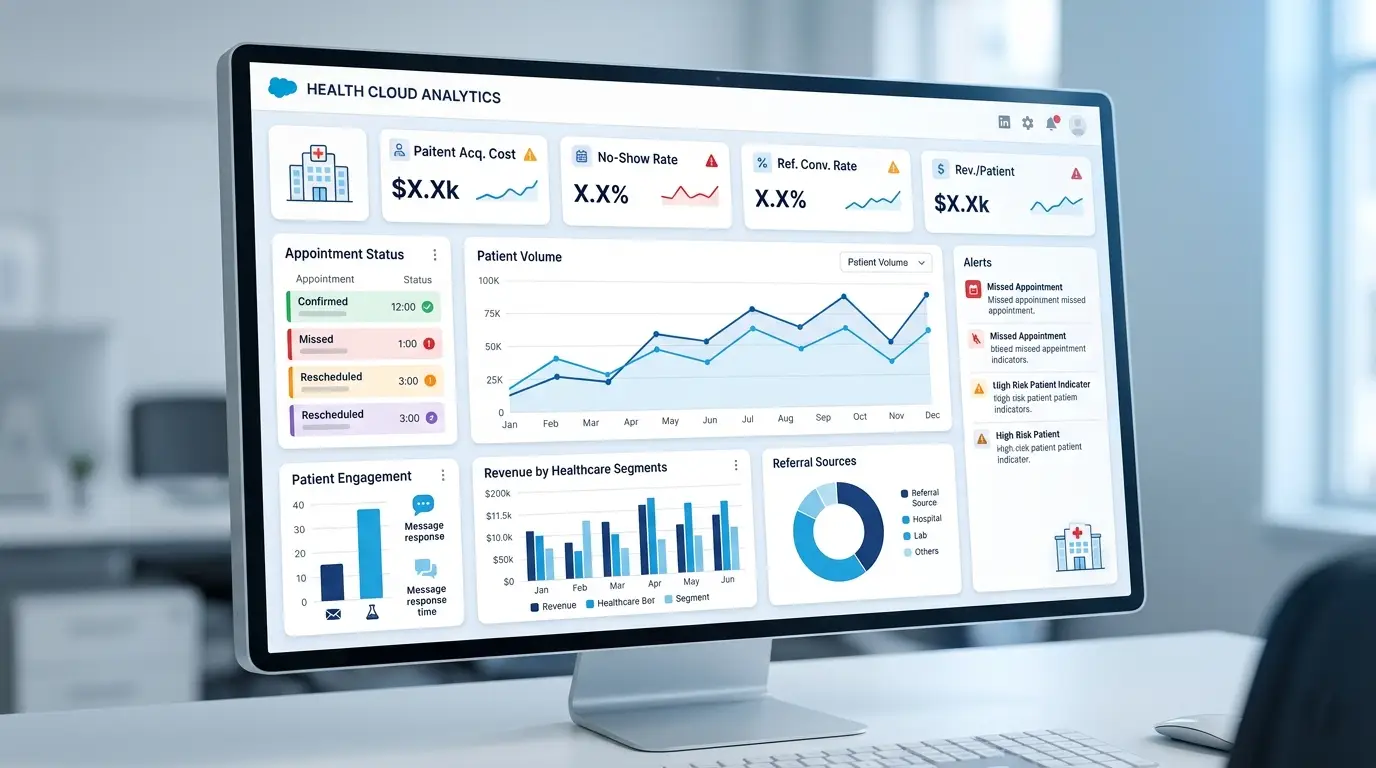
Build custom dashboards to monitor key metrics: patient acquisition cost, no-show rate, referral ROI, revenue per patient, and more. Real-time data helps leadership make faster, evidence-based decisions to improve profitability.
8. AI-Powered Patient Support with Agentforce for Healthcare
Healthcare providers can streamline patient communication and automate repetitive support tasks using Salesforce Agentforce services. AI-powered virtual agents can assist with appointment scheduling, patient inquiries, follow-up reminders, and insurance-related questions, helping organizations improve response times and patient satisfaction.
How Salesforce CRM Transforms Healthcare Operations
Beyond individual benefits, Salesforce creates an integrated operational backbone. It connects front-office (marketing, sales, patient intake) with back-office (billing, scheduling, analytics) processes. For example:
-
A patient books an online appointment → Salesforce creates a record → triggers a welcome email → assigns a care coordinator → updates the EMR integration → schedules a follow-up task.
-
A referral comes from a partner clinic → Salesforce logs the source → automates referral acceptance → notifies the clinical team → tracks the outcome → reports referral value back to the partner.
While these workflows may look seamless, they often require advanced customization and integration. This is where many healthcare organizations choose to hire a Salesforce Health Cloud developer to ensure everything runs efficiently and aligns with their specific processes.
This level of orchestration reduces administrative burden, shortens patient wait times, and increases revenue per patient encounter.
Use Cases Across Healthcare Segments
Multi-Specialty Hospitals
Hospitals with multiple departments (cardiology, orthopedics, neurology) use Salesforce to coordinate patient handoffs, share care plans, and reduce readmissions. Centralized dashboards help hospital administrators track bed occupancy, referral volumes, and patient satisfaction scores.
Diagnostic Centers
Lab and imaging centers benefit from automated appointment reminders, report delivery notifications, and follow-up campaigns encouraging repeat screenings. Salesforce also manages B2B relationships with referring doctors, tracking which physicians send the most valuable referrals.
Telehealth Providers
Virtual care platforms integrate Salesforce with video consultation tools. The CRM handles patient registration, pre-visit questionnaires, payment collection, and post-visit feedback. Automated reminders reduce missed virtual appointments.
Specialty Clinics (Dental, IVF, Cosmetic, Orthopedic)
Specialty clinics use Salesforce to nurture long patient journeys. For example, an IVF clinic can automate a 12-month communication sequence from initial inquiry to success story. Cosmetic clinics use marketing automation to promote seasonal offers and re-engage past leads.
Step-by-Step Implementation Strategy
A successful Salesforce Health Cloud implementation requires planning. Perigeon follows this proven roadmap:
Step 1: Map the Patient Journey
Document every touchpoint – from first website visit to final billing. Identify pain points, manual steps, and communication gaps. This becomes your blueprint for automation.
Step 2: Integrate Core Systems
Connect Salesforce with your EMR (e.g., Epic, Cerner), practice management system, billing software, marketing tools, and telephony. Use native connectors or APIs to ensure real-time data sync.
Step 3: Customize Fields for Healthcare
Create custom objects and fields for medical record numbers, insurance details, referring physician IDs, preferred contact methods, and consent logs. Configure picklists for appointment types, specialties, and status tracking.
Step 4: Automate Critical Workflows
Build flows for:
- New lead assignment
- Appointment confirmation and reminders
- No-show re-engagement
- Referral acknowledgment and outcome reporting
- Post-discharge follow-up sequences
Step 5: Build Leadership Dashboards
Design role-based dashboards for patient access managers, marketing heads, and CEOs. Show KPIs like: new patient conversion rate, average wait time, referral closed-won rate, and campaign ROI.
Common Mistakes to Avoid
- Skipping patient journey mapping – Leads to incomplete automation and frustrated staff.
- Poor data migration – Dirty data (duplicates, missing fields) breaks reporting. Clean and deduplicate before import.
- Neglecting user training – A powerful CRM is useless if staff don’t adopt it. Invest in role-specific training and ongoing support.
- Over-customization – Too many complex fields or flows confuse users. Start simple, iterate.
- Ignoring HIPAA requirements – Ensure all integrations, third-party apps, and user access controls are fully compliant.
Beyond numbers, it enables better patient satisfaction, stronger brand reputation, and scalable growth without adding proportional overhead.
ROI of Salesforce CRM for Healthcare Providers
When implemented correctly, Salesforce delivers measurable returns:
| Metric | Typical Improvement |
|---|---|
| Patient retention rate | +15–25% |
| Appointment no-show reduction | 20–40% |
| Referral conversion rate | +10–30% |
| Administrative hours saved | 15–20 hours/week |
| Marketing campaign ROI | 3–5x |
Beyond numbers, it enables better patient satisfaction, stronger brand reputation, and scalable growth without adding proportional overhead.
Why Healthcare Founders Should Invest Now
The healthcare market is becoming increasingly competitive. Patients choose providers who offer convenience, speed, and personalized communication. Legacy systems cannot deliver this at scale.
By adopting Salesforce CRM today, healthcare founders can:
- Build a unified patient data foundation before competitors do.
- Automate repetitive tasks and reallocate staff to high-value care coordination.
- Gain real-time visibility into business performance.
- Prepare for future AI and predictive analytics (e.g., identifying high-risk no-shows, predicting patient lifetime value).
Waiting only increases the cost of migration and the risk of losing patient loyalty to more tech-savvy providers.
Future of Healthcare CRM
The next generation of healthcare CRM will be driven by AI, voice, and interoperability standards like FHIR (Fast Healthcare Interoperability Resources). Expect to see:
- Generative AI – Automatically draft patient emails, summarize care plans, or suggest next-best actions.
- Predictive analytics – Flag patients likely to churn or miss appointments, enabling proactive outreach.
- Voice-activated workflows – Hands-free documentation for clinicians using natural language.
- Omnichannel orchestration – Seamless patient journeys across WhatsApp, chatbots, wearables, and in-clinic kiosks.
Salesforce is already investing heavily in these innovations, making it the safest long-term platform for healthcare growth.
Build a Scalable Healthcare System with Salesforce CRM
You don’t need to replace your entire IT stack overnight. Perigeon specializes in phased, business-outcome-driven Salesforce implementations for healthcare providers of all sizes – from single specialty clinics to multi-location hospital networks.
Ready to see Salesforce in action for your healthcare organization?
Contact Perigeon for a free consultation and a tailored roadmap.
Conclusion
Healthcare is no longer just about treatment—it’s about delivering connected, personalized, and efficient patient experiences.
Salesforce CRM for healthcare providers empowers organizations to break down data silos, improve care coordination, and enhance patient engagement—all while maintaining compliance and security.
As the healthcare industry continues to evolve, adopting platforms like Salesforce Health Cloud will be critical for providers aiming to stay competitive and deliver high-quality care.
FAQs
+
+
Salesforce Health Cloud offers several benefits, including:
- Centralized patient data management
- Improved patient engagement
- Automated workflows
- Better care coordination
- Enhanced data security and compliance
These capabilities help providers deliver more efficient and patient-centric care.
+
+