


Table of content
Introduction
The Electrical Equipment & Appliances Manufacturing Landscape
Why Demand Forecasting Is Mission-Critical
Key Demand Forecasting Challenges
How Salesforce Manufacturing Cloud Improves Demand Forecasting
Case Study: Appliance Manufacturer Improves Forecast Accuracy
The Future of Demand Forecasting
Conclusion & CTA
Introduction
Electrical equipment and home appliance manufacturers operate in a world of high volumes, thin margins, and intense channel pressure. From refrigerators and air conditioners to industrial electrical equipment, success depends on predicting demand accurately and executing at scale.
Demand forecasting remains one of the biggest pain points. Seasonality, retailer promotions, regional preferences, housing cycles, and energy-efficiency regulations all influence appliance demand—often resulting in forecast inaccuracies of 20–30%.
Salesforce Manufacturing Cloud helps appliance manufacturers unify sales agreements, channel inputs, production capacity, and AI-driven insights into a single connected forecasting and planning platform.
Must Read – Streamlining Retail & Distributor Networks in Appliance Manufacturing
The Electrical Equipment & Appliances Manufacturing Landscape
Product Segments
- Home appliances (ACs, refrigerators, washing machines, ovens)
- Small appliances (fans, mixers, heaters)
- Electrical equipment (switchgear, panels, motors)
Sales Channels
- Large retail chains
- Regional distributors and dealers
- E-commerce marketplaces
- Project-based B2B sales (builders, utilities)
Production Characteristics
- Mix of make-to-stock and configure-to-order
- Heavy dependence on component suppliers
- High logistics and warehousing costs
👉 In this environment, forecast accuracy directly impacts market share and profitability.
Why Demand Forecasting Is Mission-Critical for Appliance Manufacturers
- Peak-Season Readiness: Summer AC demand and festive sales leave little room for error
- Component Procurement Planning: Compressors, motors, PCBs, and metals require early commitments
- Retailer Service Levels: Stockouts lead to lost shelf space and retailer confidence
- Inventory & Working Capital Control: Appliances are bulky and expensive to store
- Margin Protection: Emergency production and air freight erode margins
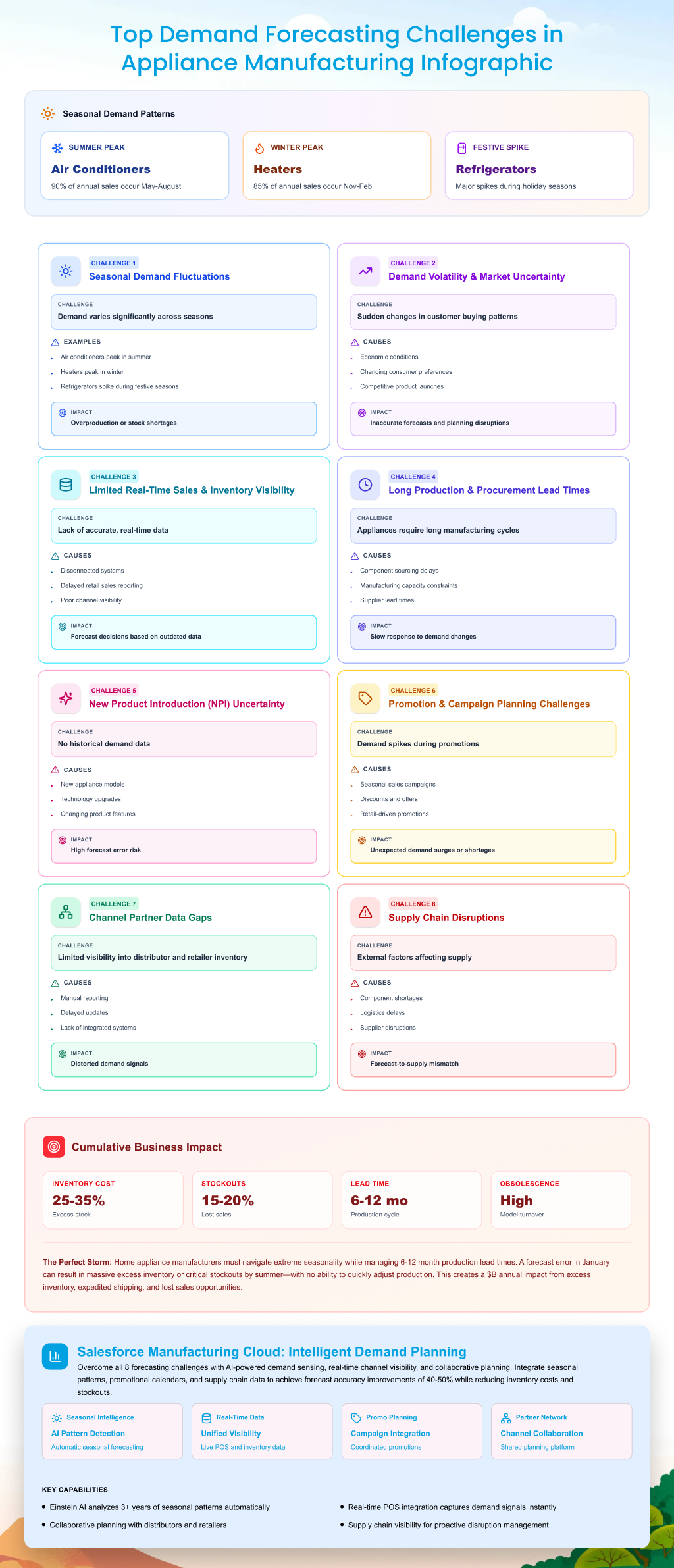
Key Demand Forecasting Challenges in Appliance Manufacturing
1. Long Production & Procurement Lead Times
Capacity and supplier commitments are locked months in advance, making late forecast changes expensive.
2. High SKU & Variant Complexity
Capacity varies by rating, energy efficiency, color, and configuration—aggregate forecasts hide SKU-level risks.
3. Seasonal & Promotion-Driven Demand
Demand spikes during summers, festivals, and mega sales distort baseline consumption.
4. Retailer & Distributor Signal Distortion
Pre-season stocking does not reflect real sell-through, delaying demand visibility.
5. Disconnected Sales, Supply & Finance Planning
Forecasts in CRM, production in ERP, and procurement in separate tools create misalignment.
How Salesforce Manufacturing Cloud Improves Demand Forecasting
1. Channel- & Account-Level Forecasting
Forecast demand by retailer, distributor, region, and product family to improve accountability.
2. Promotion-Aware Demand Planning
Links promotions and campaigns directly to forecasts, separating base demand from promotional spikes.
3. Contract-Driven Forecast Commitments
Transforms retailer and distributor agreements into committed demand.
4. ERP, Supply Chain & Logistics Integration
Aligns Salesforce forecasts with ERP, MRP, and logistics systems to keep plans executable.
5. AI-Powered Demand Sensing & Risk Alerts
Agentforce AI analyzes historical demand, seasonality, and retailer behavior to flag stockout and overbuild risks early.
Case Study: Appliance Manufacturer Improves Forecast Accuracy
A home appliance manufacturer supplying national retail chains and e-commerce platforms faced chronic AC stockouts during summer and excess inventory post-festival season.
- Forecast accuracy improved by 27%
- Peak-season stock availability exceeded 96%
- Finished goods inventory reduced significantly
The Future of Demand Forecasting in Electrical Equipment & Appliances
- AI-driven micro-seasonal forecasting by city
- IoT-enabled consumption signals from smart appliances
- Digital twin factories for capacity simulation
- Sustainability-aware planning for energy-efficient models
Conclusion
In appliance manufacturing, demand forecasting is the foundation of operational excellence. Salesforce Manufacturing Cloud enables manufacturers to forecast at retailer, region, and SKU level, align promotions with production, reduce inventory risk, and anticipate demand shifts using AI.
Ready to improve demand forecasting accuracy?
👉 Schedule a Manufacturing Cloud Strategy Session with Perigeon