

The U.S. manufacturing sector remains economically critical. According to the National Institute of Standards and Technology (NIST), manufacturing contributed approximately $2.4 trillion to U.S. GDP in 2023, representing 10.2% of total GDP, and the sector employed about 15 million people in 2024. Yet the size of the industry does not automatically translate into competitiveness. NIST’s latest analysis points to slower manufacturing growth and productivity pressures, making better use of technology, capital, talent, and supply chains increasingly important.
For U.S. manufacturers, the question is no longer simply how to produce more products at a lower cost. The bigger question is how to become more agile, productive, resilient, and responsive while continuing to manufacture in an increasingly competitive global environment.
This is where digital transformation is becoming less of an IT initiative and more of a business strategy.
Manufacturers today are managing complex networks of customers, suppliers, distributors, production teams, service organizations, and business partners. At the same time, critical information often remains spread across ERP systems, spreadsheets, CRM platforms, service applications, and other disconnected tools. When teams do not have a common view of demand, customers, inventory, agreements, assets, and service activity, even strong manufacturing operations can struggle to respond quickly.
Salesforce Manufacturing Cloud—now evolving under the name Agentforce Manufacturing is designed to address part of this challenge by connecting commercial operations, service, partner engagement, forecasting, and manufacturing-specific data on a common platform.
The opportunity is not simply to move manufacturing processes to the cloud. It is to create a more connected enterprise where information can move faster between the people and processes that need it.
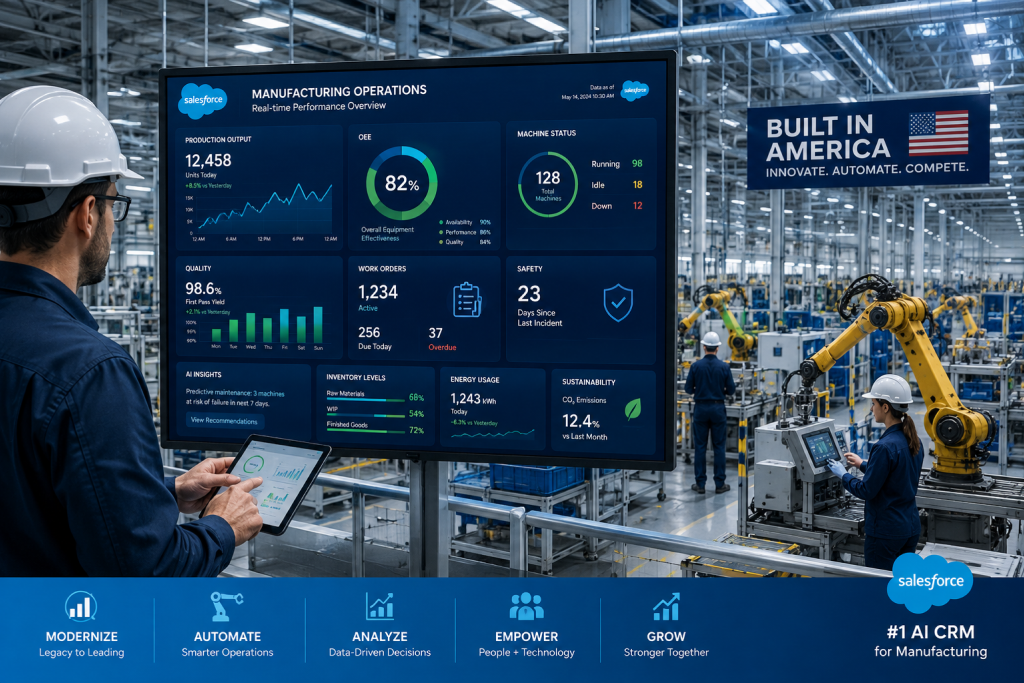
Why USA Manufacturing Competitiveness Is Changing
For decades, manufacturing competitiveness was often discussed in terms of labor costs, production capacity, access to raw materials, and economies of scale.
Those factors still matter. But today’s manufacturers are also competing on speed of decision-making.
A manufacturer may have a highly automated factory, sophisticated machinery, and a capable workforce. But if its sales team cannot accurately communicate changes in customer demand to operations, or if service teams cannot access accurate information about an installed asset, the organization can still lose time and money.
NIST’s latest manufacturing analysis highlights this broader challenge. U.S. manufacturing remains one of the world’s largest manufacturing sectors, but recent productivity and growth trends show why manufacturers need to focus on investments that can generate measurable improvements in competitiveness.
That means the next phase of manufacturing transformation will depend not only on what happens inside the factory, but also on what happens across the enterprise surrounding the factory.
From Siloed Information to Connected Manufacturing
One of the biggest barriers to manufacturing agility is fragmented information.
Consider a typical customer relationship. A customer may have a long-term purchasing agreement, a forecast, active orders, installed equipment, warranty information, service cases, and future opportunities. Different teams may own different pieces of that information.
Sales sees one picture.
Operations sees another.
Finance has another.
Service may have yet another.
The result is often a lot of manual coordination.
Salesforce for Manufacturing is designed to create greater visibility across these functions, helping manufacturers connect sales, operations, service, forecasting, and customer data.
Salesforce describes Manufacturing Cloud as extending Sales Cloud and Service Cloud with industry-specific capabilities and allowing manufacturers to integrate with existing ERP and order-management systems through APIs, MuleSoft, or other middleware.
This distinction is important.
Manufacturing Cloud does not have to replace the systems manufacturers already rely on. Instead, it can serve as a connected engagement and intelligence layer that brings information together and makes it easier for teams to act on it.
Turning Customer Demand into Better Business Decisions
One of the most important opportunities is improving the connection between customer demand and business planning.
Manufacturers frequently operate with long-term agreements, recurring orders, distributor relationships, and forecasts that change over time. A static forecast can quickly become outdated when customer requirements change.
Manufacturing Cloud provides capabilities such as Sales Agreements and Advanced Account Forecasting to help manufacturers manage planned and actual quantities, revenue, customer demand, and other business measures.
For an executive, the value is straightforward: better visibility can lead to better decisions.
Instead of asking:
“What did the customer order?”
leaders can begin asking:
“What is the customer likely to need, how is that changing, and what should we do next?”
That shift can help sales, operations, finance, and partners work from a more consistent view of the business.
Building a More Resilient Manufacturing Supply Chain
Supply-chain resilience has become a board-level issue.
Manufacturers need to understand not only their direct suppliers but also how changes in customer demand, inventory, distribution, and partner activity can affect the broader business.
Salesforce’s manufacturing capabilities include partner engagement, inventory visibility, forecasting, and sales-agreement management. Its manufacturing data model is designed to bring together commercial, service, partner, and inventory information.
This does not eliminate supply-chain risk. No software platform can.
What it can do is help organizations see changes sooner and coordinate responses faster.
That distinction matters.
Resilience is not simply about having more suppliers. It is also about having the information needed to make timely decisions when conditions change.
Improving Workforce Productivity
The manufacturing workforce is another important part of the competitiveness equation.
When experienced employees spend significant amounts of time searching for information, reconciling spreadsheets, updating systems, or coordinating routine requests, organizations are not getting the full value from their workforce.
Connected digital workflows can reduce some of this administrative burden.
Salesforce is increasingly adding AI and agent capabilities to its manufacturing platform. In its 2026 releases, Salesforce describes Agentforce Manufacturing capabilities designed to automate and assist activities across sales, service, inventory, maintenance, and other workflows.
The larger opportunity is not simply automation for its own sake.
It is about allowing employees to spend more time on judgment, problem-solving, customer relationships, engineering, and higher-value work.
For manufacturers facing productivity and talent pressures, that can become an important competitive advantage.
Making Service Part of the Manufacturing Strategy
Manufacturing competitiveness does not end when a product leaves the factory.
For equipment and asset-intensive manufacturers, the customer relationship can continue for years through maintenance, repairs, warranties, spare parts, upgrades, and other services.
This creates an opportunity to compete on something beyond the initial product: the customer experience and lifetime value of the asset.
Manufacturing Cloud provides capabilities for asset management, service operations, warranty management, cases, work orders, and related customer information. Salesforce also highlights AI-enabled service capabilities designed to help teams identify issues, manage warranty processes, and automate actions.
For manufacturers, this can mean moving from a reactive service model toward a more proactive one.
Instead of waiting for a customer to report a problem, organizations can use connected information to identify potential issues, understand asset history, and determine the appropriate next action.
The result can be better customer experiences, improved asset uptime, and potentially stronger recurring revenue opportunities.
Where AI Changes the Equation
The next stage of manufacturing transformation is likely to be defined by how effectively companies combine data, automation, and AI.
AI is most valuable when it is connected to business context.
An AI system that simply generates a summary may save a few minutes. An AI agent that can understand a customer account, review relevant information, identify a problem, recommend an action, and initiate an approved workflow can have a much greater operational impact.
Salesforce is positioning Agentforce Manufacturing around this idea, connecting people, AI agents, applications, assets, and data across the manufacturing value chain.
For manufacturing leaders, this creates an important strategic question:
How can AI become part of the operating model rather than another technology sitting alongside the business?
That is where having connected, reliable business data becomes essential.
AI cannot compensate for fragmented or inaccurate information indefinitely. The quality of the decisions an AI system supports will depend heavily on the quality and accessibility of the underlying data.
Manufacturing Competitiveness Is an Enterprise-Wide Challenge
It is important to recognize that Salesforce Manufacturing Cloud is not a replacement for the entire manufacturing technology stack.
Factories still need ERP systems, manufacturing execution systems, industrial automation, robotics, engineering systems, supply-chain technologies, and many other specialized platforms.
The opportunity is to connect these environments.
A modern manufacturing technology architecture can therefore look less like a collection of isolated applications and more like an ecosystem:
Factory systems → ERP → Customer and commercial operations → Service → Partners → Data → AI
Manufacturing Cloud can play an important role in connecting the customer, commercial, service, and partner sides of this ecosystem while integrating with existing back-office systems.
That is ultimately where the competitiveness argument becomes compelling.
What Manufacturing Leaders Should Focus On
For executives evaluating digital transformation, the goal should not be to implement technology simply because it is new.
The better question is:
Which business problems are preventing us from becoming more competitive?
For some manufacturers, the answer may be forecast accuracy.
For others, it may be fragmented customer data, inefficient service processes, poor partner visibility, inventory challenges, or the amount of manual work required to coordinate different teams.
A successful Manufacturing Cloud strategy should therefore begin with measurable business outcomes such as:
- improving forecast accuracy;
- reducing manual administrative work;
- increasing sales and operations visibility;
- improving customer and partner collaboration;
- reducing service response times;
- increasing asset uptime;
- improving inventory visibility;
- accelerating decision-making;
- creating new service and recurring-revenue opportunities.
Working with a Salesforce Development Company USA can also help manufacturers design, integrate, customize, and optimize Manufacturing Cloud around these specific business requirements.
Technology should support these outcomes—not become the outcome itself.
The Road Ahead for U.S. Manufacturing
U.S. manufacturing has significant strengths: scale, innovation, advanced research capabilities, a large industrial base, and a strong ecosystem of manufacturers and suppliers.
But maintaining that position will require continued improvement in productivity and competitiveness.
NIST’s recent manufacturing research makes the point clearly: advancing U.S. manufacturing competitiveness requires investments that improve productivity, strengthen supply chains, support innovation, and produce better outcomes from limited resources.
Digital platforms can be one part of that equation.
Salesforce Manufacturing Cloud provides manufacturers with a way to connect commercial operations, forecasting, service, partners, assets, and data. With the evolution toward Agentforce Manufacturing, the platform is also moving toward a model in which AI can help employees and organizations act on that information more quickly.
The bigger idea, however, is not about one technology platform.
It is about building a manufacturing enterprise that can sense change, understand what it means, and respond quickly.
Conclusion:
The future of U.S. manufacturing will not be determined by technology alone.
It will be determined by how effectively manufacturers combine people, physical assets, capital, supply chains, technology, and information to create value.
For manufacturing executives, that means digital transformation needs to move beyond individual systems and isolated projects. The real opportunity is to create a connected enterprise where customer demand can influence decisions, service teams have the context they need, partners can collaborate effectively, and employees can use AI and automation to focus on higher-value work.
Salesforce Manufacturing Cloud can be part of that transformation by connecting critical commercial and service processes with the broader manufacturing ecosystem.