


Table of content
Introduction
The Consumer Electronics Manufacturing Landscape
Why Rapid Product Cycles Create Operational Risk
Key Challenges in Managing Short Product Lifecycles
How Salesforce Manufacturing Cloud Manages Rapid Product Cycles
Case Study: Consumer Electronics Brand Accelerates Cycle Management
Conclusion
Introduction
Consumer electronics is defined by speed. Smartphones, wearables, TVs, smart devices, and accessories move from concept to launch to end-of-life in record time. A flagship device can peak and fade within 12–18 months, while accessories and variants turn even faster.
This velocity creates enormous pressure on manufacturers. Miss the launch window, and you lose relevance. Overbuild late in the cycle, and inventory becomes obsolete overnight. According to IDC (2024), consumer electronics manufacturers write off 8–12% of annual inventory due to poor lifecycle alignment.
Salesforce Manufacturing Cloud helps consumer electronics manufacturers manage rapid product cycles by aligning program forecasts, sales agreements, retailer signals, and AI-driven lifecycle insights into a single execution layer.
The Consumer Electronics Manufacturing Landscape
Product Categories
- Smartphones & tablets
- Wearables & accessories
- TVs & home entertainment
- Smart home and IoT devices
Sales Channels
- Large retail chains
- E-commerce platforms
- Telecom operators
- Regional distributors
Production Characteristics
- Short lifecycle SKUs
- High launch-day volume spikes
- Fast transitions between generations
👉 In this environment, lifecycle misalignment is more dangerous than demand uncertainty.
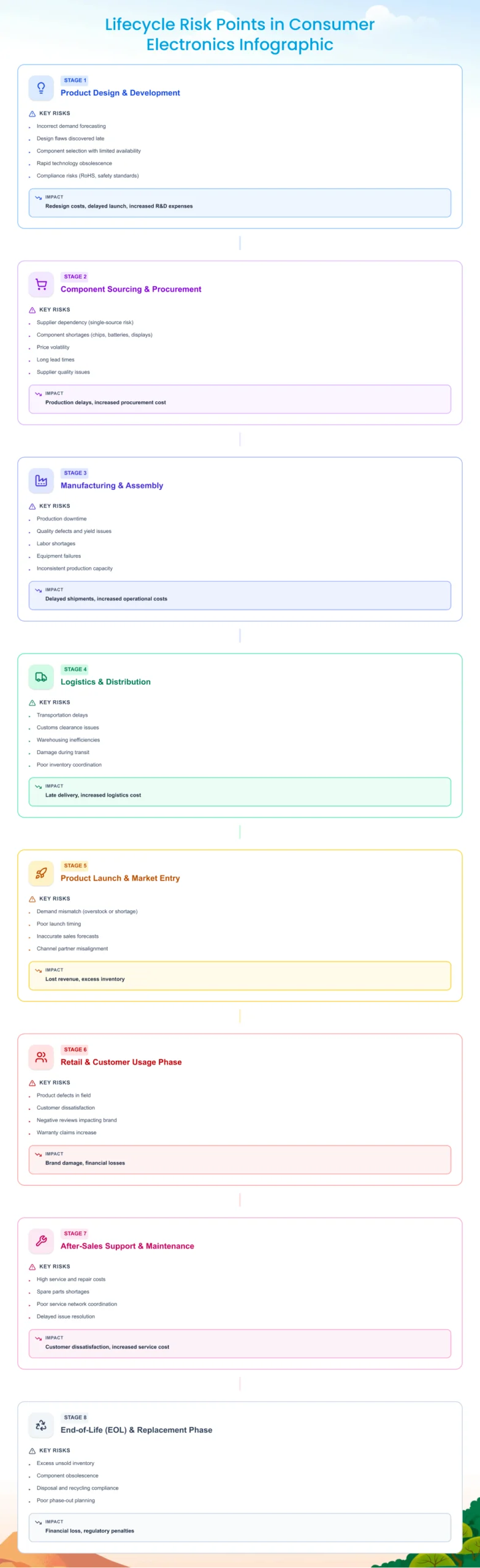
Why Rapid Product Cycles Create Operational Risk
Launch Readiness Risk
Underestimating launch demand leads to stockouts and lost mindshare.
Mid-Cycle Volatility
Promotions, reviews, and competitor launches distort demand signals.
End-of-Life (EOL) Exposure
Excess inventory near EOL rapidly becomes obsolete.
Supplier Commitment Risk
Components ordered early may not align with actual sell-through.
Channel Conflict
Retailers and e-commerce platforms react at different speeds.
Key Challenges in Managing Short Product Lifecycles
1. Compressed Launch-to-EOL Timelines
- Planning windows shrink with every generation
- Late changes cascade across the supply chain
2. Demand Volatility & Hype Cycles
- Influencer reviews and early sales skew forecasts
- Demand spikes are sharp but short-lived
3. Variant & SKU Explosion
- Memory, color, region, and bundle variants multiply complexity
- Aggregate forecasts hide SKU-level risk
4. Channel & Retailer Signal Distortion
- Pre-orders do not equal actual consumption
- Retail stock builds mask true demand
5. Disconnected Lifecycle, Sales, and Supply Data
- Product lifecycle data in PLM
- Forecasts in spreadsheets
- Orders and inventory in ERP
- No unified execution view
How Salesforce Manufacturing Cloud Manages Rapid Product Cycles
1. Program- & Lifecycle-Based Forecasting
- Forecasts by product program
- Plans by lifecycle stage: launch, growth, maturity, and EOL
- Improves timing-based decision making
2. Launch-to-EOL Sales Agreement Management
- Links channel commitments to lifecycle phases
- Enables controlled ramp-up and ramp-down
3. Retailer & Channel Collaboration
- Partners update demand signals via collaboration portals
- Early detection of post-launch demand drops
4. ERP, PLM & Supply Chain Integration
- PLM for product versions and lifecycle status
- ERP for production and inventory
- Supply planning tools for execution alignment
5. AI-Powered Lifecycle Risk & Transition Insights
- Analyzes sell-through velocity
- Monitors channel inventory aging
- Evaluates variant-level performance
- Flags overbuild risk near EOL
- Identifies early successor product ramp needs
Case Study: Consumer Electronics Brand Accelerates Cycle Management
A global consumer electronics brand launching multiple smartphone models annually faced excess inventory mid-cycle and delayed EOL decisions.
After implementing Salesforce Manufacturing Cloud:
- Lifecycle forecast accuracy improved by 30%
- EOL inventory write-offs were reduced by 22%
- Channel confidence improved during launches
Conclusion
In consumer electronics, speed without alignment is chaos. Salesforce Manufacturing Cloud enables manufacturers to:
- Manage demand by product lifecycle stage
- Align launches, transitions, and EOL decisions
- Reduce obsolescence and inventory risk
- Use AI to anticipate lifecycle inflection points
With Salesforce, consumer electronics manufacturers turn rapid cycles into repeatable, profitable execution.
🔗 Ready to manage rapid product cycles with confidence?
👉 Book a Manufacturing Cloud Strategy Session with Perigeon