
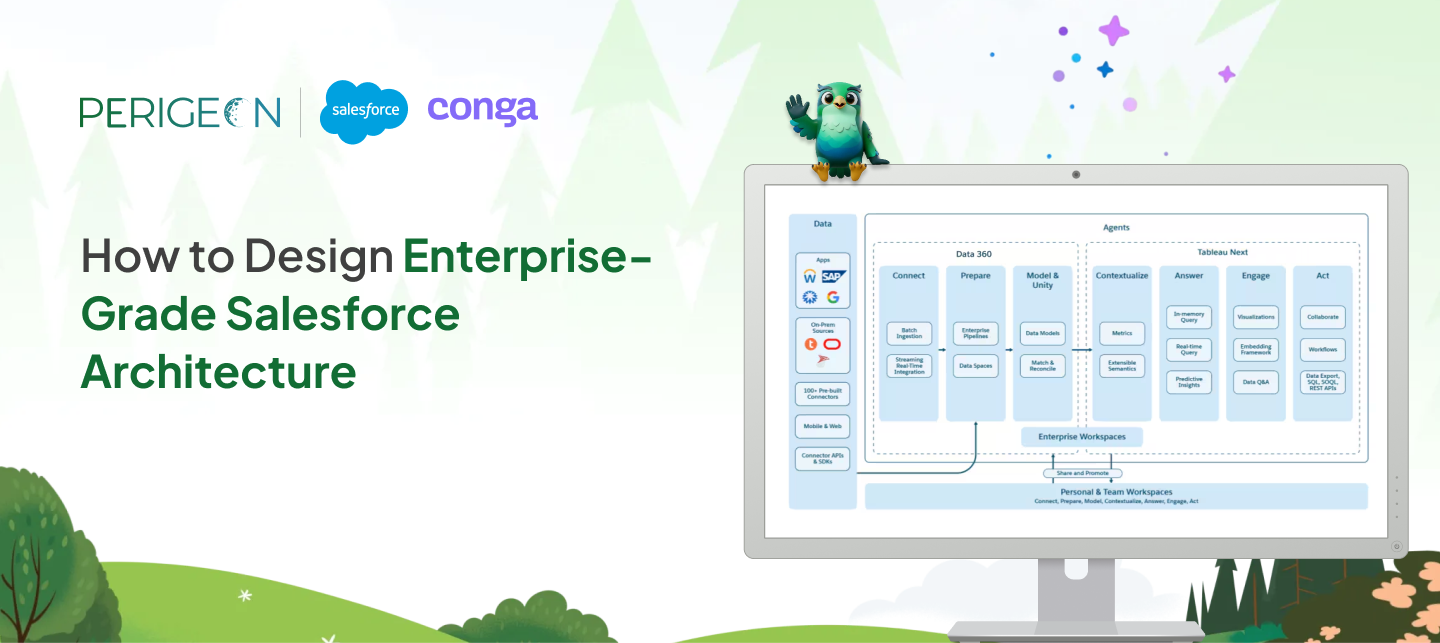
A well-designed Salesforce architecture feels invisible — everything just works smoothly, scales with your business, and stays easy to maintain for years. A poorly designed one becomes a constant source of frustration, high costs, and blocked innovation.
At Perigeon, we’ve helped many growing organizations move from chaotic, custom-heavy orgs to clean, scalable, enterprise-grade Salesforce architectures. Here’s a practical guide on how to design one that lasts.
What Makes Salesforce Architecture “Enterprise-Grade”?
Enterprise-grade architecture means your org is:
-
Scalable and future-proof
-
Secure and compliant
-
Easy to maintain and govern
-
Performant even with millions of records
-
Ready for new features like Agentforce, Revenue Cloud, and AI
It’s not about using every possible customization — it’s about making smart, intentional choices.
1. Start with a Clean, Scalable Data Model
Best Practice:
Use standard objects (Account, Contact, Opportunity, Case, etc.) as much as possible. Create custom objects only when there’s a genuine need that standard objects can’t fulfill.
Key Tips:
-
Keep lookup relationships under control (avoid deep relationship chains)
-
Use picklists and global value sets instead of free-text fields
-
Plan for data volume — use Big Objects or external objects for historical/archive data
-
Document your data model early and maintain it
2. Choose the Right Automation Strategy
Golden Rule: Declarative first, then code.
Recommended Approach:
-
Use Flows for most business logic
-
Build reusable sub-flows and invocable actions
-
Use Apex only when Flows can’t meet the requirement (complex calculations, heavy integrations, etc.)
-
Implement a proper trigger framework (never put logic directly in triggers)
-
Avoid mixing old tools (Process Builder, Workflow) with new Flows
3. Design a Simple and Secure Sharing Model
Modern Best Practice:
-
Keep role hierarchy flat and simple (maximum 8–10 levels)
-
Rely primarily on Permission Sets and Permission Set Groups instead of profiles
-
Use Sharing Rules sparingly
-
Leverage Sharing Groups and manual sharing only when absolutely necessary
This approach makes user management and compliance much easier.
4. Build Modular & Reusable Components
Avoid giant monolithic Flows or Apex classes.
Good Design Habits:
-
Create small, single-purpose Flows
-
Build reusable Lightning Web Components (LWC)
-
Use Custom Metadata Types and Custom Settings for configuration
-
Design service layers in Apex for better testability and reusability
5. Implement Strong Governance & DevOps Practices
Enterprise-grade architecture needs strong processes:
-
Establish a Salesforce Center of Excellence (CoE)
-
Use second-generation unlocked packages
-
Adopt Git-based version control with automated testing
-
Define clear change management and release processes
-
Run regular architecture reviews and technical debt audits
6. Plan for Platform Evolution
Salesforce releases three major updates every year. Your architecture must evolve with it.
Smart Practices:
-
Always test new releases in preview sandboxes
-
Maintain a roadmap for migrating deprecated features
-
Design with API version control in mind
-
Prepare your org for AI features (clean data + modular logic is essential)
7. Focus on Performance and Limits
-
Optimize SOQL queries and bulkification
-
Avoid recursive triggers and infinite loops
-
Monitor governor limits proactively
-
Use caching (Platform Cache) where appropriate
-
Archive old data regularly
How Perigeon Helps Design Enterprise-Grade Architecture
We don’t just advise — we build with you.
Our services include:
-
Architecture reviews and health audits
-
Data model optimization
-
Automation strategy and refactoring
-
Security model modernization
-
Governance framework setup
-
DevOps and package-based development
-
Ongoing architecture advisory and managed services
Whether you’re starting a new implementation or modernizing an existing org, we help you design architecture that supports long-term growth.
Ready to Build a Scalable Salesforce Architecture?
If your current org feels fragile or you’re planning a new implementation, now is the best time to get the architecture right.
Contact Perigeon for a Salesforce Architecture Review or consultation.

Frequently Asked Questions
+
+
+
+
+