


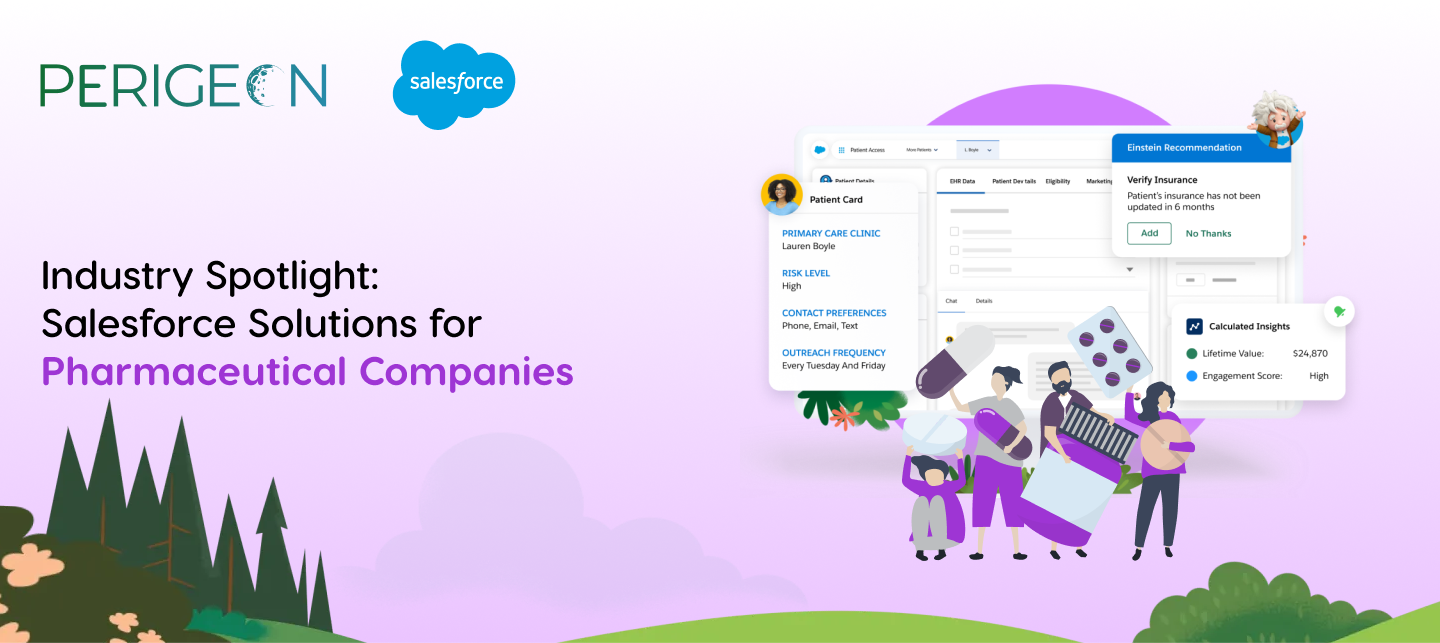
The pharmaceutical industry operates at a unique intersection of science, regulation, and human trust. With hundreds of products across complex supply chains, thousands of healthcare professionals to engage, and strict regulatory frameworks to navigate pharma companies need more than a basic CRM. They need a platform that thinks like their business.
That’s exactly what Salesforce for pharmaceutical companies delivers. From field force automation and physician targeting to patient support programs and audit-ready compliance. Salesforce has become the CRM backbone for pharma organizations worldwide.
By the numbers: As of 2025, over 1,700 companies globally use Salesforce Health Cloud with pharmaceutical manufacturers among the fastest-growing segments. Pharma companies that implement Salesforce report 30–40% improvement in field force productivity and significant reductions in compliance audit risk.
This guide covers everything you need to know about Salesforce CRM for pharmaceutical companies from module selection and field force management to integration, compliance, and choosing the right Salesforce consulting partner.
What is Salesforce for Pharma?
Salesforce for pharma refers to the suite of Salesforce cloud products, primarily Salesforce Health Cloud, Sales Cloud, Marketing Cloud, and Life Sciences Cloud, configured and implemented for the specific needs of pharmaceutical and life sciences organizations.
Unlike generic CRM software, Salesforce in the pharma industry is designed to handle:
- Managing relationships with healthcare professionals (HCPs) doctors, pharmacists, and hospital procurement teams
- Field medical representative tracking, visit planning, and call reporting
- Patient support program management and treatment adherence tracking
- HIPAA, GDPR, and FDA 21 CFR Part 11 compliance management
- Marketing campaigns targeting physicians segmented by specialization and prescribing behavior
- Integration with ERP systems, Electronic Health Records (EHR), and supply chain platforms
- Sales force automation (SFA) across multiple geographies and product lines
Salesforce’s 2023 launch of Life Sciences Cloud a dedicated expansion of Health Cloud signals just how seriously the platform is investing in the pharmaceutical and biotech sectors. It combines AI-driven engagement via Agentforce, compliance-ready data models, and industry-specific workflow automation into a single platform purpose-built for pharma.
Key Challenges Pharma CRM Must Solve
Before evaluating any CRM platform, it’s important to understand what makes pharmaceutical CRM uniquely complex compared to other industries.
Regulatory Compliance:
Every HCP interaction, sample distribution, and marketing campaign must be documented and auditable under HIPAA, GDPR, and FDA regulations. A single missed record can trigger a costly audit or enforcement action.
Long Product Cycles:
Drugs take years from R&D to commercialization. CRM data must support decisions from clinical trials through market launch and post-market surveillance far longer than most industries.
Field Force Complexity
Large pharma companies manage thousands of medical reps across territories, products, and geographies all requiring real-time data access, mobile reporting, and performance tracking.
Multiple Stakeholders
Pharma must simultaneously manage HCPs, patients, payers, pharmacies, distributors, KOLs (Key Opinion Leaders), and regulators each with different data needs and communication preferences.
Data Silos
R&D, manufacturing, commercial, and compliance teams often work in separate systems creating dangerous gaps in insight and accountability that slow decision-making.
Patient Engagement
Modern pharma is shifting from product-centric to patient-centric. Companies need tools to support treatment adherence and long-term patient outcomes at scale.
Without a purpose-built CRM platform, these challenges create operational inefficiency, compliance risk, and missed revenue opportunities. This is exactly the gap that Salesforce CRM for pharmaceutical companies is designed to fill.
Why Salesforce is the Best CRM for Pharmaceutical Companies
There is no shortage of CRM options for pharma from Veeva Vault to Microsoft Dynamics to niche pharma-specific tools. So why do leading pharmaceutical organizations consistently choose Salesforce?
Key stats:
- 1,700+ companies use Salesforce Health Cloud globally (2025)
- 30–40% average improvement in field force productivity
- $254 billion in potential annual profit gains from AI-driven pharma digital transformation by 2030 (PwC)
- Less than 20% of biopharma companies have successfully executed digital transformation (BCG 2022)
Salesforce stands apart for five core reasons in the pharma context:
Unified Platform Across All Business Functions:
Salesforce connects commercial, medical affairs, regulatory, and operations teams on a single platform. Unlike niche pharma tools, it eliminates data silos between sales, marketing, R&D, and supply chain giving leadership a true 360° view of the business.
AI-Powered Engagement with Agentforce:
Salesforce’s AI engine, Agentforce, delivers intelligent recommendations for next-best HCP engagement, podcast-style pre-call summaries for sales reps, and automated adverse event flagging capabilities that generic CRMs simply don’t offer for pharma use cases.
Compliance-Ready by Design:
Salesforce is built with regulatory compliance in mind. HIPAA, GDPR, FDA 21 CFR Part 11 these aren’t add-ons; they’re embedded into Health Cloud’s architecture through audit trails, role-based access, and FHIR-aligned data models.
Ecosystem and Scalability:
With thousands of AppExchange integrations, a global partner ecosystem, and regular product releases, Salesforce scales with your pharma business as you expand products, geographies, and business lines.
Patient-Centric Design
Salesforce Health Cloud is built around the patient journey, not just the transaction. This enables pharma companies to deliver true patient support programs, from financial assistance to treatment adherence management, at scale.
Key Salesforce Solutions for the Pharmaceutical Industry
Salesforce offers multiple cloud products relevant to pharma organizations. Here’s how each one maps to a pharmaceutical business need:
Salesforce Health Cloud for Pharma:
Health Cloud is the primary platform for patient-facing pharma operations and is widely used as Health Cloud solutions for pharma. It provides a unified CRM for all patient interactions, enabling pharma companies to track each patient’s journey from program enrollment through ongoing treatment. Key pharma use cases include:
- Patient support program management — financial assistance, copay programs, free drug for uninsured patients
- Treatment adherence tracking with automated follow-up tasks and alerts
- Adverse event capture and pharmacovigilance using a FHIR-aligned data model
- Patient portals via Experience Cloud for self-service enrollment and information access
- Coordinating nurse educators, infusion scheduling, and specialist referrals
Salesforce Life Sciences Cloud:
Launched in 2023, Life Sciences Cloud is Salesforce’s dedicated platform for pharma and medtech. It combines Health Cloud’s patient capabilities with commercial tools purpose-built for the life sciences industry — including AI-driven HCP engagement, intelligent field rep interfaces, and compliant marketing automation for physician audiences.
Salesforce Sales Cloud for Pharma Field Force:
Sales Cloud powers the commercial engine of pharma field teams. Medical representatives use it for territory management, call planning, sample tracking, and performance dashboards. With Agentforce, reps get AI-generated pre-call briefings and next-best-action suggestions before every physician visit.
Salesforce Marketing Cloud for HCP Engagement:
Marketing Cloud enables pharma marketing teams to design and execute compliant multi-channel campaigns for healthcare professionals — segmented by specialty, prescribing behavior, therapeutic area, and engagement history. It supports email, SMS, digital, and in-person channel orchestration with full audit capabilities.
Salesforce CRM Analytics (Tableau CRM):
Pharma leadership teams use CRM Analytics to visualize territory performance, track drug adoption rates, monitor field rep activity, and generate compliance reports all within the Salesforce interface.
Salesforce CRM for Pharma Field Force Management
For most pharma companies, the field force their network of medical representatives, MSLs (Medical Science Liaisons), and key account managers is their most important commercial asset. Managing this force effectively is where Salesforce pharma CRM delivers some of its most tangible ROI.
What Salesforce Does for Pharma Field Reps
Step 1 — Territory & Call Planning:
Reps build daily call schedules based on AI-prioritized HCP lists, geographic clusters, and promotional cycle targets — directly within Salesforce Mobile, with or without internet connectivity.
Step 2 — Pre-Call Intelligence:
Before each physician visit, Agentforce delivers a voice-activated, podcast-style briefing prescribing trends, last interaction notes, sample history, and recommended talking points for that specific physician.
Step 3 — In-Call Execution:
During visits, reps access approved promotional content, capture real-time call notes, log sample distributions, obtain e-signatures, and submit adverse event reports all within one mobile interface.
Step 4 — Post-Call Reporting:
Call reports sync automatically to Salesforce, feeding manager dashboards with rep activity, territory coverage, sample compliance, and conversion metrics in real time.
Step 5 — Manager Coaching & Performance:
Regional sales managers use Salesforce dashboards to identify underperforming territories, coach reps through joint-visit planning, and track team KPIs against promotional cycle targets.
Field Force Result:
Pharma companies using Salesforce Sales Cloud for field force automation report 30–40% improvement in rep productivity, faster new product adoption by physicians, and significantly reduced time spent on manual call reporting.
Compliance & Audit Readiness with Salesforce Pharma
Regulatory compliance is non-negotiable in the pharmaceutical industry. Whether you operate under HIPAA in the US, GDPR in Europe, or FDA 21 CFR Part 11 for electronic records your CRM must be both compliant by design and audit-ready at any moment.
Here’s how Salesforce handles pharma compliance requirements:
HIPAA Compliance:
Salesforce Health Cloud is HIPAA-compliant and supports Business Associate Agreements (BAAs). Patient data is encrypted at rest and in transit, with role-based access controls ensuring only authorized personnel can view protected health information (PHI).
FDA 21 CFR Part 11:
For electronic records and signatures in regulated environments, Salesforce provides complete audit trails, timestamped record-locking, controlled document workflows, and validated system architecture consistent with 21 CFR Part 11 requirements.
HCP Spend Tracking & Sunshine Act:
Salesforce can automate validation of fair market value for HCP speaker programs, track aggregate spend per physician across samples, meals, and honoraria, and generate reports for Open Payments (Sunshine Act) submissions reducing compliance team workload dramatically.
GDPR for EU Pharma Operations:
For European operations, Salesforce provides consent management, data residency controls, right-to-be-forgotten workflows, and privacy center tools to manage patient and HCP data in full GDPR compliance.
Key point:
Salesforce DevSecOps tools allow pharma IT teams to build and release Salesforce customizations within a validated, change-controlled pipeline that satisfies regulatory requirements for software development in GxP environments.
Salesforce Integration & Automation for Pharma Companies
One of the most common questions pharma IT leaders ask is: “How does Salesforce integrate with our existing systems?” The answer is: comprehensively.
ERP Integration:
Salesforce integrates with SAP, Oracle, and Microsoft Dynamics ERP systems syncing order management, inventory, distribution data, and financial reporting with commercial CRM data. This eliminates the disconnect between sales forecasts and supply chain reality that plagues many pharma organizations.
EHR / EMR Integration:
Using FHIR (Fast Healthcare Interoperability Resources) standards, Salesforce Health Cloud connects with Electronic Health Record systems. This enables real-world evidence generation, adverse event surveillance from EHR data, and targeted HCP outreach based on diagnosis codes and prescribing patterns.
Sales Force Automation (SFA) Integration:
For pharma companies migrating from legacy SFA systems like Siebel, Veeva CRM, or local pharma SFA tools, Salesforce provides migration tools and API-first integration to absorb historical call data, HCP databases, and sample inventory records.
Marketing & Digital Channel Integration:
Salesforce Marketing Cloud connects with medical education portals, HCP digital engagement platforms, patient apps, and third-party data providers enabling truly orchestrated omnichannel engagement for both healthcare professionals and patients.
Supply Chain & Manufacturing:
For pharma manufacturers, Salesforce Manufacturing Cloud provides visibility into production schedules, demand signals from commercial teams, and distribution partner performance — all linked to the CRM data that drives demand forecasting.
Real Case Study: Salesforce Sales Cloud for Pharma
Client: Mid-Size Specialty Pharmaceutical Company |
Check Out Case Study – Salesforce Sales and Service Cloud Implementation for the Pharma Industry
Challenge:
The client faced significant operational challenges due to a heavy reliance on manual processes for managing sales activities and distributor relationships, resulting in delays, reduced efficiency, and slower decision-making.
The lack of a centralized system limited visibility into distributor performance and sales progress, making it difficult for leadership to gain actionable insights. At the same time, customer service requests were handled through unstructured channels, leading to inconsistent responses and poor tracking of resolution timelines.
Additionally, reporting required manual data consolidation from multiple sources, making it time-consuming and prone to inaccuracies, ultimately impacting overall productivity and service quality.
Solution by Perigeon Software:
- Implemented a centralized CRM using Salesforce Sales Cloud and Salesforce Service Cloud to unify customer, distributor, and sales data.
- Automated key sales and service workflows to reduce manual effort and improve task efficiency.
- Established structured case management to track service requests and ensure timely resolutions.
- Enabled distributor and partner performance tracking for better visibility and collaboration.
- Developed real-time dashboards and reports to streamline reporting and support data-driven decisions.
Results:
- Accelerated sales execution with improved accuracy and better activity tracking
- Enhanced compliance monitoring with greater transparency and traceability
- Increased visibility into distributor and partner performance for smarter decision-making
- Streamlined reporting with real-time insights and reduced manual effort
- Scalable CRM foundation to support future growth and evolving business needs
How to Choose a Salesforce Implementation Partner for Pharma
Selecting the right Salesforce implementation partner for your pharmaceutical company is as important as selecting Salesforce itself. A poor implementation can set a pharma organization back by 12–18 months and create compliance risks that take years to resolve.
Here’s what to evaluate when choosing a pharma Salesforce consulting partner:
Life Sciences / Health Cloud experience: Has the partner implemented Health Cloud or Life Sciences Cloud specifically for pharma clients? A generic Salesforce experience is not sufficient.
Compliance track record: Can they demonstrate experience configuring HIPAA-compliant environments, FDA 21 CFR Part 11-aligned workflows, and HCP spend tracking?
Field force automation expertise: Have they configured territory management, SFA, and mobile rep tools for pharma field teams?
ERP and EHR integration capability: Do they have certified integration developers for SAP, Oracle, or HL7/FHIR EHR connections?
Salesforce AppExchange credentials: Are they a registered Salesforce Consulting Partner with verified customer reviews?
Post-implementation support model: What does ongoing support, system health checks, and upgrade management look like after go-live?
Quickstart options: For companies that need faster time-to-value, does the partner offer a Quickstart Implementation package?