


The insurance industry is becoming increasingly digital, making it essential for insurers, brokers, agencies, and MGAs to connect customer, policy, claims, and service data across their business.
Salesforce Financial Services Cloud (FSC) for Insurance provides an industry-focused CRM foundation for managing customer relationships, policies, claims, agents, producers, and service interactions. Salesforce now positions these capabilities under Agentforce Financial Services (formerly Financial Services Cloud), bringing AI-powered capabilities into the insurance customer and service experience.
For organizations looking to modernize broader insurance operations, Salesforce Digital Insurance extends the platform with capabilities for product management, pricing, quoting, policy administration, claims management, and group benefits.
In this guide, we’ll explore Salesforce FSC for Insurance, its insurance data model, policy and claims use cases, Customer 360, Agentforce, Digital Insurance, integrations, implementation, benefits, and key considerations for insurance businesses.
Key Takeaways
- Salesforce Financial Services Cloud provides an industry-focused CRM foundation for insurance organizations.
- Insurance teams can connect customer, policy, coverage, claims, and relationship information.
- Salesforce’s insurance data model provides industry-specific structures for managing insurance information.
- Insurance Agent Console capabilities can help representatives view policyholder information, policies, and claims in a connected workspace.
- Agentforce can assist insurance representatives with policy, quote, and claims-related service workflows.
- Salesforce Digital Insurance addresses deeper insurance operations, including quoting, policy administration, claims, product management, pricing, and group benefits.
- Successful FSC implementation depends on data architecture, integrations, automation, security, migration, governance, and user adoption.
- Insurance organizations should evaluate their existing core systems before deciding which Salesforce capabilities to implement.
What Is Salesforce Financial Services Cloud for Insurance?
Salesforce Financial Services Cloud is an industry-focused CRM platform designed to help financial-services organizations manage customer relationships, data, interactions, and business processes.
For insurance organizations, Salesforce provides industry-specific capabilities around policyholders, policies, claims, insurance products, producers, relationships, and service experiences.
Salesforce’s current Insurance for Financial Services documentation describes capabilities for managing claims and policies, tracking policies, quotes and commissions, understanding claims performance, managing customer profiles, and supporting customer service and onboarding.
Instead of treating an insurance customer as simply a contact record, FSC enables organizations to create a broader view of the relationship.
This connected approach is one of the major advantages of using an industry-specific Salesforce architecture.
Why Do Insurance Companies Need an Industry-Specific CRM?
Traditional CRM systems often require extensive customization before they can represent insurance relationships accurately.
Insurance businesses deal with relationships that are more complicated than a simple:
Customer → Account → Opportunity
model.
An insurance organization may need to represent:
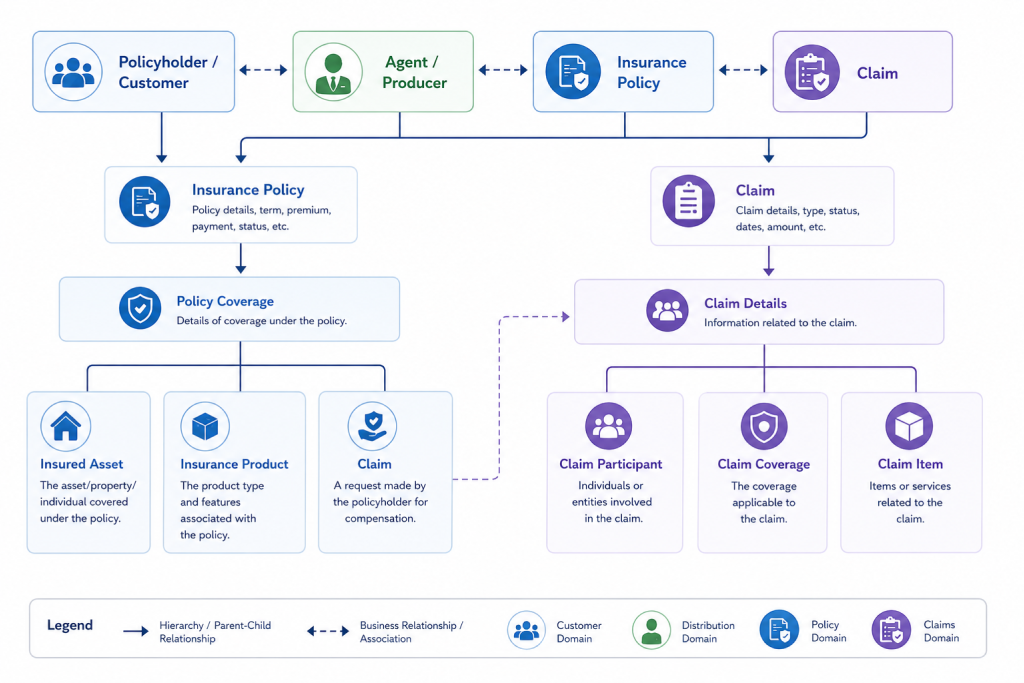
Policyholder → Policy → Coverage → Insured Asset → Claim → Claim Participant → Agent/Producer
at the same time.
The organization may also have multiple customer relationships across:
- Personal insurance
- Commercial insurance
- Life insurance
- Property and casualty
- Health-related insurance
- Employee benefits
- Brokerage
- MGA operations
This creates significant data and process complexity.
An industry-specific CRM helps create a foundation that is closer to how insurance businesses actually operate.
Salesforce Financial Services Cloud Insurance Data Model
The insurance data model is one of the most important areas to understand before implementing Salesforce for insurance.
Salesforce provides an insurance-specific data model designed to represent insurance customers, policies, claims, products, producers, and related information.
Instead of building every relationship from scratch, organizations can use Salesforce’s industry capabilities as a foundation and extend them according to their business requirements.
Common Insurance Data Entities
Depending on the Salesforce capabilities and implementation, an insurance solution may work with entities such as:
- Account
- Person Account
- Contact
- Insurance Policy
- Policy Participant
- Policy Coverage
- Insurance Product
- Claim
- Claim Participant
- Claim Coverage
- Asset
- Producer
- Quote
- Commission
- Relationship
- Household
These entities allow Salesforce to represent the relationships between customers, policies, coverages, claims, assets, and insurance professionals.
Why the Insurance Data Model Matters
Data architecture has a direct impact on:
- Reporting
- Customer 360
- Service workflows
- Automation
- AI
- Integrations
- Data migration
- Analytics
- Future Salesforce expansion
A poorly designed data model can create problems later when an insurer tries to introduce automation, Agentforce, portals, analytics, or additional Salesforce products.
That is why data-model planning should happen early in an FSC implementation rather than after configuration has already begun.
Customer 360 for Insurance
Insurance customers often interact with multiple departments throughout their relationship with an insurer.
A customer may:
- Request a quote.
- Purchase a policy.
- Contact customer service.
- Change coverage.
- Add an insured asset.
- Report a claim.
- Communicate with an adjuster.
- Renew the policy.
- Purchase another insurance product.
If each interaction is stored in a different system, employees may struggle to understand the complete customer relationship.
Salesforce Financial Services Cloud helps bring relevant customer information into a connected CRM environment.
This can support a more complete view of:
- Customer profile
- Policies
- Claims
- Coverages
- Assets
- Interactions
- Service cases
- Relationships
- Life events
- Business milestones
Salesforce’s insurance capabilities include customer profiles, relationship management, customer interactions, life events, onboarding, service capabilities, and an Insurance Agents Console.
Salesforce for Insurance Policy Management
Policy information is central to almost every insurance relationship.
Service representatives may need to answer questions such as:
- What policies does this customer have?
- Which coverage applies?
- When does the policy expire?
- Which assets are insured?
- What claims are associated with the policy?
- Which agent manages the account?
- What recent service interactions occurred?
Salesforce’s Financial Services Cloud insurance capabilities can provide representatives with policy and claim information within the customer context.
The Salesforce Financial Services Cloud administration documentation describes policy and claim components that can surface relevant policy and claim details for agents and allow organizations to configure which information is displayed.
For deeper policy-administration requirements, Salesforce Digital Insurance adds capabilities for managing policy lifecycle activities such as changes, cancellations, and automated renewals.
This distinction is important.
FSC can provide the customer and relationship context around insurance policies, while Digital Insurance extends Salesforce into deeper policy administration capabilities.
Salesforce for Insurance Claims Management
Claims are one of the most important moments in the insurance customer journey.
When a customer reports a loss, the service team needs to quickly understand:
- Who is the customer?
- Which policy is involved?
- What coverage applies?
- What happened?
- Who are the claim participants?
- What assets are involved?
- What information has already been collected?
- What actions need to happen next?
Salesforce supports insurance claims processes through its industry data model and insurance capabilities.
Salesforce’s Agentforce capabilities can also support claims service workflows. The Claims Service Employee Assistance agent can help customer service representatives identify the account, select the relevant policy, collect incident details, create the claim, add participants and items, and draft customer-facing communications.
Salesforce Digital Insurance goes further into claims operations with capabilities covering claims intake, adjudication, reserves, and payments.
Example Insurance Claims Workflow
A simplified workflow could look like:
Customer reports loss
↓
Service representative identifies policyholder
↓
Relevant policy is located
↓
Coverage information is reviewed
↓
Incident information is collected
↓
Claim is created
↓
Participants and claim items are added
↓
Claim workflow is initiated
↓
Customer communication is generated
↓
Claim progresses through adjudication and settlement
The exact architecture depends on the insurer’s Salesforce products, core claims platform, integrations, and operating model.
Salesforce Insurance Agent and Broker Management
Insurance organizations frequently depend on agents, brokers, producers, account managers, and other distribution professionals.
A CRM needs to manage not only policyholders but also the professionals responsible for acquiring and servicing those relationships.
Salesforce can help organizations connect:
- Customers
- Producers
- Agents
- Brokers
- Policies
- Accounts
- Service activities
- Commissions
- Relationships
For insurance brokerages, Salesforce also offers a dedicated Financial Services Cloud for Insurance Brokerages capability designed around producers and account managers. Salesforce positions this offering around creating a complete customer view across producers and account managers.
This makes Salesforce relevant to more than traditional insurance carriers.
It can also be considered by:
- Insurance brokerages
- Agencies
- MGAs
- Distribution organizations
- Employee benefits organizations
- Producer networks
Insurance Customer Service with Salesforce
Customer service is one of the most practical areas for Salesforce FSC.
Insurance service teams may handle:
- Policy questions
- Coverage inquiries
- Address changes
- Documentation requests
- Quote questions
- Claims inquiries
- Renewal questions
- Billing-related requests
- Proof-of-insurance requests
- General account servicing
A connected customer view can help representatives spend less time searching across systems.
Salesforce’s current Insurance Service Assistance capability uses the insurance data model to provide representatives with summaries of policyholder portfolios, individual insurance quotes, policies, assets, and coverages.
This is particularly relevant as insurance organizations move from traditional CRM automation toward AI-assisted service.
Agentforce for Insurance
Agentforce is becoming an increasingly important part of Salesforce’s financial-services strategy.
Salesforce describes Agentforce for Financial Services as a collection of AI capabilities designed to help financial-services teams automate routine tasks, generate insights, and improve service productivity.
For insurance, Salesforce provides capabilities including Insurance Service Assistance and Claims Service Employee Assistance.
Insurance Service Assistance
Insurance representatives can use AI assistance to access summaries of policyholder portfolios, policies, coverages, quotes, and related information.
Claims Service Employee Assistance
Claims-related service representatives can receive assistance during first notice of loss workflows, including identifying the account, selecting the policy, collecting incident details, creating a claim, adding participants and items, and drafting communications.
Proof of Insurance
Salesforce’s recent insurance capabilities also include AI-assisted generation of proof-of-insurance documents using the Salesforce Insurance data model.
These examples demonstrate where AI can be useful in insurance: not simply generating text, but assisting employees with structured, repeatable processes.
Salesforce Digital Insurance vs Financial Services Cloud for Insurance
This is one of the most important distinctions for insurance technology buyers.
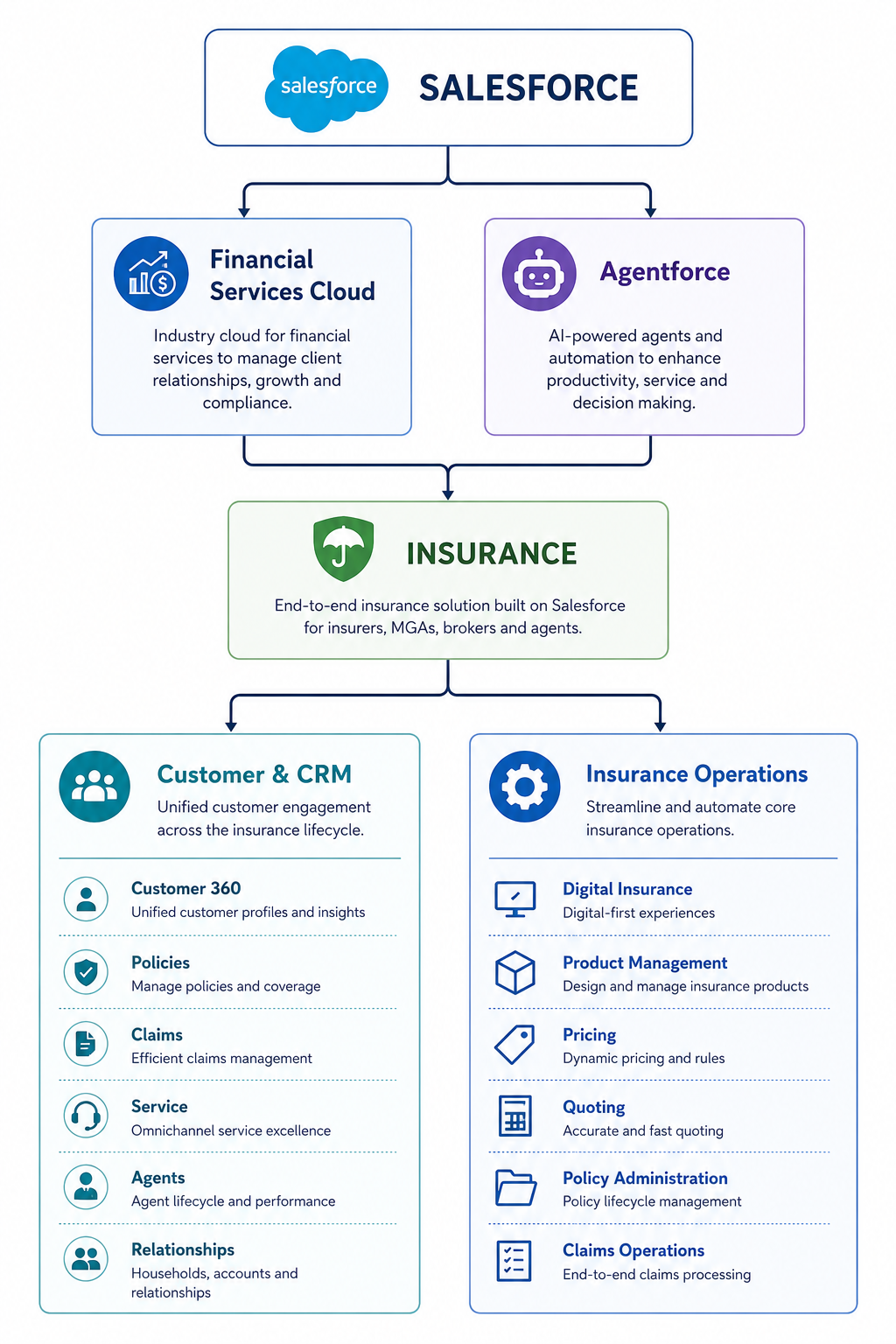
The terms Financial Services Cloud, Insurance for Financial Services, and Digital Insurance can appear together, but they address different layers of an insurance technology architecture.
| Capability | Financial Services Cloud / Insurance | Digital Insurance |
|---|---|---|
| Customer 360 | Yes | Yes |
| Insurance customer relationships | Yes | Yes |
| Insurance data model | Yes | Yes |
| Customer service | Yes | Yes |
| Agentforce | Yes | Yes |
| Insurance quoting | Depending on architecture | Yes |
| Product management | Limited/related capabilities | Yes |
| Rating | Depends on solution architecture | Yes |
| Policy administration | Customer/context focused | Yes |
| Claims lifecycle | Industry CRM/service capabilities | Yes |
| Claims adjudication | Depends on implementation | Yes |
| Reserves & payments | Depends on implementation | Yes |
| Group benefits | Related capabilities | Yes |
Salesforce Digital Insurance supports core insurance operations such as product management, pricing, quoting, policy administration, claims, and group benefits.
However, implementing Financial Services Cloud does not necessarily mean replacing existing core insurance systems. Insurers should determine which processes Salesforce will manage, which will remain in existing systems, and which should be integrated.
Salesforce FSC Insurance Integrations
Most established insurance organizations already have multiple enterprise systems.
These can include:
- Policy administration systems
- Claims management platforms
- Billing systems
- Underwriting platforms
- Rating engines
- Document management systems
- ERP platforms
- Payment systems
- Data warehouses
- Identity platforms
- Customer portals
- Marketing platforms
- Analytics systems
Salesforce can act as a customer and engagement layer while integrating with these systems.
For example:
Policy Administration System
↓
Integration Layer / APIs
↓
Salesforce Financial Services Cloud
↓
Customer Service / Agent / Broker
This architecture allows Salesforce to provide customer-facing context without necessarily requiring the organization to replace every existing insurance core platform.
Salesforce also positions Digital Insurance as capable of working with existing core claims systems, supporting an end-to-end solution or integrated digital capabilities depending on the organization’s requirements.
Salesforce FSC Data Migration for Insurance
Data migration is often one of the most challenging parts of an insurance CRM implementation.
Legacy insurance systems may contain:
- Customer records
- Policy records
- Historical policies
- Claims
- Coverage information
- Agent information
- Producer records
- Addresses
- Communication history
- Documents
- Financial information
The challenge is not simply moving records from one database to another.
The organization must determine:
- Which data needs to be migrated.
- Which data should be archived.
- Which records are duplicates.
- How legacy fields map to the Salesforce insurance data model.
- How historical relationships should be preserved.
- How data quality will be validated.
- Which integrations depend on the migrated records.
A strong migration process normally includes:
Discovery → Data profiling → Mapping → Cleansing → Transformation → Migration → Validation → Reconciliation
For insurance organizations, this becomes particularly important because policy and claim relationships must remain accurate.
Agentforce Financial Services Insurance Implementation
A successful implementation requires more than configuring Salesforce screens.
A typical implementation should address several layers.
1. Business Discovery
Understand:
- Current processes
- Users
- Customer journeys
- Policy workflows
- Claims workflows
- Service processes
- Distribution processes
- Regulatory requirements
2. Solution Architecture
Determine:
- What Salesforce will manage
- What existing systems will manage
- Integration architecture
- Data ownership
- Security model
- Automation strategy
3. Data Model
Define how customers, policies, claims, coverages, assets, agents, and relationships will be represented.
4. Configuration and Customization
Configure Salesforce capabilities and build only the customization that is genuinely required.
5. Integration
Connect Salesforce with policy, claims, billing, ERP, identity, document, and other enterprise systems.
6. Data Migration
Clean, transform, migrate, and validate legacy information.
7. Testing
Test:
- Business processes
- Integrations
- Security
- Data
- Automation
- User experience
- Performance
8. User Adoption
Train:
- Service representatives
- Agents
- Brokers
- Managers
- Administrators
- Operations teams
9. Optimization
After launch, monitor usage, business outcomes, automation, data quality, and user feedback.
Benefits of Salesforce Financial Services Cloud for Insurance
1. Connected Customer Information
Insurance teams can access customer information, policies, claims, relationships, and interactions from a connected Salesforce environment.
2. Better Customer Service
Representatives can spend less time switching between systems and more time resolving customer requests.
3. Industry-Specific Data
The insurance data model provides a foundation for representing insurance-specific relationships.
4. Workflow Automation
Salesforce Flow and related automation capabilities can reduce repetitive manual tasks.
5. AI-Assisted Service
Agentforce can assist representatives with policy, quote, claims, and service workflows.
6. Improved Agent and Broker Visibility
Insurance organizations can connect distribution relationships with customers, policies, and business activities.
7. Integration with Existing Technology
Salesforce can be integrated with existing insurance and enterprise applications rather than requiring every legacy platform to be replaced.
8. Scalable Customer Experience
Organizations can extend Salesforce across service, portals, data, marketing, analytics, and AI capabilities as requirements evolve.
Challenges to Consider Before Implementing Salesforce for Insurance
Salesforce is powerful, but implementation complexity should not be underestimated.
Data Complexity
Insurance data often exists across multiple legacy systems.
Integration Complexity
Core insurance platforms may use different APIs, data structures, and integration patterns.
Customization
Excessive customization can increase maintenance costs and reduce upgrade flexibility.
Regulatory Requirements
Insurance organizations need appropriate controls for data access, privacy, auditability, and regulatory obligations.
User Adoption
A technically successful implementation can still fail if agents, brokers, service representatives, and administrators do not adopt the new processes.
AI Governance
Organizations introducing Agentforce should establish appropriate governance around permissions, data access, human oversight, testing, and responsible AI usage.
How Much Does Salesforce Financial Services Cloud for Insurance Cost?
There is no single implementation price for Salesforce FSC for insurance.
The overall cost can depend on:
- Salesforce licensing
- Number of users
- Financial Services Cloud capabilities
- Digital Insurance requirements
- Agentforce requirements
- Data migration
- Integrations
- Custom development
- Existing Salesforce architecture
- Testing
- Training
- Change management
- Ongoing support
Salesforce also structures some Digital Insurance capabilities around usage-based components, including policy administration, claims management, and group benefits.
For this reason, organizations should avoid comparing implementation projects using license price alone.
A better approach is to evaluate:
Total cost of ownership + implementation complexity + operational benefits + scalability.
Is Salesforce Financial Services Cloud Right for Your Insurance Business?
Salesforce FSC can be a strong option for insurance organizations that want to improve customer relationship management, service, data visibility, automation, and employee productivity.
It can be particularly valuable when an organization needs to connect:
Customers + Policies + Claims + Agents + Service + Data + AI
However, the correct architecture depends on the organization’s existing technology landscape.
Before starting a project, ask:
- Do we need a CRM modernization?
- Do we need deeper policy administration?
- Do we need a claims platform?
- Which core systems should remain?
- What data needs to move to Salesforce?
- Which systems need real-time integration?
- Which processes should be automated?
- Where can Agentforce provide measurable value?
- What should our customer and policy data model look like?
- How will security and governance be managed?
The answers should determine the Salesforce architecture—not the other way around.
How Perigeon Helps Insurance Companies with Salesforce Financial Services Cloud
Implementing Salesforce in insurance requires a combination of Salesforce expertise, insurance-process understanding, data architecture, integration experience, and implementation discipline.
Perigeon helps financial-services organizations plan, implement, customize, integrate, migrate, and optimize Salesforce Financial Services Cloud. Its current Financial Services Cloud offering specifically covers insurance-related processes involving policyholders, agents, brokers, service, and claims.
Services include:
- Salesforce Financial Services Cloud consulting
- FSC implementation
- Custom Financial Services Cloud solutions
- Salesforce integration
- Financial Services Cloud data migration
- Workflow and automation
- Agentforce for Financial Services
- Ongoing Salesforce support and optimization
For insurance organizations evaluating Salesforce, the right implementation strategy starts with understanding the existing business processes and technology landscape.
Final Thoughts
Salesforce Financial Services Cloud helps insurers connect customer data, policies, claims, service, agents, automation, and AI within a modern CRM ecosystem.
With Agentforce adding AI-powered capabilities and Salesforce Digital Insurance supporting deeper insurance operations, Salesforce offers insurers a scalable platform for modernizing customer and insurance processes.
Before implementation, insurers should define their business architecture, data model, integrations, and customer experience to ensure Salesforce supports their long-term goals.