


Australia is investing in a more productive, technology-enabled manufacturing future.
The country’s National Robotics Strategy highlights robotics and automation as important technologies for improving productivity, strengthening manufacturing, addressing workforce pressures, and building Australia’s technology capabilities. The strategy also focuses on increasing the adoption of robotics and automation across Australian industries.
But advanced manufacturing is not only about machines on the factory floor.
It also depends on what happens before production, between production teams and suppliers, and after products reach customers.
This is where connected business platforms such as Salesforce Manufacturing Cloud can play a role.
Advanced Manufacturing Is About More Than Automation
Robotics, automation, AI, and connected machinery often dominate discussions about advanced manufacturing.
However, a manufacturer can automate production and still have disconnected:
- Customer data
- Sales forecasts
- Supplier information
- Distributor relationships
- Service records
- ERP data
- Production planning
That creates a gap between physical manufacturing and business decision-making.
Australia’s National Robotics Strategy specifically focuses on building a collaborative robotics and automation ecosystem, increasing adoption, developing capabilities, and supporting commercialization.
For manufacturers, this creates a broader digital transformation question:
How do you connect the information surrounding the factory with the people and systems making business decisions?
4 Ways Manufacturing Cloud Can Support Australian Manufacturers
1. Connect Demand With Forecasting
Manufacturers need to understand what customers and distributors are likely to order.
Manufacturing Cloud provides forecasting capabilities that can help sales and operations teams work with a more connected view of expected demand.
This can support better conversations around:
- Expected sales volumes
- Customer demand
- Product requirements
- Revenue forecasts
- Future production needs
The goal is not to replace production planning systems, but to provide better commercial visibility that can support planning. More detail on these forecasting capabilities is available through our Salesforce Manufacturing Cloud implementation work.
2. Bring Sales Agreements Into One Place
Manufacturers often work with long-term customer and distributor agreements.
Manufacturing Cloud provides Sales Agreements to help organizations track planned and actual business performance.
Instead of managing commitments through disconnected spreadsheets, teams can gain visibility into agreement-related information alongside customer and sales data.
This can make it easier to identify changes between what was planned and what is actually happening.
3. Connect CRM With ERP
Advanced manufacturers typically already have ERP systems managing critical operational processes.
Salesforce does not necessarily need to replace those systems.
Instead:
Salesforce → Customers, sales, agreements, forecasts, service
ERP → Inventory, purchasing, finance, production, orders
Integration between the two can create a connected flow of information.
Salesforce also highlights ERP and Order Management integration for Manufacturing Cloud processes such as sales agreement performance tracking.
4. Support Partner Collaboration
Manufacturers depend on distributors, dealers, suppliers, and service partners.
A connected Salesforce environment can help organizations manage these relationships alongside customer and sales information.
Depending on the architecture, manufacturers can use Salesforce capabilities to support partner collaboration, forecasting, service, and information sharing. Practical examples of this approach appear in our insights on distributor collaboration in manufacturing.
What This Could Look Like in an Australian Manufacturing Business
Consider an Australian equipment manufacturer supplying products through distributors.
A customer demand increase is detected.
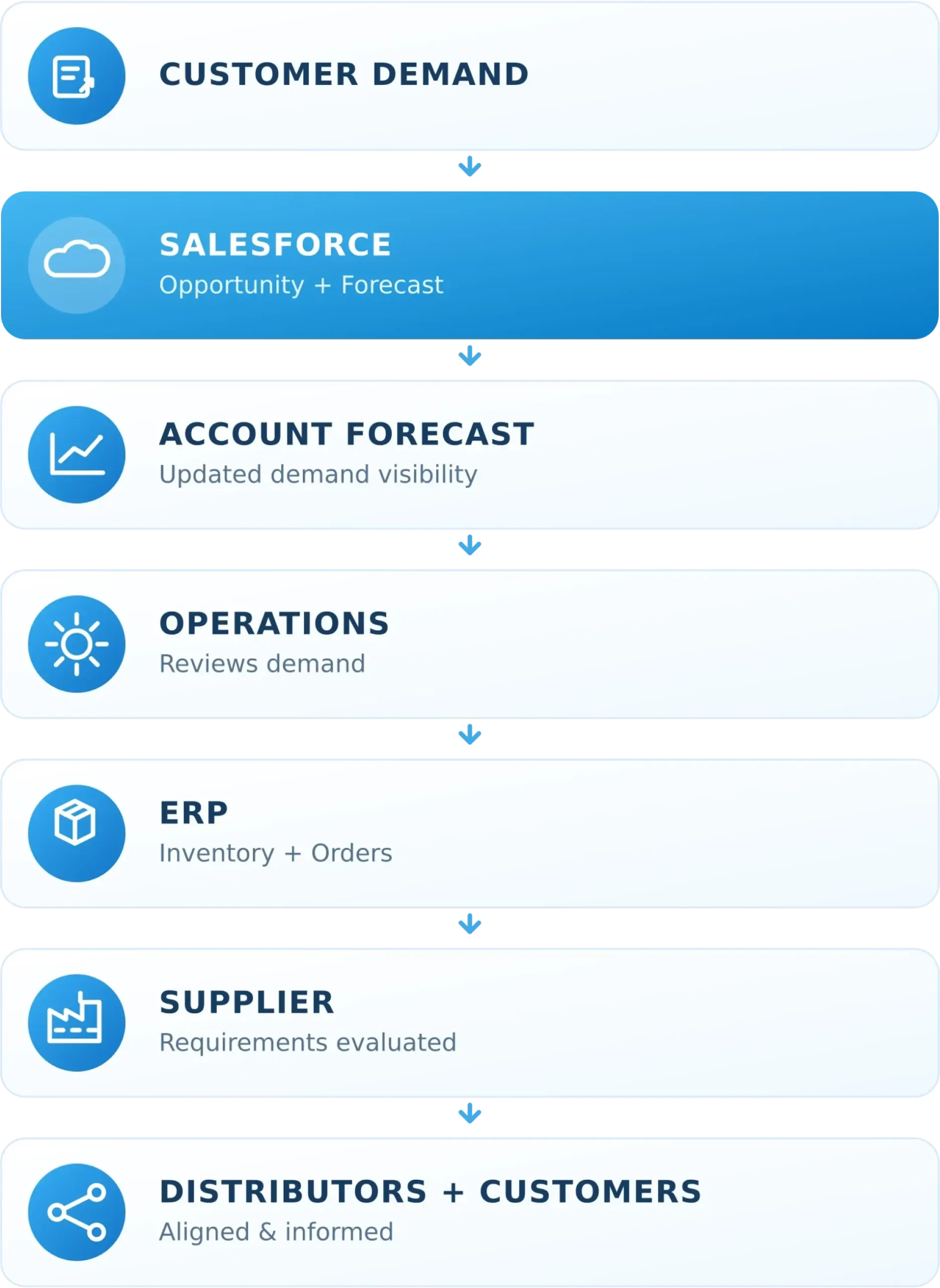
Instead of the information remaining with the sales team, a connected process could allow the signal to flow through the organization:
Customer demand
↓
Salesforce opportunity and forecast
↓
Account forecast updated
↓
Operations reviews expected demand
↓
ERP handles inventory/order requirements
↓
Supplier requirements are evaluated
↓
Customer and distributor teams remain aligned
The technology architecture will vary by organization, but the principle is simple:
Make business information available where it can influence the next decision.
Salesforce Manufacturing Cloud and Australia’s Advanced Manufacturing Goals
There is a natural connection between the broader direction of Australian manufacturing and the capabilities of a connected manufacturing CRM.
| Advanced Manufacturing Need | Salesforce Manufacturing Cloud Role |
|---|---|
| Better productivity | Workflow and process automation |
| Data-driven decisions | Manufacturing analytics and visibility |
| Demand responsiveness | Forecasting and account intelligence |
| Stronger partner networks | Distributor and partner collaboration |
| Connected systems | CRM and enterprise integrations |
| Better customer relationships | Unified customer and service information |
| Scalable digital processes | Salesforce platform and industry capabilities |
Salesforce can instead serve as one component of the broader digital infrastructure supporting manufacturers.
What Manufacturers Should Prioritize Before Implementing Salesforce
Technology should follow the operating model.
Before implementing Salesforce Manufacturing Cloud, manufacturers should establish:
A clear data strategy
Identify which system owns customer, product, order, inventory, supplier, and financial information.
Connected workflows
Map how information moves between sales, operations, service, partners, and ERP.
Integration priorities
Start with the systems that have the greatest impact on business visibility.
User adoption
A sophisticated platform creates limited value if employees continue using disconnected spreadsheets and manual processes.
Scalable architecture
Design Salesforce around future products, markets, distributors, and business units rather than only today’s requirements.
Perigeon’s Salesforce manufacturing practice focuses on connecting sales, service, marketing, operations, forecasting, and business systems through Salesforce. Additional context on industry-specific applications can be found in our discussion of mining supply chain visibility.
Building the Digital Layer Around Advanced Manufacturing
Australia’s advanced manufacturing ambitions require more than advanced machinery.
Manufacturers also need connected information, responsive processes, better collaboration, and scalable digital infrastructure.
Salesforce Manufacturing Cloud can contribute to this layer by connecting customer demand, sales agreements, forecasting, service, partner relationships, analytics, and enterprise systems.
For manufacturers considering this transition, Perigeon’s Salesforce consulting for manufacturing can help map business requirements to Salesforce capabilities, integrations, and scalable CRM architecture.
The objective is not to digitize everything at once.
It is to connect the right information, automate the right processes, and give the right teams visibility when they need it.
Final Thoughts
Australia’s manufacturing future is increasingly connected to automation, technology adoption, productivity, innovation, and stronger industrial capabilities.
But the factory is only one part of that transformation.
The businesses that support advanced manufacturing also need connected sales processes, accurate demand visibility, integrated systems, collaborative partner networks, and scalable digital workflows.
Salesforce Manufacturing Cloud can provide part of that digital foundation, helping manufacturers connect the commercial and operational information surrounding their production environment.
For Australian manufacturers, the opportunity is not simply to adopt another CRM. It is to build a more connected digital operating model around the manufacturing business.