
Demand forecasting is one of the most important planning activities for manufacturers. When forecasts are inaccurate, businesses can end up with excess inventory, production bottlenecks, missed orders, or unnecessary pressure on procurement teams.
For Canadian manufacturers managing multiple customers, distributors, product lines, and regions, forecasting becomes even more complex. Sales information may sit in CRM systems, order data in ERP platforms, and customer commitments in spreadsheets or disconnected processes.
Salesforce Manufacturing Cloud can help bring these signals together, giving manufacturers a more connected view of demand, sales agreements, opportunities, and account forecasts. Salesforce describes Manufacturing Cloud as a platform for connecting opportunities with demand forecasts and providing visibility across the manufacturing value chain.
How Does Salesforce Improve Manufacturing Demand Forecasting?
Salesforce Manufacturing Cloud improves demand forecasting by connecting sales agreements, opportunities, orders, account forecasts, and operational information in a shared environment.
For Canadian manufacturers, this can help teams:
- Combine current business with new sales opportunities
- Track planned and actual customer demand
- Build account-level forecasts
- Bring sales and operations teams closer together
- Connect forecast information with ERP and planning systems
- Identify changes in customer demand earlier
- Improve visibility across distributors and customer accounts
Salesforce’s current documentation also highlights Advanced Account Forecasting, which can use opportunities, orders, sales agreements, historical orders, and custom measures to create multi-horizon forecasts.
Why Demand Forecasting Is Challenging for Canadian Manufacturers
Canadian manufacturers operate across diverse markets and supply chains. A manufacturer may sell directly to customers in Ontario and Quebec while also relying on distributors across Western Canada or exporting to the United States.
That creates several forecasting questions:
- Is the latest customer demand reflected in the forecast?
- Are sales agreements being considered?
- Have distributors changed their expected volumes?
- Are open opportunities realistic?
- Can operations see changes early enough to respond?
- Is the forecast connected to inventory and production planning?
The challenge is often not a lack of data. It is getting the right data together at the right time.
When sales, customer commitments, orders, and operational information remain separated, forecasting can become dependent on manual updates and spreadsheet consolidation.
From Sales Pipeline to Demand Signal
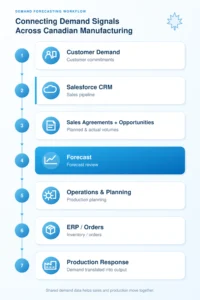
One of the biggest advantages of a manufacturing-focused CRM is that forecasting does not have to start with a spreadsheet.
Manufacturing Cloud can bring together information such as:
Sales opportunities → Sales agreements → Orders → Forecast calculations → Operations planning
Salesforce explains that its manufacturing forecasting capabilities can use sources such as opportunities, orders, sales agreements, historical orders, and other measures depending on the forecasting configuration.
This creates a more connected forecasting process.
For example, suppose a Canadian industrial equipment manufacturer expects increased orders from a major distributor.
The sales team can capture the opportunity and customer commitment in Salesforce. Forecast information can then be used by account, product, period, or other relevant dimensions, helping operations understand the potential demand instead of waiting for information to arrive through separate spreadsheets or emails.
Three Ways Canadian Manufacturers Can Improve Forecasting
Connect Customer Commitments With Forecasts
Customer agreements can contain valuable information about expected volumes, revenue, pricing, and future demand.
Manufacturing Cloud supports sales agreements with time-phased metrics such as planned quantities and actual orders. Salesforce also supports tracking agreement performance using information from ERP or Order Management systems.
This matters because historical orders alone may not tell the complete story.
A customer may have:
- A recurring purchasing pattern
- A long-term agreement
- An active opportunity
- A planned volume increase
- A change in product requirements
Bringing these signals together gives forecasting teams more context. Practical configuration approaches are covered in our Manufacturing Cloud implementation services.
Give Sales and Operations the Same Forecast
Forecast accuracy is not only a sales responsibility.
Sales teams understand customer conversations and pipeline changes. Operations teams understand production capacity, inventory, procurement, and fulfillment requirements.
When these teams work from different numbers, even a well-designed forecast can become difficult to act on.
Manufacturing Cloud’s forecasting capabilities are designed to support collaboration between sales, operations, product teams, and distribution partners.
For a Canadian manufacturer, this can create a workflow where:
Sales identifies demand → Forecast is updated → Operations reviews the impact → Planning teams respond
The exact workflow will depend on the company’s ERP, production model, and planning processes. Broader industry applications of this approach appear in our manufacturing industry solutions overview.
Connect CRM Forecasting With ERP Data
CRM data is only one part of manufacturing planning.
ERP systems often contain information about orders, inventory, pricing, purchasing, and other operational activities. Connecting these systems can help manufacturers avoid making forecasting decisions from an incomplete picture.
Salesforce states that its manufacturing forecasting capabilities can share consolidated forecast information with demand-planning and financial-planning systems.
This is where CRM + ERP integration becomes important.
Instead of replacing an existing ERP, Salesforce can become a connected layer for customer, sales, agreement, and forecasting information while relevant operational data continues to flow between systems.
For manufacturers evaluating this type of transformation, a tailored Salesforce manufacturing CRM solution can help align CRM capabilities with existing business processes.
A Practical Canadian Manufacturing Example
Consider a Canadian manufacturer supplying components to industrial distributors.
Historically, the company may forecast demand using:
- Previous-year sales
- Spreadsheet adjustments
- Sales representative estimates
- Distributor emails
- Open purchase orders
Now imagine those inputs are connected through a Salesforce-based process.
A distributor signals that demand will increase next quarter.
The sales team updates the relevant account information and opportunity. The forecast reflects the expected change. Operations can review the projected volume alongside existing commitments and orders.
The result is not necessarily a perfect forecast.
The benefit is better visibility into why the forecast changed and which customer or product signals are driving that change.
That distinction is important. Technology does not eliminate uncertainty in manufacturing demand. It can make the underlying information easier to access, collaborate on, and act upon.
What Should Manufacturers Evaluate Before Implementation?
Salesforce Manufacturing Cloud should be configured around the manufacturer’s actual forecasting process rather than simply reproducing an existing spreadsheet inside CRM.
Canadian manufacturers should consider:
Forecasting dimensions
Determine whether forecasts need to be viewed by account, product, region, period, distributor, or another business dimension.
Data sources
Identify which information should come from Salesforce, ERP, order management, historical sales, agreements, or other systems.
Forecast ownership
Define who creates, reviews, adjusts, and approves forecasts.
Planning cycles
Map the technology to existing weekly, monthly, quarterly, or annual planning processes.
Data quality
Forecasting depends on reliable underlying information. Duplicate accounts, outdated opportunities, incomplete product data, and inconsistent customer records can reduce confidence in forecast results.
Salesforce itself documents configuration considerations and limitations for account forecasting, reinforcing the need to design the forecasting model carefully during implementation.
Why Salesforce Manufacturing Cloud Fits a Connected Forecasting Strategy
The value of Manufacturing Cloud is not simply having another forecasting dashboard.
Its role is to connect customer relationships, sales agreements, opportunities, orders, forecasts, and operational processes so teams can work from a more consistent view of demand.
Salesforce’s Canadian Manufacturing Cloud offering positions the platform around demand forecasts, customer and distributor service, contextual data, AI, and analytics across the manufacturing value chain.
For Canadian manufacturers, this approach can support:
- More connected demand planning
- Better sales and operations collaboration
- Improved customer visibility
- Stronger distributor coordination
- More consistent forecast reviews
- Better integration between CRM and planning processes
The implementation approach should ultimately reflect the company’s products, customers, supply chain, ERP architecture, and forecasting methodology.
Final Takeaway
Demand forecasting will always involve uncertainty. Market conditions, customer behavior, supply constraints, and unexpected changes can affect even well-designed forecasts.
The goal is therefore not simply to produce a number.
It is to create a connected forecasting process where sales, customer commitments, orders, and operational information can be reviewed together.
For Canadian manufacturers, Salesforce Manufacturing Cloud provides capabilities that can support this approach through sales agreements, account forecasting, collaboration, and integration with enterprise planning systems.
With the right data model, integrations, and forecasting process, manufacturers can move from manually consolidating demand signals toward a more connected and actionable view of what customers may need next.