

Introduction
Diagnostic and imaging equipment manufacturers operate in one of the most complex segments of the healthcare industry. Unlike high-volume consumer goods production, these organizations manage long sales cycles, high-value equipment, multi-year service agreements, strict regulatory requirements, and extensive distributor networks.
As demand for advanced diagnostic technologies continues to grow, manufacturers face increasing pressure to improve forecasting accuracy, maintain distributor alignment, and manage complex customer contracts without sacrificing operational efficiency.
Salesforce Manufacturing Cloud helps address these challenges by connecting sales agreements, account-based forecasts, and channel partner insights within a unified platform. This enables healthcare equipment manufacturers to gain better visibility into revenue opportunities, improve production planning, and strengthen relationships across their distribution ecosystem.
Why Revenue Visibility Is a Major Challenge in Diagnostic & Imaging Manufacturing
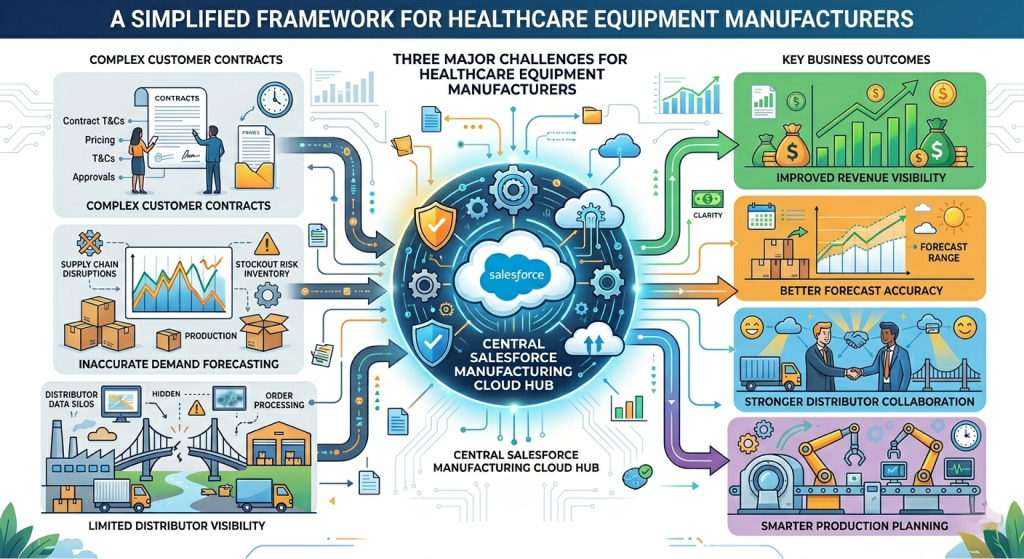
Healthcare equipment manufacturers face several interconnected challenges:
- Complex customer contracts with hospitals and healthcare networks
- Limited visibility into distributor-driven sales
- Inaccurate demand forecasting
- Long procurement and approval cycles
- Difficulty aligning sales commitments with production plans
When these processes operate in silos, organizations often struggle with inventory imbalances, delayed deliveries, and missed revenue opportunities.
Salesforce Manufacturing Cloud addresses these challenges by creating a connected framework that links customer agreements, forecasts, and distributor performance.
Managing Complex Contracts with Salesforce Manufacturing Cloud
Diagnostic and imaging equipment purchases frequently involve more than a one-time transaction. Contracts often include:
- Multi-year service agreements
- Preventive maintenance commitments
- Equipment upgrade schedules
- Warranty obligations
- Volume-based pricing structures
Managing these agreements through spreadsheets or disconnected systems can make it difficult to understand future revenue commitments and customer expectations.
Manufacturing Cloud allows organizations to track sales agreements in a structured manner, giving sales, operations, and finance teams access to a shared view of contractual obligations.
Key Benefits
- Improved visibility into customer commitments
- Better coordination between sales and production teams
- More accurate revenue projections
- Enhanced customer relationship management
By connecting contract data to operational planning, manufacturers can reduce uncertainty and improve decision-making.
How Manufacturing Cloud Improves Forecast Accuracy
Forecasting is particularly challenging in the healthcare equipment sector because purchasing decisions often involve lengthy approval processes, capital expenditure reviews, and changing healthcare priorities.
Traditional forecasting methods frequently rely on historical sales data and manual reporting. This can result in forecasting gaps when market conditions shift.
Salesforce Manufacturing Cloud introduces account-based forecasting, allowing manufacturers to create forecasts based on actual customer agreements and sales opportunities.
How It Helps
- Provides real-time forecast visibility
- Aligns sales forecasts with production planning
- Supports collaborative forecasting across teams
- Improves demand planning accuracy
Instead of relying solely on assumptions, manufacturers can build forecasts using customer-specific commitments and distributor insights.
This level of visibility helps organizations reduce excess inventory, minimize stock shortages, and optimize resource allocation.
Streamlining Distributor Networks in Diagnostic & Imaging Manufacturing
Many diagnostic equipment manufacturers depend heavily on distributors and channel partners to reach healthcare providers across different regions.
However, distributor management often presents several challenges:
- Delayed sales reporting
- Inconsistent forecasting practices
- Limited inventory visibility
- Difficulty measuring partner performance
Without accurate distributor data, forecasting becomes less reliable and production planning becomes more difficult.
Manufacturing Cloud helps centralize distributor information and creates a more collaborative environment between manufacturers and channel partners.
Benefits of Distributor Collaboration
- Better visibility into channel demand
- Improved sales forecasting accuracy
- Stronger partner relationships
- Faster response to market changes
- Enhanced inventory management
When distributor forecasts are integrated with customer agreements and sales forecasts, manufacturers gain a more complete view of future demand.
Connecting Contracts, Forecasts, and Distributors in a Single Ecosystem
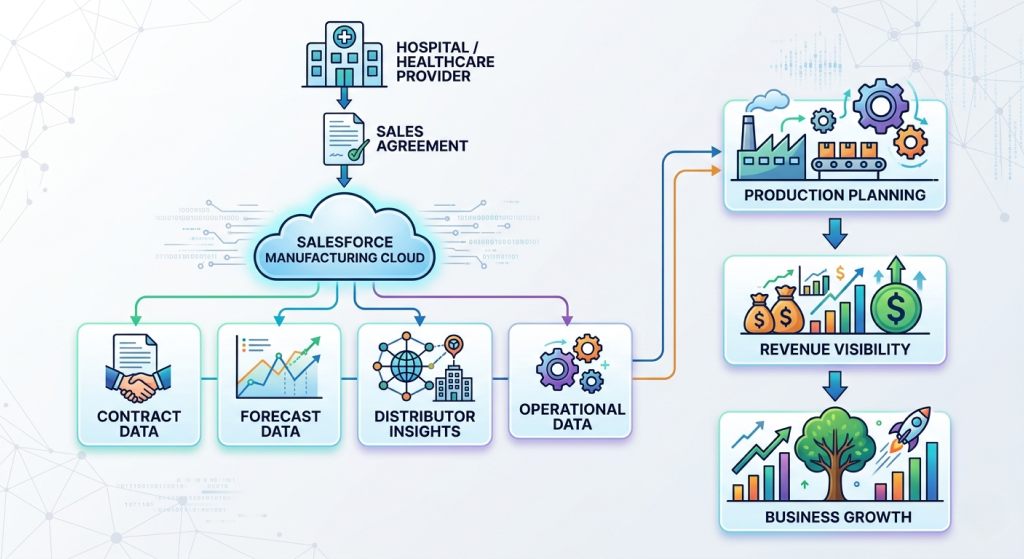
The real value of Salesforce Manufacturing Cloud emerges when these processes work together.
For example:
- A hospital signs a multi-year equipment agreement.
- The agreement automatically contributes to forecast planning.
- Distributor demand signals validate market expectations.
- Operations teams adjust production schedules accordingly.
- Leadership gains a more accurate view of future revenue.
This connected approach helps manufacturers move from reactive planning to proactive decision-making.
Benefits of Salesforce Manufacturing Cloud for Healthcare Equipment Manufacturers
Organizations that adopt Manufacturing Cloud can achieve several strategic advantages:
| Business Area | Impact |
|---|---|
| Contract Management | Improved visibility into customer commitments |
| Forecasting | More accurate demand predictions |
| Distributor Management | Better channel collaboration |
| Production Planning | Improved alignment with market demand |
| Revenue Visibility | Enhanced business forecasting |
| Customer Relationships | Stronger long-term partnerships |
Best Practices for Successful Implementation
To maximize value from Manufacturing Cloud:
- Standardize sales agreement processes
- Establish clear forecasting methodologies
- Encourage distributor participation
- Integrate forecasting with operational planning
- Monitor forecast accuracy regularly
- Use data-driven performance reviews
Organizations that treat forecasting, contracts, and channel management as connected processes often achieve better outcomes than those managing them separately.
The Role of Perigeon in Manufacturing Cloud Transformation
Implementing Salesforce Manufacturing Cloud requires more than deploying technology. Manufacturers must align sales agreements, forecasting processes, distributor collaboration, and operational planning to achieve measurable business outcomes.
As a salesforce manufacturing cloud development partner, Perigeon helps manufacturers design and implement scalable Manufacturing Cloud solutions that improve contract visibility, forecast accuracy, and channel collaboration while supporting long-term business growth.
Conclusion
Diagnostic and imaging equipment manufacturers face increasing pressure to improve visibility across contracts, forecasts, and distributor networks. Managing these processes independently often creates inefficiencies, forecasting errors, and missed growth opportunities.
Salesforce Manufacturing Cloud provides a unified platform that connects customer agreements, account-based forecasting, and distributor collaboration, enabling manufacturers to make more informed decisions and respond effectively to market demand.
For healthcare equipment manufacturers seeking greater operational alignment and revenue visibility, a connected approach to contract management, forecasting, and channel collaboration can become a significant competitive advantage.