


Salesforce Winter ’27 brings another major wave of innovation across the Salesforce platform, with new capabilities spanning Agentforce, AI, Data 360, automation, development, security, service, sales, and user experience.
For Salesforce admins, developers, consultants, and business leaders, the challenge isn’t finding the release notes. It’s identifying which Salesforce Winter ’27 new features are actually worth paying attention to.
In this guide, we’ve highlighted some of the most important Winter ’27 features and updates, with a focus on what they do and why they matter.
Salesforce’s official Winter ’27 release notes are now available, and Salesforce’s sandbox preview guidance provides early access so teams can test their configurations before production upgrades.
Note: Feature availability can vary by product, edition, license, and release status. Some capabilities are generally available, while others are Beta, Preview, or require administrator setup. Always check the official Salesforce release notes before enabling a feature in production.
What’s New in Salesforce Winter ’27?
The Winter ’27 release continues several major Salesforce trends:
- AI agents becoming part of everyday business processes
- Greater integration between Agentforce and enterprise data
- More powerful Data 360 capabilities
- AI-assisted development and administration
- Stronger security controls
- Better service experiences
- Improved Salesforce platform management
- More industry-specific Agentforce capabilities
Let’s look at the features that stand out.
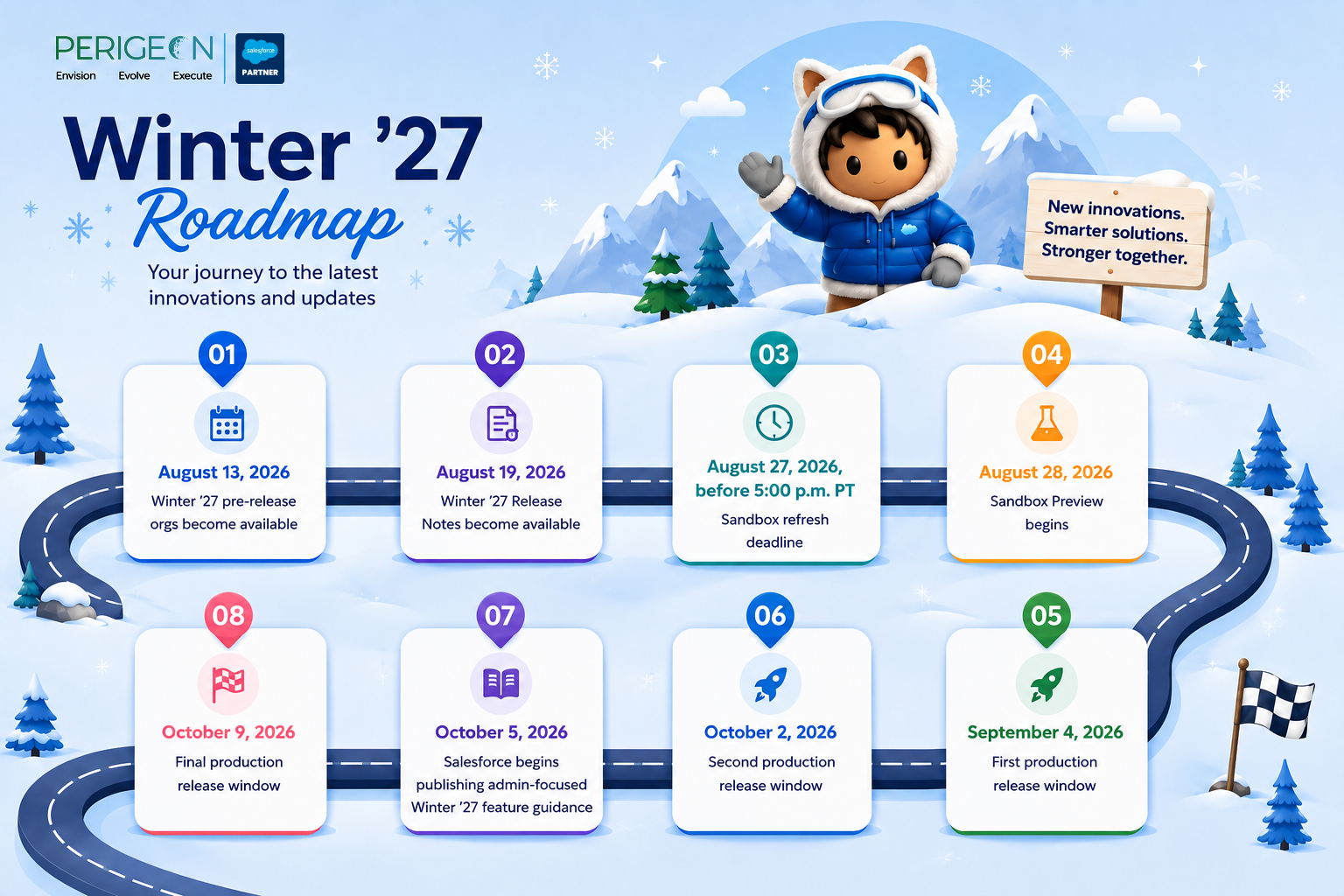
Salesforce Winter ’27: Important Dates
Salesforce rolls out each major release in phases based on the instance on which an organization is hosted.
1. Agentforce Expands Its AI Capabilities
Agentforce continues to be one of the biggest areas of innovation in Salesforce Winter ’27.
Salesforce is expanding Agentforce beyond individual conversational experiences and making it more deeply connected to business processes, data, security, and other Salesforce capabilities.
Winter ’27 includes capabilities around Agentforce observability, agent interoperability, voice experiences, multilingual conversations, and improved agent management. Salesforce’s feature-availability documentation lists capabilities such as Agentforce Observability, MCP interoperability, improved Agentforce Voice, and support for more languages.
Why it matters
Businesses are moving from simply asking AI to generate content toward using AI agents to perform defined business tasks.
That means Salesforce teams can start thinking about:
- Which processes can be delegated to agents?
- What data should an agent access?
- Which actions should require approval?
- How should agent performance be monitored?
- How can AI work alongside existing Flow and Apex automation?
The important shift is from AI assistance to AI-enabled business processes.
2. Salesforce Flow: The Biggest Update in Years
Flow gets one of its most substantial refreshes in recent releases. Admins and developers get real quality-of-life wins alongside new governance tools:
- Flow Tags: Organize and find flows faster by tagging them, instead of relying on naming conventions alone.
- Unused Resources filter: Instantly see which variables and resources in a flow are no longer used or missing descriptions — useful for cleanup before handovers.
- Collapsible flow sections: Group and label sections of a flow, then collapse or expand them to focus on the part you’re working on.
- Split by Field Value element: A new element that lets you branch flow logic based on a specific field’s value, similar to a switch-case, without stacking multiple Decision elements.
- Flow Test Mode and reusable test scenarios: Save test scenarios, run automated assertions, use isolated test data, and track test coverage — bringing proper testing discipline to declarative automation.
- Multi-record screen flow launches: Launch screen flows for multiple selected records directly from list views and related lists, passing record IDs as a collection variable.
- Modernized Flow Builder UI: A refreshed canvas with a new resource menu, grouped elements, and a customizable builder experience.
- New Time screen component: Capture time input directly, without the old picklist workaround.
3. Agentforce Interoperability with MCP
One of the most important developments in Salesforce’s AI strategy is the use of the Model Context Protocol (MCP).
Salesforce is expanding Agentforce interoperability through MCP, giving agents a standardized way to discover and interact with approved tools and capabilities.
Salesforce’s developer documentation describes Hosted MCP Servers as a way to connect MCP-compatible AI clients to Salesforce data and automation through governed, authenticated connections.
Why it matters
MCP can help connect Salesforce with a broader AI ecosystem.
Instead of keeping AI functionality inside a single application, organizations can build more connected workflows between:
AI agents → Salesforce → business data → business actions
This can be especially relevant for organizations building enterprise AI solutions that need controlled access to CRM data and actions.
4. Agentforce Observability Gets More Attention
As businesses deploy more AI agents, knowing what those agents are doing becomes just as important as building them.
Winter ’27 includes Agentforce observability capabilities designed to give teams better insight into agent activity and performance. Salesforce lists refined agent analytics and custom scorers among its Agentforce capabilities, with some observability features available as Beta.
Why it matters
Enterprise AI needs more than impressive demos.
Organizations need to understand:
- How agents are performing
- Where agents fail
- How users interact with agents
- Whether agents are producing useful outcomes
- Which processes need improvement
Observability provides the foundation for managing AI agents more responsibly at scale.
5. Agentforce Voice Becomes More Natural
Voice continues to become an important part of Salesforce’s AI experience.
Salesforce’s current feature documentation highlights sharper transcription and more natural voice for Agentforce Voice.
Why it matters
Voice can make AI interactions more natural for customer service and other conversational use cases.
Instead of requiring users to type every request, voice-enabled agents can support more natural interactions.
Potential use cases include:
- Customer support
- Service requests
- Employee assistance
- Voice-based information retrieval
- Guided troubleshooting
As voice quality improves, the focus shifts from whether AI can understand speech to whether it can complete useful business tasks through conversation.
6. Agentforce Supports More Languages
Salesforce is also expanding language support for Agentforce.
The Winter ’27 feature documentation includes the ability to chat with Agentforce in 24 additional languages, currently listed as Beta.
Why it matters
Global organizations often have customers and employees working across multiple languages.
Expanded language support can make AI experiences more accessible without requiring every interaction to be limited to English.
For international Salesforce implementations, this can be particularly valuable for:
- Customer service
- Employee support
- Self-service
- Global sales operations
- Regional service teams
Salesforce Winter ’27 Data 360 Features
7. Execute Data 360 SQL Queries from Apex
Data is at the center of Salesforce’s AI strategy, and Winter ’27 continues to bring Data 360 closer to the development platform.
Salesforce’s release documentation identifies Execute SQL Queries from Apex, giving developers a way to execute Data 360 SQL queries from Apex.
Why it matters
Developers can use custom Apex logic together with Data 360 data capabilities.
This can open opportunities for:
- Data-driven applications
- Advanced automation
- AI-powered experiences
- Custom services
- Complex data processing
For developers, this is another step toward treating Salesforce data capabilities as part of the broader application platform rather than a separate analytics layer.
8. Easier Data 360 Governance Metadata Migration
Winter ’27 also improves the ability to move Data 360 governance metadata from sandbox environments to production.
Salesforce’s feature documentation includes Migrate Data 360 Governance Metadata from Sandbox to Production among the current Data 360 capabilities.
Why it matters
Moving configuration consistently between environments is important for teams managing larger Salesforce implementations.
It can help reduce manual configuration and make deployment processes more repeatable.
For enterprise teams, governance and deployment consistency become increasingly important as Data 360 becomes part of larger AI and CRM architectures.
9. Better Handling of Data 360 Ingestion Errors
Winter ’27 introduces Problem Records DLOs to help troubleshoot ingestion issues in Data 360.
The feature is designed to provide a more structured way to identify and work with problematic records during data ingestion.
Why it matters
Data quality directly affects analytics, automation, segmentation, and AI.
If bad or incomplete data enters the platform, downstream processes can produce unreliable results.
Better visibility into ingestion problems can help teams identify data-quality issues earlier.
10. Faster Data Activation with Rapid Publish
Salesforce is also improving the activation side of Data 360.
Winter ’27 includes Rapid Publish to Data 360 targets, allowing segments to be activated more quickly to supported destinations.
Why it matters
Data becomes more valuable when businesses can act on it quickly.
Faster activation can help organizations turn unified customer data into:
- Targeted audiences
- Personalized experiences
- Marketing actions
- Customer engagement
- AI-driven decisions
This is another example of Salesforce connecting data management with business execution.
Salesforce Winter ’27 Admin and Platform Features
11. More Granular List View Permissions
Salesforce is improving control over list view access.
The Winter ’27 feature documentation includes granular list view permissions, allowing organizations to give users more specific control over sharing and editing list views.
Why it matters
List views are heavily used in many Salesforce organizations.
However, giving users broad list-view permissions can provide more access than administrators actually want.
More granular permissions allow administrators to better balance:
User flexibility + administrative control
This is particularly useful for larger Salesforce environments with different user groups and governance requirements.
12. More Flexible Custom Fields on Standard Entities
Winter ’27 also expands what administrators can do with custom fields on standard Salesforce entities.
Salesforce lists Do More with Custom Fields on Standard Entities among its current customization capabilities.
Why it matters
Custom fields are fundamental to Salesforce customization.
Additional flexibility can help organizations model business-specific information without immediately requiring custom objects or custom development.
For admins, these improvements can make Salesforce configuration more adaptable while keeping solutions closer to the standard platform.
13. Better Management of Org Health and Usage
Salesforce is also adding capabilities that help administrators understand and manage their Salesforce environment.
Winter ’27 documentation includes features such as license utilization alerts and Beta capabilities for organization health and usage metrics.
Why it matters
As Salesforce environments grow, organizations need visibility into:
- License utilization
- Platform usage
- Configuration health
- Potential implementation risks
- Capacity planning
These capabilities can help administrators identify problems earlier rather than reacting after an issue becomes operationally significant.
Salesforce Winter ’27 Security Features
14. Enhanced Security Center Capabilities
Security Center continues to become more useful for Salesforce security teams.
Winter ’27 includes new alert metrics and Beta capabilities that extend Security Center with Agentforce-powered security investigation features. These include capabilities around anomaly triage, investigation timelines, risk scores, and remediation plans.
Why it matters
Security teams increasingly need to investigate large volumes of activity.
AI-assisted security capabilities can help organizations:
- Identify suspicious behavior
- Prioritize investigations
- Understand incidents
- Review risk
- Plan remediation
The key benefit is not replacing security teams with AI. It’s helping teams focus their attention on the most important risks.
15. Consolidated Field-Level Encryption Experience
Salesforce is also preparing for a more consolidated field-level encryption experience in Winter ’27.
The official feature documentation includes Prepare for a Consolidated Field-Level Encryption Experience in Winter ’27 as an administrator setup item.
Salesforce is also increasing the record limit for encryption synchronization.
Why it matters
Encryption becomes increasingly important as organizations store more sensitive customer and business information in Salesforce.
For organizations using Shield Platform Encryption, these changes are worth reviewing as part of the Winter ’27 upgrade process.
Salesforce Winter ’27 Service Features
16. Scale Service Assistant with Multiple Agents
Salesforce is continuing to expand Agentforce Service Assistant.
Winter ’27 includes the ability to scale Service Assistant across more of the business with multiple agents.
Why it matters
Customer service organizations rarely have a single type of customer request.
Different processes may require different specialized capabilities.
Multiple agents can provide a more structured approach where individual agents focus on specific tasks or service processes.
This can help organizations move toward more specialized and scalable AI-assisted service operations.
17. Dynamic, Real-Time Service Plans
Salesforce is also introducing capabilities around dynamic service plans that provide real-time issue-resolution guidance.
The Winter ’27 documentation lists Get Real-Time Issue Resolution with Dynamic Service Plans along with related capabilities for contextual guidance and agent actions. Some of these capabilities are listed as Preview.
Why it matters
Traditional service processes often depend on static knowledge articles and predefined checklists.
Dynamic service plans can move toward a more adaptive model where the recommended steps change based on the situation.
This could help service representatives resolve issues more efficiently while keeping AI assistance connected to defined business processes.
Salesforce Winter ’27 Industry Features
18. New Agentforce Capabilities for Manufacturing
For manufacturing organizations, Winter ’27 includes several industry-specific Agentforce capabilities.
Salesforce’s current feature documentation lists capabilities for warranty claims and coverage, dealer sales operations, order conversion from samples, and distributor procure-to-receive operations under Agentforce for Manufacturing.
Why it matters
Industry-specific AI is potentially more valuable than generic AI because it can be designed around real business processes.
For manufacturers, use cases can extend beyond simple questions and answers into processes such as:
- Warranty management
- Dealer operations
- Order management
- Distributor processes
- Service operations
This reflects Salesforce’s broader move toward industry-specific agentic workflows.
19. New Agentforce Capabilities for Education
Salesforce is also expanding Agentforce for Education.
Winter ’27 includes capabilities such as a Financial Aid Inquiry Agent, student financial planning tools, student recruitment capabilities, course search, transfer-credit estimates, and student goals. Several of these features require administrator setup, while some are generally available.
Why it matters
Educational institutions can use these capabilities to support students and staff across processes that traditionally require significant manual effort.
The broader trend is clear:
AI is moving from general-purpose assistance toward industry-specific workflows.
Salesforce Winter ’27 Marketing Features
20. Agentforce for Marketing Gets More Strategic
Marketing is another major area of Winter ’27 innovation.
Current Winter ’27 coverage highlights new capabilities across Marketing Cloud Next, including audience management, content creation, campaign management, AI capabilities, and deeper marketing-and-sales alignment.
One notable direction is the introduction of Agentforce Marketing Goals Agent, which helps marketers translate goals, budgets, and eligible audiences into recommended marketing strategies for review and approval.
Why it matters
Marketing AI is moving beyond content generation.
The bigger opportunity is using AI to help connect:
Business goal → marketing strategy → audience → execution → optimization
That can potentially reduce the gap between planning and campaign execution.
Salesforce Winter ’27 Developer Updates
21. Apex Changes for API Version 67.0
Winter ’27 corresponds to API version 67.0.
Salesforce’s release documentation includes changes to Apex behavior and developer capabilities associated with the new API version. One important clarification is that Apex triggers run in a “without sharing” context for database operations in API version 67.0 and later.
Another notable Apex change in Winter ’27 is the increased Apex heap limit, which provides developers with more capacity when handling larger data sets and complex processing. Read more about the Apex heap limit increase in Salesforce Winter ’27 and its impact on Apex development.
Why it matters
Developers should not treat a Salesforce seasonal release as only an admin event.
API version changes can affect:
- Apex behavior
- Integrations
- Custom applications
- Testing
- Security
- Deployment processes
Development teams should review the API and Apex release notes before upgrading critical applications.
Important Salesforce Winter ’27 Release Updates
Not every important Winter ’27 change is a new feature.
Some changes affect existing Salesforce implementations and may require action.
OAuth 2.0 Username-Password Flow Retirement
Salesforce has scheduled the retirement of the OAuth 2.0 username-password flow for connected apps in Winter ’27.
Organizations using this authentication method need to migrate affected integrations to supported OAuth approaches, including the web-server flow or client-credentials flow.
Instanced URLs in API Traffic
Salesforce is also enforcing a change around API traffic that uses incorrect instance URLs.
Organizations should ensure their API traffic uses the appropriate My Domain login URL rather than relying on incorrect or outdated instance URLs. This update was previously postponed and is scheduled for Winter ’27 enforcement.
Accessibility Improvements
Salesforce is continuing its WCAG 2.2 accessibility work.
The Winter ’27 release-update schedule includes accessibility improvements for elements such as cards, docked containers, menu lists, and panels when users view Salesforce at high magnification.
These changes are important for organizations that need to maintain accessible Salesforce experiences.
Salesforce Winter ’27 Features at a Glance
| Feature | Salesforce Area | Primary Benefit |
| Agentforce observability | Agentforce | Better agent monitoring |
| Agent interoperability with MCP | Agentforce / AI | Connect agents with governed tools |
| Expanded Agentforce Voice | Agentforce | More natural voice interactions |
| Additional language support | Agentforce | Broader global accessibility |
| Data 360 SQL from Apex | Data 360 / Development | Build data-driven applications |
| Data 360 governance migration | Data 360 | Easier deployment |
| Problem Records DLOs | Data 360 | Better ingestion troubleshooting |
| Rapid Publish | Data 360 | Faster data activation |
| Granular list-view permissions | Admin | Better access control |
| License utilization alerts | Admin | Better capacity planning |
| Security Center enhancements | Security | Better investigation and risk visibility |
| Consolidated encryption experience | Security | Easier encryption management |
| Multiple Service Assistant agents | Service | More scalable AI service |
| Dynamic service plans | Service | Real-time resolution guidance |
| Agentforce for Manufacturing | Manufacturing | Industry-specific automation |
| Agentforce for Education | Education | AI-powered student support |
| Marketing Goals Agent | Marketing | Goal-driven marketing strategy |
| API 67.0 / Apex updates | Development | New platform capabilities |
Feature availability varies by Salesforce product, edition, license, and status. Salesforce distinguishes capabilities that are immediately available from those requiring administrator setup, Beta/Preview access, or other enablement.
Which Winter ’27 Features Should Salesforce Teams Prioritize?
Not every feature will be equally valuable to every Salesforce organization.
For Salesforce Admins
Start with:
- Agentforce administration
- List-view permissions
- Org health and usage
- Security Center
- Accessibility updates
- Data 360 governance
For Salesforce Developers
Prioritize:
- API version 67.0
- Apex changes
- Data 360 SQL from Apex
- MCP and Agentforce interoperability
- Integration authentication
- Platform security changes
For Salesforce Service Teams
Focus on:
- Service Assistant
- Multiple AI agents
- Dynamic service plans
- Agentforce-powered service processes
For Manufacturing Organizations
Pay particular attention to:
- Warranty management
- Dealer operations
- Order conversion
- Distributor processes
- Industry-specific Agentforce capabilities
For Business Leaders
The biggest opportunities are likely to come from:
- AI agents
- Intelligent automation
- Connected data
- Industry-specific AI
- Customer service transformation
- Marketing automation
How to Prepare for Salesforce Winter ’27
Even if your primary interest is the new features, a successful Salesforce upgrade requires more than reading the feature list.
1. Review the official release notes
Start with the Salesforce Winter ’27 release notes and identify features relevant to your products and edition.
2. Test in a sandbox
Use your preview sandbox to test critical business processes, integrations, Flows, Apex, and user experiences before production.
Salesforce’s official preview guidance recommends using the sandbox preview to test configurations ahead of the release.
3. Review integrations
Pay particular attention to authentication methods and API endpoints.
4. Test custom development
Review Apex, Lightning Web Components, integrations, and automated tests against API version 67.0.
5. Evaluate AI opportunities
Don’t implement Agentforce simply because it is new.
Identify business processes where an AI agent can produce a measurable improvement.
6. Check feature availability
Some Winter ’27 capabilities require administrator setup, while others may be Beta or Preview.
Confirm the status before planning production implementation.
Final Thoughts
Salesforce Winter ’27 is not just another seasonal collection of CRM enhancements.
The release shows Salesforce’s continued movement toward a platform where AI agents, CRM data, automation, development, and industry-specific processes work together.
For admins, Winter ’27 introduces more tools for managing and governing Salesforce.
For developers, new Apex, Data 360, API, and AI capabilities open additional possibilities for building connected applications.
For businesses, Agentforce and industry-specific capabilities provide new ways to automate processes and improve customer and employee experiences.
The key isn’t to adopt every new Salesforce Winter ’27 feature.
Instead, identify the capabilities that solve real business problems, test them in a sandbox, and introduce them into your Salesforce architecture where they can deliver measurable value.
As Salesforce continues to move toward an increasingly AI-powered platform, Winter ’27 is an important release for organizations looking to modernize their Salesforce environment.