

For U.S. manufacturers, planning has never been simply about predicting how many products customers will buy. It is about connecting demand with production, inventory, capacity, suppliers, revenue, and customer commitments—and doing so while market conditions continue to change.
That makes Sales & Operations Planning (S&OP) an increasingly important business discipline.
Manufacturers need sales teams to understand what customers are likely to purchase. Operations teams need enough visibility to plan production and inventory. Finance needs confidence in revenue expectations. Supply-chain teams need to anticipate material requirements. When these teams work from different forecasts or disconnected information, even small changes in demand can create larger operational problems.
Salesforce Manufacturing Cloud is designed to help address this disconnect. Its manufacturing capabilities bring together sales agreements, customer demand, actual orders, forecasting, and collaboration so manufacturers can develop a more connected view of the business. Salesforce now positions these capabilities under Agentforce Manufacturing, while Manufacturing Cloud remains an important search and product reference for manufacturers.
The opportunity is bigger than improving a sales forecast.
It is about creating a more connected planning process in which sales and operations can work from the same picture of demand.
Why Sales & Operations Planning Matters for U.S. Manufacturers
Manufacturing decisions are rarely isolated.
A change in customer demand can affect procurement, production schedules, inventory levels, workforce requirements, logistics, revenue projections, and ultimately customer satisfaction.
This is why S&OP exists: to create alignment between commercial expectations and operational reality.
Yet traditional planning processes can make that alignment difficult. Forecasts may be maintained in spreadsheets, customer agreements may be stored separately from actual order data, and operational teams may have limited visibility into changes happening on the sales side.
The result can be a familiar cycle:
Changing demand → outdated forecast → planning adjustments → excess inventory or shortages → higher costs and customer pressure
For manufacturers operating in a competitive U.S. market, reducing that cycle time can become a meaningful advantage.
NIST’s 2026 Annual Report on the U.S. Manufacturing Economy continues to examine productivity, competitiveness, and trends affecting the domestic manufacturing industry, reinforcing the importance of improving how manufacturers use technology and resources to remain competitive. we explored further in our analysis of driving U.S. manufacturing competitiveness with Salesforce Manufacturing Cloud.
The Challenge: Sales and Operations Often See Different Pictures
Imagine a manufacturer with a long-term customer agreement.
The sales team knows the customer expects to purchase a certain volume over the coming year. Actual orders begin to change. A new opportunity appears. Meanwhile, operations is planning production based on historical demand and existing inventory.
If those signals do not reach the right teams quickly, the organization may be planning against yesterday’s reality.
This is one of the problems Manufacturing Cloud was designed to address.
Salesforce describes Manufacturing Cloud as a way to align sales and operations around customer demand, helping manufacturers forecast, plan, and manage more predictable business outcomes.
The idea is straightforward:
Give sales and operations greater visibility into the same demand signals.
Connecting Sales Agreements With Actual Business Performance
One of the most useful capabilities for S&OP is the ability to connect long-term commercial commitments with what is actually happening.
Manufacturing Cloud’s sales agreement capabilities allow manufacturers to manage planned quantities, actual orders, pricing, cost, margin, and other time-phased metrics. Salesforce also describes the ability to bring order information from ERP or order-management systems into agreement performance tracking.
This creates a more useful conversation around customer commitments.
Instead of simply asking:
“What did we agree to sell?”
teams can also ask:
“What has actually happened, how are we tracking against the agreement, and what does that tell us about future demand?”
That context can help sales and operations identify changes earlier and adjust planning accordingly.
Creating a More Unified Demand Forecast
Forecasting is at the center of effective S&OP.
But a useful manufacturing forecast often needs more than a sales representative’s estimate.
It may need to incorporate:
- Historical orders
- Current orders
- Sales agreements
- Opportunities
- Product demand
- Customer inputs
- Regional trends
- Inventory requirements
- Service-part demand
- Other business-specific measures
Salesforce’s Advanced Account Forecasting is designed to support configurable, multi-horizon forecasts across different business dimensions. Forecasts can be organized by factors such as product, time period, location, business unit, or inventory location.
Salesforce also says manufacturers can generate forecasts using sources such as opportunities, orders, sales agreements, historical orders, and custom measures.
This matters because manufacturing demand is rarely one-dimensional.
A forecast for an automotive component manufacturer, for example, may need to be understood by customer, vehicle program, component, plant, geography, and time period.
The ability to view demand through these different dimensions can make planning conversations more relevant. For a deeper look at how U.S. manufacturers can improve forecast accuracy with these capabilities, see How U.S. Manufacturers Can Improve Forecast Accuracy with Salesforce Agentforce Manufacturing.
Bringing Sales, Operations, and Partners Into the Conversation
S&OP becomes more effective when forecasting is collaborative.
Sales may understand customer intentions.
Operations understands production constraints.
Finance understands revenue implications.
Partners and suppliers may have additional information about component demand or capacity.
Manufacturing Cloud provides capabilities that allow stakeholders to contribute to and work with forecast information. Salesforce specifically highlights collaboration among product, operations, sales teams, and distribution partners as part of its manufacturing forecasting capabilities.
Partner collaboration can also extend through Salesforce Experience Cloud. Salesforce documentation describes partner access to advanced account forecasts covering areas such as product demand, component production, and service-part inventory.
This creates an opportunity to move S&OP beyond an internal meeting.
Instead, it can become a more connected planning process across the broader manufacturing ecosystem.
From Forecasting to Better Planning Decisions
A forecast by itself does not create business value.
The value comes from what teams do with it.
When manufacturers have greater visibility into planned and actual demand, they can use that information to support decisions around inventory, production schedules, procurement, customer commitments, and revenue planning.
Salesforce describes Manufacturing Cloud forecasts as bringing planned and actual measures together and allowing forecasts to be viewed across different dimensions. It also describes using forecast information to inform inventory and operational planning.
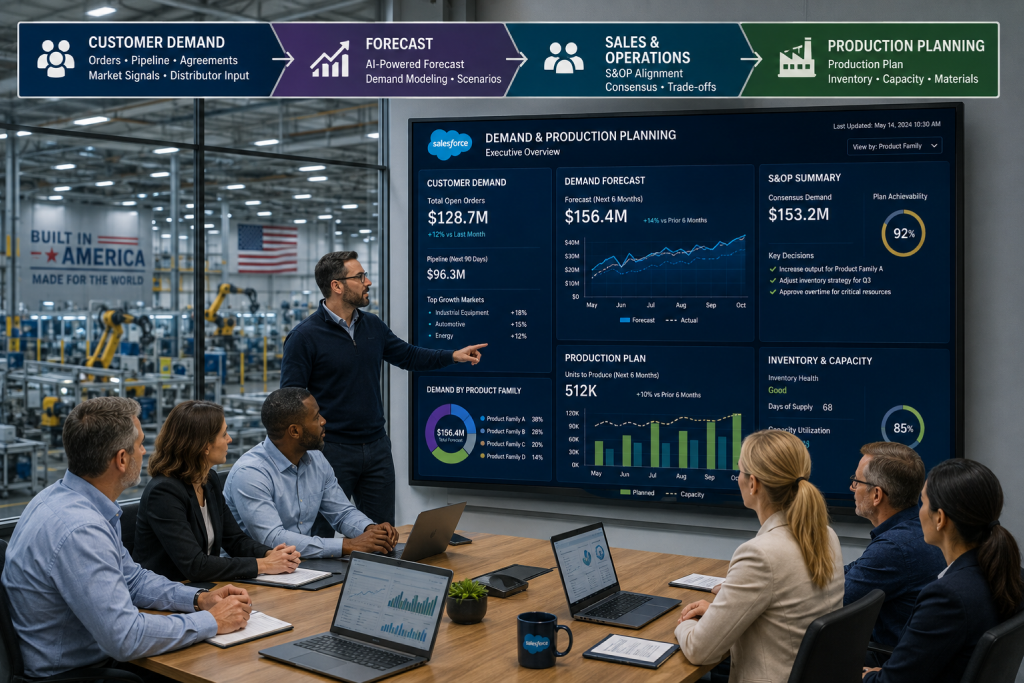
This creates a more connected planning cycle:
Customer demand
↓
Sales agreements and opportunities
↓
Demand forecast
↓
Sales & Operations alignment
↓
Production and inventory planning
↓
Actual performance
↓
Updated forecast
The important part is the feedback loop.
S&OP should not be a once-a-month exercise where a forecast is created and then forgotten. It should become an ongoing process of comparing expectations with reality and adjusting decisions accordingly.
Reducing the Dependence on Spreadsheets
Spreadsheets are not inherently bad.
They remain useful for analysis and scenario planning.
The problem arises when spreadsheets become the primary system for coordinating critical business decisions across departments.
Multiple versions of a forecast can create uncertainty:
- Which forecast is current?
- Who changed the number?
- Which customer commitments are included?
- Are actual orders reflected?
- Has operations reviewed the latest version?
- Are finance and sales using the same assumptions?
A connected platform can reduce some of this friction by bringing relevant information into a common environment.
Salesforce’s manufacturing data model includes capabilities for advanced forecasting, sales agreements, inventory information, product and asset information, and other manufacturing-specific processes.
The objective is not necessarily to eliminate every spreadsheet.
It is to make sure that critical planning decisions are based on accessible, governed, and connected business information.
Where AI Can Take S&OP Next
The next evolution of S&OP will likely involve more than dashboards and automated forecasts.
AI can potentially help teams identify patterns, surface exceptions, summarize changes, and recommend actions.
Salesforce’s current positioning around Agentforce Manufacturing is moving in this direction, combining manufacturing data and workflows with AI capabilities. Learn more about how Agentforce for Manufacturing improves sales, service, and operational efficiency.
Consider a future planning scenario.
A forecast changes significantly for a major customer.
Instead of requiring several teams to discover the change independently, an AI-enabled system could help surface the variance, identify the affected products and agreements, highlight relevant inventory or operational implications, and bring the information to the appropriate teams for review.
The important point is that AI becomes more useful when it has access to relevant business context.
That makes the foundation of connected data particularly important.
Salesforce Manufacturing Cloud Is Not a Replacement for ERP
It is also important to set realistic expectations.
Manufacturing Cloud should not be viewed as a replacement for every system involved in manufacturing planning.
ERP, MRP, MES, supply-chain planning, production control, and other specialized systems continue to play important roles.
The opportunity is to connect these systems with the commercial and customer information needed for better planning.
Salesforce specifically describes integrating forecast information with enterprise planning systems, including demand and financial planning systems. Perigeon’s Salesforce Manufacturing Cloud implementation and integration services help manufacturers make this connection practical.
That means manufacturers can think about Manufacturing Cloud as part of a broader technology ecosystem rather than an isolated replacement project.
The architecture can become:
Customer & market signals → Salesforce → ERP / planning systems → Operations → Actual performance → Salesforce
This connected approach can help close the gap between what the business expects to happen and what is actually happening.
What Manufacturers Should Measure
A successful S&OP transformation should ultimately be measured through business outcomes.
Manufacturers should consider metrics such as:
- Forecast accuracy
- Forecast bias
- Inventory levels
- Customer service levels
- On-time delivery
- Production-plan adherence
- Order fulfillment
- Revenue predictability
- Planning-cycle time
- Time spent manually preparing forecasts
The exact metrics will vary by industry and business model.
The important principle is to connect technology investments to measurable operational outcomes.
A more sophisticated forecasting platform is valuable only if it helps the organization make better decisions.
A More Connected Approach to S&OP
For U.S. manufacturers, the future of S&OP is likely to be more connected, collaborative, and data-driven.
The traditional model often depends on periodic meetings, manually consolidated forecasts, and information gathered from multiple systems.
A more modern approach can continuously connect:
Customer demand + sales agreements + orders + forecasts + operations + inventory + partners + actual performance
Salesforce Manufacturing Cloud provides capabilities that can support this model, particularly through sales agreements, advanced account forecasting, collaboration, and integration with enterprise planning environments. For a broader view of how Salesforce supports manufacturers, explore our Salesforce for Manufacturing Industry overview.
The goal is not simply to create a more accurate spreadsheet.
It is to create a shared view of demand that helps the organization make better decisions faster.
Conclusion
Sales & Operations Planning sits at the intersection of sales expectations and operational reality.
When those two sides are disconnected, manufacturers can struggle with excess inventory, missed opportunities, production inefficiencies, and customer commitments that are harder to fulfill.
When they are connected, the organization has a better opportunity to anticipate demand, coordinate resources, and respond to change.
Salesforce Manufacturing Cloud can help support that connection by bringing sales agreements, demand forecasts, actual orders, and cross-functional collaboration into a more unified environment. Its Advanced Account Forecasting capabilities extend this further by allowing manufacturers to build configurable forecasts across different products, locations, periods, and business dimensions.