



Banks and financial institutions today face intense pressure. Customers expect personalized service across every channel. Regulators demand strict compliance. Competitors (including fintechs) move faster. And internal teams often work with fragmented data spread across core banking systems, legacy CRMs, and spreadsheets.
This is exactly the problem Salesforce Financial Services Cloud was built to solve.
In this complete guide, you’ll learn what Financial Services Cloud is, how it works for banking and finance organizations, its key features, real-world benefits, use cases, and practical implementation advice — so you can decide whether it’s the right platform for your institution.
What is Salesforce Financial Services Cloud?
Salesforce Financial Services Cloud (often called FSC) is a purpose-built industry CRM designed specifically for banking, wealth management, insurance, and lending organizations. Unlike standard Sales Cloud or Service Cloud, it comes with pre-built data models, objects, and workflows that understand the unique complexities of financial relationships.
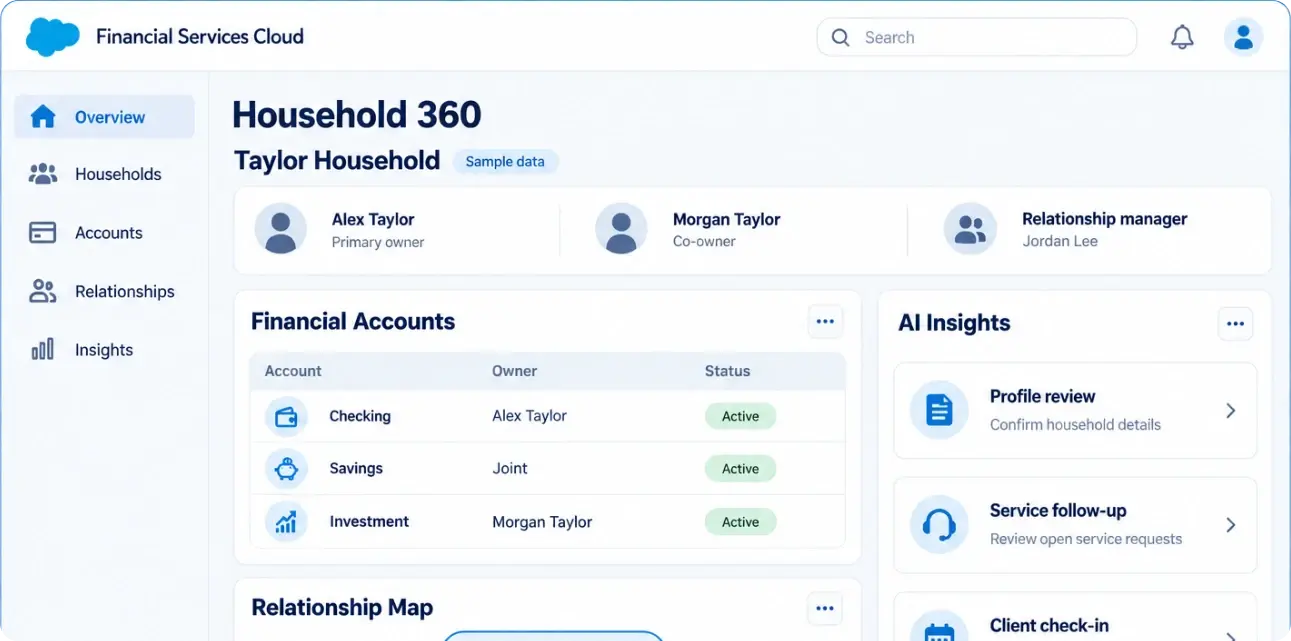
At its core, Financial Services Cloud is built around the idea that a customer is not just an individual account. People belong to households, hold multiple financial products, have complex relationships (family members, business partners, beneficiaries), and interact with the institution across many touchpoints over years.
It sits on top of the Salesforce platform and can be layered with Sales Cloud, Service Cloud, Marketing Cloud, Data Cloud, and Agentforce (Salesforce’s AI agent platform).
As of 2026, Salesforce has significantly expanded Financial Services Cloud with Agentforce for Financial Services — pre-built AI agents designed for banking service, relationship management, wealth advisory, and insurance workflows.
Key Features of Financial Services Cloud for Banking & Finance
Here are the most important capabilities that make FSC different from a generic CRM:
-
Household and Relationship Management
Financial Services Cloud provides a true 360-degree view of the customer and their household. You can map family members, joint accounts, business relationships, influencers, and referral sources — all in one place. This is critical for relationship managers and wealth advisors.
-
Financial Accounts and Transactions
The platform includes dedicated objects for financial accounts (deposits, loans, investments, credit cards, insurance policies, etc.) and transactions. Banks can display balances, recent activity, and product holdings without forcing users to log into multiple systems.
-
Industry-Specific Console Apps
- Retail Banking Console
- Commercial Banking Console
- Wealth Management tools
These consoles give bankers and advisors a single workspace with the information they need most.
-
Action Plans
Pre-built, repeatable task templates for processes such as account opening, KYC/AML checks, annual reviews, loan applications, and claim processing. Action Plans improve consistency, compliance, and productivity.
-
Agentforce for Financial Services (2026 Focus)
Salesforce has heavily invested in AI agents tailored for financial services. These include agents for:
- Banking service and dispute resolution
- Relationship manager assistance (meeting prep and follow-up)
- Financial advisor support
- Insurance service assistance
These agents can handle routine tasks while keeping humans in the loop for high-value interactions.
-
Compliance and Risk Features
Record Alerts, audit trails, field-level security, and integration capabilities help institutions meet regulatory requirements. Many banks also pair FSC with Salesforce Shield for advanced encryption and event monitoring.
-
Digital Lending and Origination Support
Financial Services Cloud supports lending workflows, collateral management, and integration with loan origination systems — helping banks modernize the borrowing experience.
-
Strong Integration Capabilities
Using MuleSoft or native APIs, FSC can connect with core banking systems, payment platforms, identity verification tools, and data warehouses. Learn more about our Salesforce Integration Services.
Benefits of Using Salesforce for Banking and Finance
Organizations that implement Financial Services Cloud typically see improvements in several key areas:
- Better Customer Experience — A complete view of the customer enables more relevant conversations and proactive service.
- Higher Employee Productivity — Relationship managers and service teams spend less time searching for information and more time engaging clients.
- Improved Compliance Posture — Standardized processes and better data visibility reduce operational risk.
- Faster Onboarding and Service Resolution — Automation and guided processes shorten cycle times.
- Scalability — The same platform can support retail banking, commercial banking, and wealth management as the institution grows.
- Foundation for AI — With clean data and industry data models in place, banks can adopt Agentforce and generative AI more effectively.
Salesforce has published customer success metrics showing strong ROI and productivity gains across financial services clients, though results always depend on implementation quality and change management.
Real-World Use Cases
Retail Banking
Branch staff and contact center agents get a full view of the customer’s products, recent interactions, and household relationships. This reduces average handle time and increases cross-sell opportunities.
Wealth Management
Advisors can track financial goals, assets under management (including held-away assets), and next-best actions. Meeting preparation that used to take hours can be reduced significantly with AI assistance.
Commercial Banking
Relationship managers gain visibility into complex business relationships, ownership structures, and referral opportunities across the organization.
Lending
Loan officers and operations teams can manage applications, track stages, and coordinate with underwriting and document collection in a more structured way.
Insurance
Policy and claims visibility, agent-of-record management, and customer service workflows become more efficient. you can also explore our detailed guide on Salesforce Financial Services Cloud for Insurance.
How to Implement Financial Services Cloud Successfully
Successful implementations follow a disciplined approach:
-
Start with Clear Business Objectives
Don’t implement technology for its own sake. Define specific outcomes (e.g., reduce onboarding time by 30%, improve advisor productivity, improve first-contact resolution). -
Prioritize Data Quality
Household modeling and financial account relationships only work if the underlying data is clean and well-structured. Data cleansing and governance should be part of the project from day one. -
Choose the Right Scope
Many institutions begin with one line of business (for example, retail banking or wealth) rather than trying to roll out everything at once. -
Plan Integrations Early
Core banking, document management, identity verification, and analytics systems must be carefully mapped. -
Focus on Change Management and Training
Bankers and advisors will only adopt the system if it makes their daily work easier. Role-based training and super-user programs are essential. -
Consider Partner Support
Because of the complexity of financial services data models and compliance requirements, many organizations work with experienced Salesforce partners who specialize in Financial Services Cloud.
Many organizations partner with experienced teams for end-to-end delivery. At Perigeon, we offer specialized Salesforce Financial Services Cloud Consulting & Services and complete Salesforce Implementation Services tailored for banking and financial institutions.
Financial Services Cloud vs Traditional Banking CRM
| Aspect | Traditional Banking CRM | Salesforce Financial Services Cloud |
|---|---|---|
| Data Model | Generic (Accounts & Contacts) | Industry-specific (Households, Financial Accounts) |
| Relationship Complexity | Limited | Strong household & multi-party support |
| Industry Processes | Heavy customization required | Pre-built Action Plans & consoles |
| AI & Automation | Often limited or bolted on | Native Agentforce + industry agents |
| Scalability Across Lines | Difficult | Designed for retail, commercial & wealth |
| Ecosystem & Integration | Varies | Strong (MuleSoft, AppExchange, APIs) |
Frequently Asked Questions (FAQ)
+
+
+
+
+
Final Thoughts
Salesforce Financial Services Cloud is not just another CRM. It is a purpose-built platform designed for the realities of banking and financial services complex relationships, strict compliance, multi-product households, and the growing need for intelligent automation.
When implemented well, it gives institutions a unified view of the customer, empowers frontline teams, and creates a strong foundation for AI-driven experiences.
If your organization is still relying on fragmented systems or heavily customized generic CRMs, now is a good time to evaluate whether Financial Services Cloud can help you deliver better client experiences while controlling operational risk.
Ready to explore how Financial Services Cloud can work for your bank or financial institution?