


Real estate companies don’t usually have a shortage of data. They have a shortage of connected data.
A single property enquiry may come through a website, property portal, paid advertisement, broker, referral, phone call, or social media campaign. The prospect may then communicate with a sales representative, attend a site visit, negotiate a property, complete a booking, and eventually require post-sale service.
When each interaction is managed through separate spreadsheets, emails, applications, and messaging platforms, sales teams lose visibility and customers can receive inconsistent experiences.
This is where Salesforce for real estate can make a difference.
Salesforce can provide a centralized platform for managing leads, customer relationships, sales pipelines, marketing campaigns, service requests, property-related processes, reporting, automation, integrations, and AI-powered workflows.
However, implementing Salesforce successfully is about more than configuring a CRM.
A successful real estate Salesforce implementation requires a clear understanding of the organization’s sales process, property lifecycle, data model, integrations, users, reporting requirements, and long-term business goals.
In this guide, we explain how Salesforce can be used by real estate developers, brokers, property management companies, commercial real estate organizations, and investors—and what businesses should consider before implementing it.
What Is Salesforce CRM for Real Estate?
Salesforce for real estate means configuring and implementing Salesforce around the specific processes of a real estate organization.
Instead of treating Salesforce as simply a contact database, organizations can use it to connect multiple stages of the customer and property lifecycle.
Depending on the business model, this can include:
- Lead generation and qualification
- Property and project management
- Buyer and seller management
- Sales opportunity management
- Site visit scheduling
- Booking and transaction processes
- Broker and channel-partner management
- Marketing automation
- Customer service
- Tenant service
- Maintenance requests
- Reporting and analytics
- Customer and partner portals
- AI-powered assistance and automation
The important point is that Salesforce is a configurable platform. A developer, brokerage, property manager, and real estate investor may all require different Salesforce data models and workflows.
That is why the implementation strategy matters as much as the technology itself.
For organizations evaluating an industry-specific Salesforce approach, Perigeon’s Salesforce solutions for Construction & Real Estate are designed around real estate and construction business processes.
Why Do Real Estate Companies Need Salesforce CRM?
Consider a real estate developer launching a new project.
Marketing generates enquiries through Google Ads, social media, property portals, the company website, channel partners, and offline campaigns.
The sales team then needs to:
- Capture the enquiry
- Identify the prospect’s requirements
- Assign the lead to the right salesperson
- Contact the prospect
- Recommend a suitable property
- Schedule a site visit
- Follow up
- Create an opportunity
- Negotiate
- Complete the booking
- Continue the customer relationship after the sale
If these steps are managed manually, several problems can appear.
Disconnected customer data
Customer information can be spread across spreadsheets, emails, marketing platforms, messaging applications, and individual sales representatives’ records.
Slow lead response
A lead that is not assigned immediately may remain unattended while the prospect speaks with a competitor.
Missed follow-ups
Sales representatives may forget calls, meetings, or follow-up activities.
Limited pipeline visibility
Management may not have an accurate real-time view of:
- Active leads
- Qualified opportunities
- Site visits
- Expected bookings
- Revenue forecasts
- Agent performance
- Project performance
Manual reporting
Sales managers may spend hours consolidating spreadsheets to prepare weekly or monthly reports.
Fragmented customer service
After a property is sold or leased, customers may still need support with documentation, handover, maintenance, service requests, or other issues.
Salesforce can connect these processes through a common CRM and automation framework.
How Salesforce Works for Real Estate
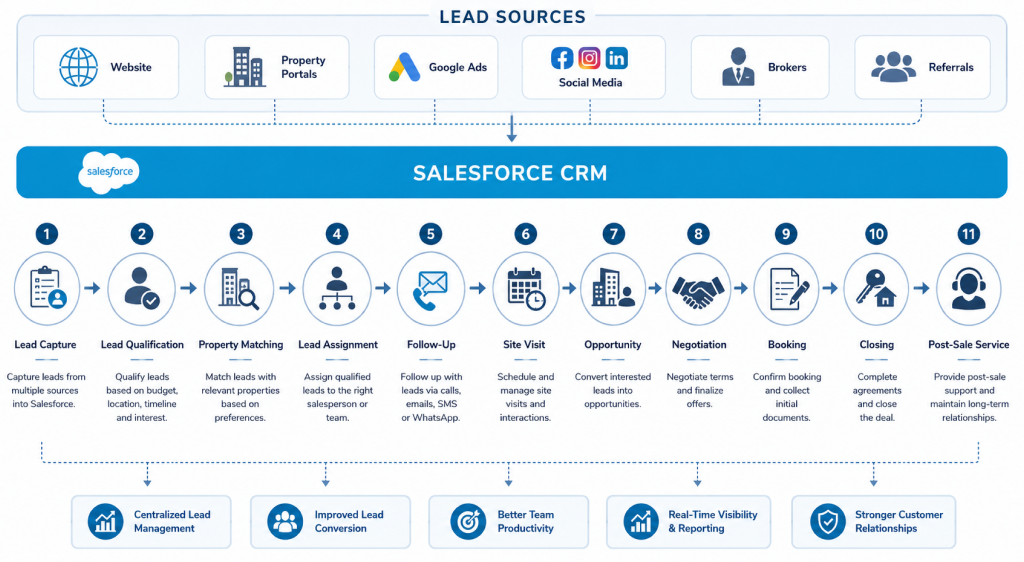
A typical real estate sales lifecycle can look like this:
Lead Capture → Lead Qualification → Property Matching → Lead Assignment → Follow-Up → Site Visit → Opportunity → Negotiation → Booking → Closing → Post-Sale Service
Let’s look at how Salesforce can support each stage.
1. Lead Capture
Leads can enter Salesforce from:
- Website forms
- Property portals
- Advertising platforms
- Social media
- Referral partners
- Brokers
- Events
- Phone calls
- Email campaigns
Instead of manually copying information into a spreadsheet, integrations and automation can create and route leads automatically.
2. Lead Qualification
Sales teams can capture information such as:
- Property preference
- Preferred location
- Budget
- Purchase or rental intent
- Financing status
- Preferred timeline
- Project interest
- Lead source
- Customer preferences
This helps sales teams prioritize prospects.
3. Lead Assignment
Salesforce can automatically route leads according to business rules such as:
- Geography
- Project
- Property type
- Lead source
- Sales team
- Language
- Agent availability
- Lead priority
4. Property Matching
Once a prospect’s requirements are understood, the sales team can identify suitable properties, units, projects, or listings.
5. Site Visits
Site visits can become part of the CRM workflow, with scheduling, reminders, activities, and follow-up tasks.
6. Opportunity Management
Once a lead becomes qualified, the sales team can track the opportunity through stages such as:
Qualified → Site Visit → Negotiation → Booking → Closed Won
Sales managers can monitor expected revenue, probability, closing dates, activities, and next steps.
7. Booking and Closing
The process can continue from opportunity management toward booking, documentation, transaction, and closure.
8. Post-Sale Service
The customer relationship does not end when the transaction closes.
Salesforce can continue supporting customer communication, service requests, maintenance, and post-sale engagement.
Salesforce CRM Features for Real Estate Businesses
A well-designed Salesforce implementation can support many areas of a real estate organization.
Lead Management
Lead management is one of the most important capabilities for real estate businesses.
Salesforce can help teams:
- Capture leads
- Assign leads
- Track lead sources
- Score and qualify prospects
- Automate follow-ups
- Track customer interactions
- Identify inactive leads
- Measure conversion rates
For organizations receiving hundreds or thousands of enquiries, automated lead management can significantly reduce administrative work.
Contact and Account Management
Salesforce can maintain a centralized view of customers, companies, investors, tenants, partners, and other stakeholders.
Teams can track:
- Contact information
- Communication history
- Activities
- Opportunities
- Service requests
- Campaign interactions
- Relationships
- Customer preferences
This gives sales and service teams more context when interacting with customers.
Opportunity Management
Real estate transactions often involve multiple stages and stakeholders.
Salesforce can provide visibility into the complete opportunity pipeline.
For example:
New Lead → Qualified → Site Visit Scheduled → Site Visit Completed → Negotiation → Booking → Closed Won
Management can then monitor:
- Pipeline value
- Opportunity stages
- Expected revenue
- Closing dates
- Conversion rates
- Sales performance
Property and Project Management
Salesforce can be configured around an organization’s property structure.
Depending on the business model, the data model could include:
Project → Building → Floor → Unit → Property
Property information may include:
- Property type
- Location
- Area
- Price
- Availability
- Status
- Amenities
- Ownership
- Customer
- Sales representative
The exact data model should be designed according to business requirements.
Marketing Automation
Real estate buying cycles can be long.
Someone may enquire about a property today but not be ready to purchase for several months.
Marketing automation can help organizations maintain engagement through:
- Email campaigns
- Lead nurturing
- Customer segmentation
- Project launches
- Event campaigns
- Personalized journeys
- Follow-up campaigns
Perigeon’s Salesforce Marketing Cloud services can be considered when organizations need personalized customer journeys, marketing automation, segmentation, and cross-channel engagement.
Customer Service
The customer journey continues after the sale.
Real estate organizations may need to manage:
- Customer enquiries
- Tenant requests
- Maintenance
- Complaints
- Documentation requests
- Handover support
- Service appointments
- Escalations
Salesforce Service Cloud can help centralize these interactions.
Salesforce Service Cloud solutions focus on case management, workflow automation, customer support, and connected field-service operations.
Reporting and Dashboards
Real estate executives need visibility into business performance.
Salesforce dashboards can provide insights into:
- Lead volume
- Lead source
- Conversion rate
- Sales pipeline
- Project performance
- Agent performance
- Site visits
- Bookings
- Revenue
- Forecast
- Customer service
- Marketing performance
The objective is to move from manually prepared reports toward timely, actionable business intelligence.
Salesforce for Different Real Estate Businesses
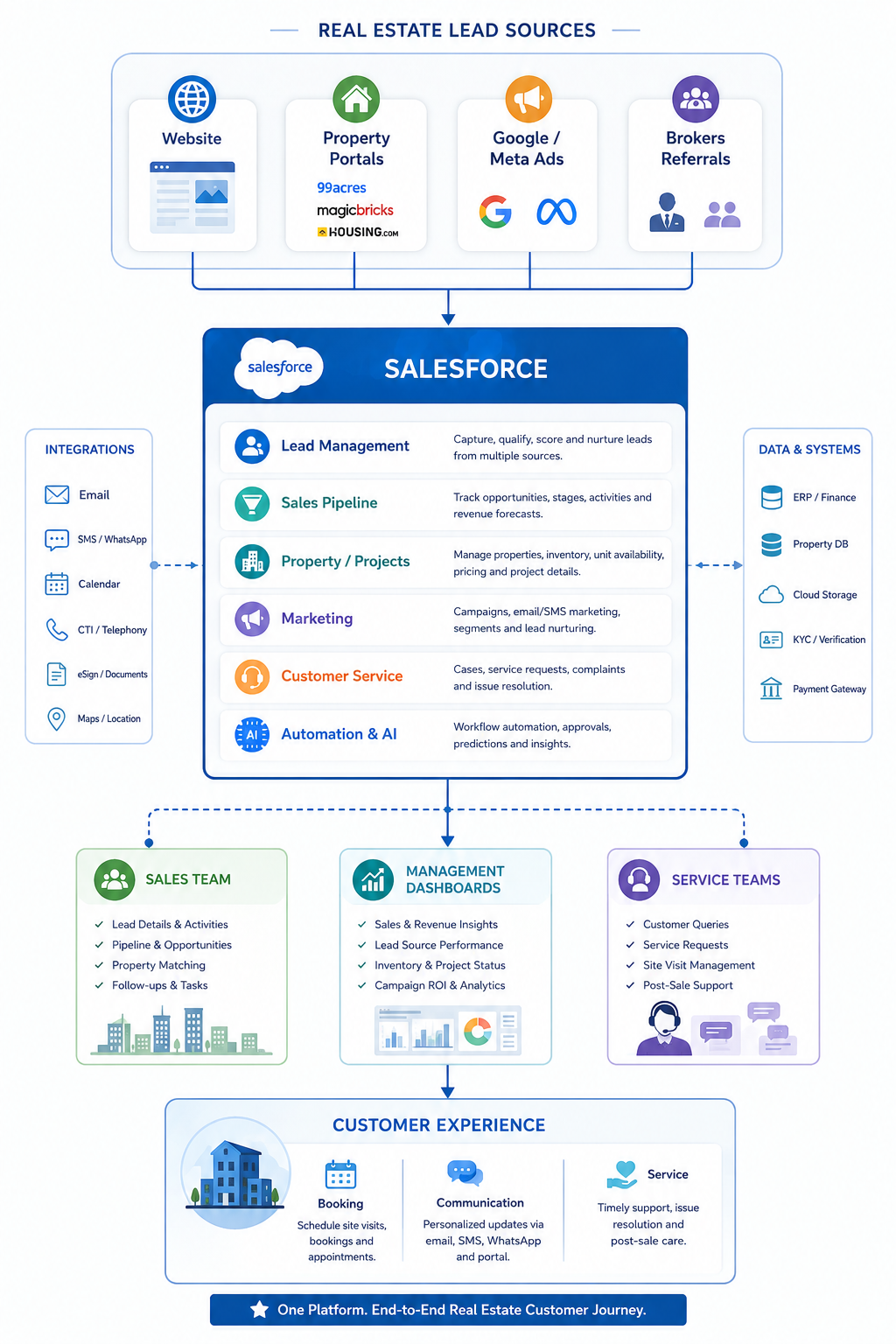
Salesforce can be configured for different real estate business models.
Salesforce for Real Estate Developers
Developers often manage multiple projects, large lead volumes, sales teams, inventory, channel partners, and customer relationships.
Salesforce can help developers manage:
- Project enquiries
- Property inventory
- Lead distribution
- Site visits
- Sales opportunities
- Channel partners
- Bookings
- Marketing campaigns
- Customer communication
- Post-sale service
A developer launching a new project can connect marketing campaigns, lead capture, sales follow-up, site visits, opportunities, and bookings within a connected CRM workflow.
Salesforce for Real Estate Brokers
Brokerages typically manage buyers, sellers, listings, agents, commissions, and follow-ups.
Salesforce can help brokers:
- Centralize buyer and seller information
- Track property enquiries
- Manage listings
- Assign leads
- Monitor agents
- Track opportunities
- Automate follow-ups
- Measure conversion rates
Management can also gain visibility into individual agent performance and overall brokerage performance.
Salesforce for Property Management Companies
Property management involves continuous interaction between owners, tenants, service teams, and management.
Salesforce can support:
- Tenant information
- Owner relationships
- Lease-related processes
- Service requests
- Maintenance
- Communication
- Escalations
- Customer service
- Reporting
A carefully designed implementation can connect property, tenant, owner, and service information.
Salesforce for Commercial Real Estate
Commercial real estate often involves longer sales cycles, complex stakeholder relationships, leasing activities, and high-value opportunities.
Salesforce can help organizations manage:
- Commercial properties
- Tenants
- Investors
- Leasing opportunities
- Stakeholders
- Customer relationships
- Forecasting
- Communication
Salesforce for Real Estate Investors
Real estate investors may need to track opportunities across the complete property lifecycle:
Property Identification → Acquisition → Due Diligence → Investment → Development/Renovation → Disposition
Salesforce can also support investor relationship management and communication.
Salesforce Clouds for Real Estate
Salesforce offers multiple products that can be combined depending on the organization’s requirements.
Sales Cloud
Sales Cloud can support:
- Lead management
- Contact management
- Opportunity management
- Sales activities
- Pipeline management
- Forecasting
Organizations looking for a broader Salesforce services and implementation strategy can evaluate the Salesforce capabilities available through Perigeon.
Service Cloud
Service Cloud can support:
- Customer support
- Tenant enquiries
- Case management
- Service requests
- Escalations
- Knowledge management
Experience Cloud
Experience Cloud can support customer, partner, broker, investor, and other stakeholder portals.
Marketing Cloud
Marketing Cloud can support:
- Lead nurturing
- Segmentation
- Campaign management
- Customer journeys
- Personalized communication
Field Service
Field Service can be useful when real estate organizations need to manage:
- Inspections
- Maintenance
- Service appointments
- Work orders
- Field teams
Data and AI
Salesforce data and AI capabilities can help organizations connect information, automate processes, provide recommendations, and create AI-powered experiences.
The right Salesforce product combination depends on the organization’s business model, size, users, integrations, processes, and objectives.
Salesforce Automation for Real Estate
Automation is where Salesforce can move beyond being a database.
Consider a typical property enquiry.
Without automation
Website → Email Notification → Salesperson Notices → Spreadsheet Entry → Manual Follow-Up
With a properly designed Salesforce workflow
Website → Salesforce → Lead Created → Lead Assigned → Customer Notification → Sales Task → Qualification → Opportunity
The difference is process consistency.
Salesforce automation can be used to:
- Assign new leads
- Create follow-up tasks
- Send notifications
- Trigger customer communication
- Update opportunity stages
- Escalate overdue activities
- Notify managers
- Create service cases
- Update records
- Trigger marketing journeys
- Generate reports
The goal should not be to automate everything.
The goal is to automate the right processes.
AI and Agentforce for Real Estate
AI is becoming an increasingly important component of modern CRM strategies.
For real estate organizations, useful AI applications include:
AI-Assisted Lead Qualification
AI can help sales teams understand and prioritize enquiries using available customer and interaction data.
Sales Assistance
Sales representatives can use AI assistance to summarize customer information, review activities, and identify potential next steps.
Customer Service Assistance
AI can help service representatives find relevant information and respond more efficiently.
Automated Summaries
Customer interactions, meetings, and activities can be summarized to reduce administrative work.
Next-Best Actions
AI can help identify potential next steps based on customer and opportunity information.
Marketing Personalization
Customer data can support more relevant and personalized marketing journeys.
Agentic AI
Salesforce’s Agentforce capabilities can support AI-powered agents and experiences for specific business processes.
However, there is an important implementation principle:
AI is only as useful as the data and processes behind it.
If customer data is incomplete, duplicated, outdated, or scattered across disconnected systems, AI cannot solve the underlying data architecture problem by itself.
That is why data quality and CRM architecture should come before an ambitious AI strategy.
Salesforce Integrations for Real Estate
Most established real estate organizations already use multiple applications.
A Salesforce implementation therefore often requires integration with existing technology.
Common integration categories include:
- Property portals
- Websites
- Advertising platforms
- Social media
- Telephony
- ERP systems
- Accounting platforms
- Payment systems
- Property management platforms
- Document management
- Analytics platforms
A simplified architecture might look like:
Website + Property Portals + Marketing Channels
↓
Integration Layer
↓
Salesforce
↓
Lead Management
↓
Sales Team
↓
Opportunity Management
↓
Booking / Transaction
↓
Customer Service
The goal isn’t necessarily to replace every existing system.
The goal is to make the systems work together and ensure that the right information reaches the right application at the right time.
Perigeon’s Salesforce integration services cover integration with existing business systems and are particularly relevant when a real estate organization needs to connect Salesforce with ERP, marketing, or other enterprise applications.
Salesforce Data Model for Real Estate
A strong Salesforce implementation begins with the data model.
A simplified real estate structure could look like:
Lead
↓
Contact / Account
↓
Project
↓
Property / Unit
↓
Opportunity
↓
Site Visit
↓
Booking
↓
Transaction
↓
Service
But the actual structure depends on the business.
A developer might require:
Project → Tower → Floor → Unit
A brokerage might require:
Listing → Property → Seller → Buyer
A property-management company might require:
Property → Owner → Tenant → Lease → Service Request
This is why copying another company’s Salesforce configuration is rarely the right approach.
The data model should reflect the organization’s actual business processes.
How to Implement Salesforce for a Real Estate Company
A successful Salesforce implementation requires more than technical configuration.
Step 1: Business Discovery
Start by understanding:
- Business objectives
- Existing processes
- Users
- Pain points
- Existing systems
- Data sources
- Reporting requirements
- Integration requirements
Step 2: Process Mapping
Document the current and future-state processes.
For example:
Lead → Qualification → Site Visit → Opportunity → Booking → Closure
Identify where manual work, duplicate data, delays, and process gaps exist.
Step 3: Salesforce Architecture
Define:
- Objects
- Fields
- Relationships
- Security
- User roles
- Automation
- Integrations
- Reporting
- Data model
Step 4: Data Migration
Legacy data may need to be:
- Extracted
- Cleaned
- Deduplicated
- Mapped
- Validated
- Migrated
- Tested
Data migration should not be treated as simply uploading a spreadsheet.
Poor-quality legacy data can create problems throughout the CRM.
Step 5: Configuration and Development
The Salesforce environment can then be configured around the approved architecture.
This may include:
- Objects
- Fields
- Page layouts
- Flows
- Validation rules
- Reports
- Dashboards
- Lightning components
- Custom development
Step 6: Integrations
Connect Salesforce with the required external systems.
Step 7: Testing
Test:
- Business processes
- Automation
- Integrations
- Security
- Data
- Reports
- User journeys
Step 8: User Training
Users need to understand both how Salesforce works and why the new process exists.
Step 9: Go-Live
Deploy the solution using a controlled go-live strategy.
Step 10: Continuous Optimization
Salesforce should not be considered a project that ends on go-live day.
As the business changes, the CRM should evolve.
Organizations looking for structured deployment can also explore Salesforce implementation services for discovery, configuration, deployment, integration, automation, and ongoing optimization.
Salesforce QuickStart for Real Estate
Not every real estate company needs a massive enterprise implementation on day one.
For organizations with a clearly defined scope, a phased or QuickStart approach can provide a faster path to adoption.
A QuickStart implementation can focus on essential capabilities such as:
- Leads
- Accounts
- Contacts
- Opportunities
- Assignment rules
- Core automation
- Reports
- Dashboards
- User training
Perigeon’s Salesforce QuickStart implementation offering is designed around streamlined deployments, business workflows, training, and scalable foundations.
This approach can be particularly useful for growing organizations that want to establish a CRM foundation first and expand functionality over time.
How Much Does Salesforce Cost for Real Estate?
There is no universal Salesforce implementation price for every real estate organization.
The total investment can depend on:
- Number of users
- Salesforce products
- Implementation complexity
- Customization
- Integrations
- Data migration
- Automation
- AI requirements
- Reporting
- Training
- Ongoing support
A useful way to think about the total investment is:
Salesforce Licensing + Implementation + Integrations + Data Migration + Training + Ongoing Support
A small brokerage with a simple sales process may need a very different Salesforce solution from a large developer managing multiple projects, thousands of leads, channel partners, integrations, and post-sale services.
Therefore, organizations should define their business requirements before estimating implementation cost.
Benefits of Salesforce for Real Estate
A properly implemented Salesforce solution can help real estate organizations achieve several business outcomes.
Centralized Customer Data
Sales, marketing, and service teams can work from a shared customer view.
Faster Lead Response
Automated lead routing and notifications can reduce delays.
Better Sales Visibility
Managers can monitor pipeline, opportunities, conversion, and forecasts.
Reduced Manual Work
Automation can reduce repetitive administrative tasks.
Better Customer Experience
Employees can access relevant customer information during interactions.
Improved Reporting
Executives can gain faster visibility into business performance.
Scalability
A properly designed architecture can evolve as the organization grows.
Better Collaboration
Sales, marketing, service, management, and partners can work through connected processes.
Pros and Cons of Salesforce CRM for Real Estate
Salesforce can be an excellent platform, but it isn’t automatically the right choice for every real estate organization.
Advantages
- Highly configurable
- Scalable
- Strong ecosystem
- Powerful automation
- Advanced reporting
- Extensive integration capabilities
- Multiple Salesforce products
- AI capabilities
- Support for complex business processes
Potential Challenges
- Implementation can be complex
- Poor architecture can create technical debt
- Data migration can be challenging
- Users require training
- Licensing and implementation costs need to be planned
- Ongoing administration may be required
- Excessive customization can make future changes more difficult
The objective should not be to customize Salesforce as much as possible.
The objective should be to customize it where customization creates measurable business value.
Salesforce vs. a Real Estate-Specific CRM
One of the most common questions is whether a company should choose Salesforce or a specialized real estate CRM.
A specialized CRM may provide certain industry features out of the box and can be simpler for organizations with straightforward requirements.
Salesforce can be a stronger option when an organization needs:
- Complex workflows
- Multiple integrations
- Enterprise scalability
- Advanced automation
- Extensive customization
- Multiple business processes
- Advanced reporting
- AI capabilities
- Connected customer experiences
The right choice depends on the business.
A small brokerage with a simple sales process may not need the complexity of a highly customized enterprise CRM.
A growing developer, enterprise brokerage, property-management organization, or diversified real estate company may benefit more from Salesforce’s flexibility and ecosystem.
Common Salesforce Implementation Mistakes in Real Estate
After years of working with CRM implementations, one lesson becomes clear:
Most Salesforce problems aren’t caused by Salesforce itself.
They are often caused by implementation decisions.
1: Automating a Broken Process
Don’t automate a process simply because it exists.
First determine whether the process should exist in its current form.
2: Poor Data Architecture
Adding hundreds of fields without a clear data model creates long-term maintenance problems.
3: Ignoring User Adoption
A technically excellent CRM can still fail if sales representatives don’t use it consistently.
4: Migrating Dirty Data
Moving duplicate or inaccurate legacy information into Salesforce only transfers the problem.
5: Over-Customization
Not every requirement needs custom code.
Use standard Salesforce capabilities where they are appropriate and customize when there is a clear business reason.
6: Ignoring Integrations
A CRM cannot provide a complete customer view if important information remains locked inside disconnected systems.
7: Treating Go-Live as the End
A Salesforce implementation should evolve as the business evolves.
How to Choose a Salesforce Implementation Partner for Real Estate
Choosing the right Salesforce implementation partner is as important as choosing the CRM itself.
Look for a partner that can demonstrate expertise in:
Salesforce architecture
The partner should understand data models, security, automation, integrations, scalability, and long-term maintainability.
Business process consulting
The implementation should be based on business requirements rather than simply configuring standard Salesforce objects.
Integration
The partner should be able to connect Salesforce with the systems your organization already depends on.
Data migration
The partner should have a structured approach to cleansing, mapping, validating, and migrating data.
User adoption
Training and change management should be part of the implementation strategy.
Ongoing support
Your Salesforce environment will likely require optimization after go-live.
Perigeon currently positions itself as a Salesforce Ridge/Silver Consulting Partner and reports 120+ successful global projects, a 5/5 AppExchange rating, and USA and India delivery presence.
You can learn more about Perigeon’s Salesforce consulting services and implementation approach here.
Why Choose Perigeon for Salesforce Real Estate Implementation?
Salesforce implementation should not be about putting another CRM into the business.
It should be about improving how the business operates.
Perigeon works across Salesforce consulting, implementation, integration, customization, data migration, automation, support, and optimization.
For real estate organizations, a Salesforce solution can be designed around processes such as:
- Lead management
- Property and project management
- Sales pipeline management
- Customer service
- Marketing automation
- Partner management
- Field operations
- Portals
- Reporting
- AI-powered workflows
The objective is to create a connected CRM ecosystem that helps the organization sell more effectively, operate more efficiently, and provide a better customer experience.
If your organization is evaluating Salesforce for real estate, start with a business and technology assessment rather than jumping directly into configuration.
Talk to a Salesforce expert at Perigeon to evaluate your real estate CRM requirements and implementation roadmap.
Final Thoughts
Salesforce can do much more for a real estate organization than store customer information.
When properly designed, it can connect the customer and sales lifecycle—from the first property enquiry to qualification, site visit, opportunity, booking, transaction, and post-sale service.
But successful Salesforce implementation doesn’t begin with technology.
It begins with the business.
Before configuring Salesforce, organizations should understand their processes, users, data, integrations, reporting requirements, and long-term goals.
Then Salesforce can be designed around those requirements.
For real estate companies looking to improve lead management, sales visibility, automation, customer experience, and operational efficiency, Salesforce can provide a scalable foundation for digital transformation.