
Salesforce Manufacturing Cloud helps UAE manufacturers manage sales agreements, track customer commitments, and improve forecasting accuracy. By connecting sales agreements with account-based forecasting and actual sales data, manufacturers can gain better visibility into expected demand and customer performance.
For manufacturers across the UAE, where customer relationships, supply chain coordination, and production planning are closely connected, managing long-term sales commitments is essential. However, spreadsheets, disconnected systems, and manual reporting can make it difficult to track agreed quantities, monitor performance, and identify changes in customer demand.
Salesforce Manufacturing Cloud provides a structured approach to managing these commitments and connecting sales planning with business operations.
Why Sales Agreement Management Matters for UAE Manufacturers
Manufacturing businesses often work with distributors, dealers, retailers, and enterprise customers through recurring purchasing arrangements. These relationships may involve agreed product quantities, delivery schedules, pricing terms, and sales targets over a defined period.
Without a centralized system, managing these agreements can become challenging.
Common challenges include:
- Limited agreement visibility: Sales teams may struggle to access the latest agreement details and customer commitments.
- Manual tracking: Teams often depend on spreadsheets to monitor quantities, targets, and actual sales.
- Forecasting gaps: Changes in customer demand may not be reflected quickly in sales forecasts.
- Disconnected departments: Sales, finance, and operations teams may work with different versions of customer information.
- Delayed performance insights: Managers may find it difficult to identify agreements that are underperforming.
For UAE manufacturers operating across sectors such as automotive, food and beverage, chemicals, building materials, and industrial equipment, better agreement visibility can support more informed business decisions.
What Are Sales Agreements in Salesforce Manufacturing Cloud?
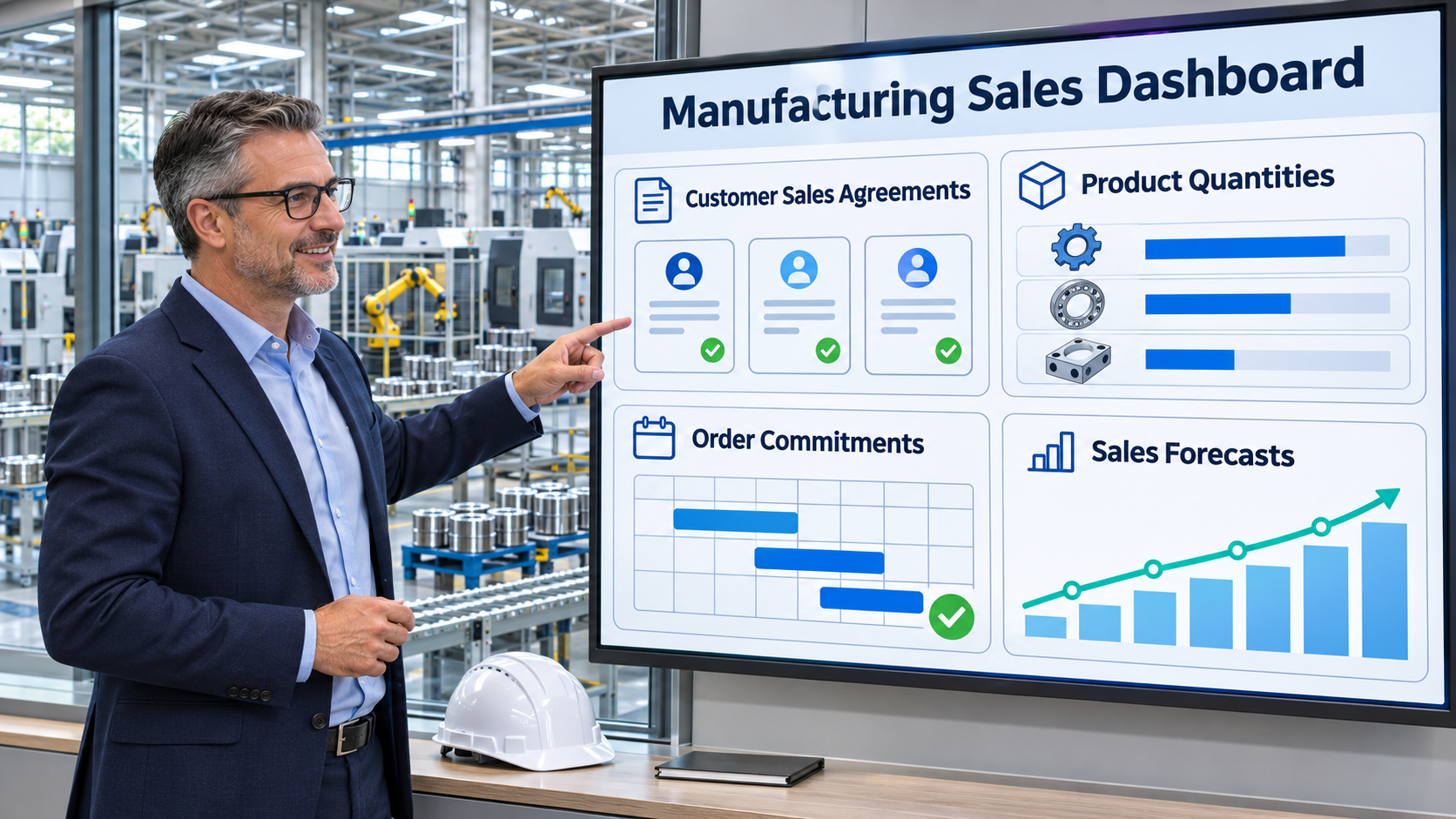
Sales Agreements in Salesforce Manufacturing Cloud provide a structured way to manage planned sales commitments between manufacturers and their customers.
Businesses can define agreement periods, products, planned quantities, and other relevant commercial details. Sales teams can then compare agreed commitments with actual sales information to understand account performance.
Instead of managing customer commitments through disconnected spreadsheets, manufacturers can maintain agreement information within their CRM environment.
This helps sales and account management teams work with a more consistent view of customer expectations and purchasing activity.
How Salesforce Manufacturing Cloud Simplifies Sales Agreement Management
1. Centralized Sales Agreement Management
Managing agreements across multiple customers and distributors can become complicated as a manufacturing business grows.
Salesforce Manufacturing Cloud provides a centralized environment for maintaining sales agreement information. Teams can access relevant agreement details, review associated products, and monitor commitments within the Salesforce platform.
For UAE manufacturers working with customers across different emirates or international markets, this visibility can help improve coordination between account managers and sales leadership.
2. Better Tracking of Product and Quantity Commitments
Sales agreements often include commitments for specific products and quantities over a defined period.
Manufacturers need to understand how much a customer has agreed to purchase and how actual purchasing activity compares with those commitments.
Manufacturing Cloud supports the management of product-level agreement details, including planned quantities and related sales information.
This allows account managers to review customer commitments more consistently and identify potential gaps between planned and actual sales.
3. Improved Account-Based Forecasting
Accurate forecasting is important for manufacturers because sales expectations influence production planning, inventory decisions, and supply chain coordination.
Salesforce Manufacturing Cloud connects sales agreements with account-based forecasting capabilities. This helps businesses develop a more informed view of expected customer demand.
For example, a UAE building materials manufacturer supplying multiple construction companies can use agreement information and sales forecasts to understand expected demand across customer accounts.
This can help sales and operations teams identify changes in purchasing patterns and discuss potential adjustments earlier.
4. Visibility into Actuals vs. Agreement Commitments
An agreement is useful only when businesses can monitor how actual purchasing activity compares with the original commitment.
Manufacturing Cloud supports visibility into agreement performance by helping teams compare planned quantities with actual sales data.
This can help manufacturers identify:
- Customers purchasing below agreed quantities.
- Accounts showing stronger-than-expected demand.
- Products with changing purchasing patterns.
- Agreements that may require review or renewal.
These insights give account managers a clearer starting point for customer discussions and commercial planning.
5. Connected Sales and ERP Data
Sales agreement management becomes more valuable when customer commitments can be considered alongside operational and financial information.
Many UAE manufacturers already use ERP platforms to manage inventory, orders, finance, and fulfilment. Integrating relevant ERP data with Salesforce can help connect customer-facing sales information with operational processes.
With the right integration architecture, teams can work towards a more consistent view of customer agreements, order activity, and business performance.
The integration approach depends on the manufacturer’s existing ERP platform, data structure, and business requirements.
6. Better Collaboration Across Sales Teams
Sales agreement information is relevant to more than one account manager. Sales leaders, finance teams, and operations stakeholders may all need access to different aspects of customer commitments.
By bringing agreement information and related customer data into a shared CRM environment, Manufacturing Cloud can improve visibility across teams.
This supports more informed discussions about customer performance, changing demand, and future sales opportunities.
Benefits of Sales Agreement Management for UAE Manufacturers
Implementing a structured sales agreement management process can support several business improvements.
Business Area Potential Benefit Sales management Better visibility into customer commitments Account management More informed customer conversations Forecasting Improved understanding of expected demand Operations Better coordination with sales expectations Management reporting Clearer visibility into agreement performance Customer relationships More consistent tracking of commercial commitments
The value depends on how well sales agreements, actual sales data, and existing business systems are configured and maintained.
Industry Applications Across the UAE
Sales Agreement Management can support manufacturers across several industries:
Automotive Manufacturing: Track recurring product commitments with dealers, distributors, and business customers.
Building Materials: Monitor agreed quantities for cement, steel, construction materials, and related products supplied to project-based customers.
Food and Beverage: Manage recurring purchasing commitments with retailers, wholesalers, and distribution partners.
Chemical and Petrochemical: Improve visibility into customer-level product commitments and purchasing trends.
Industrial Equipment: Track long-term commercial agreements and expected product demand across enterprise accounts.
Each industry may require different agreement structures, forecasting processes, and integration requirements.
How Perigeon Helps UAE Manufacturers with Salesforce Manufacturing Cloud
Successful implementation requires more than deploying CRM software. Manufacturers need a solution aligned with their sales processes, customer agreements, forecasting requirements, and existing business systems.
Perigeon helps businesses plan and implement Salesforce solutions based on their operational and commercial requirements.
Through its Salesforce Manufacturing Cloud consulting and implementation services, Perigeon can help manufacturers assess their requirements, configure relevant capabilities, connect business systems, and improve visibility across sales operations.
The implementation approach can be aligned with the manufacturer’s existing workflows, data environment, and long-term business objectives.
Conclusion
Sales agreement management plays an important role in helping UAE manufacturers maintain customer commitments and understand expected demand.
Salesforce Manufacturing Cloud brings sales agreements, account-based forecasting, and actual sales visibility into a connected CRM environment. This can help manufacturers improve agreement tracking, identify performance gaps, and support better coordination between sales and operations teams.
For UAE manufacturers looking to strengthen customer relationships and modernize sales processes, Manufacturing Cloud offers a structured foundation for managing commercial commitments.