


Introduction
Most organizations use Slack for communication and Salesforce for CRM — but treat them as separate systems.
That separation is where productivity loss begins.
The real value emerges when Slack and Salesforce work together as one connected system, enabling real-time collaboration around customer data, deals, and service operations.
we help organizations bridge this gap through Slack Salesforce integration services that turn disconnected workflows into real-time business execution layers.
Key Takeaways
- Slack + Salesforce integration improves real-time decision-making
- Teams stop switching between CRM and communication tools
- Sales cycles become faster and more collaborative
- Alerts and updates reach teams instantly inside Slack
- CRM adoption improves significantly
- It creates a connected digital revenue workspace
Why This Integration Is Often Ignored
Even though both platforms are widely used, companies often fail to connect them because:
- They treat Slack as “chat” only
- Salesforce is used only by sales teams
- Lack of technical implementation support
- No clear integration strategy
- No understanding of workflow value
As a result, critical CRM updates remain siloed inside Salesforce.
What Happens Without Slack + Salesforce Integration
Without integration, teams face:
- Delayed sales updates
- Manual CRM checking
- Missed deal changes
- Slow internal communication
- Low Salesforce engagement
- Fragmented customer visibility
This leads to slower revenue cycles and reduced operational efficiency.
What Changes With Slack + Salesforce Integration
When integrated properly, Slack becomes a real-time CRM collaboration layer.
Teams can:
- Get instant Salesforce alerts in Slack
- Discuss opportunities in dedicated channels
- Update CRM records from Slack
- Collaborate on customer issues in real time
- Improve sales response time dramatically
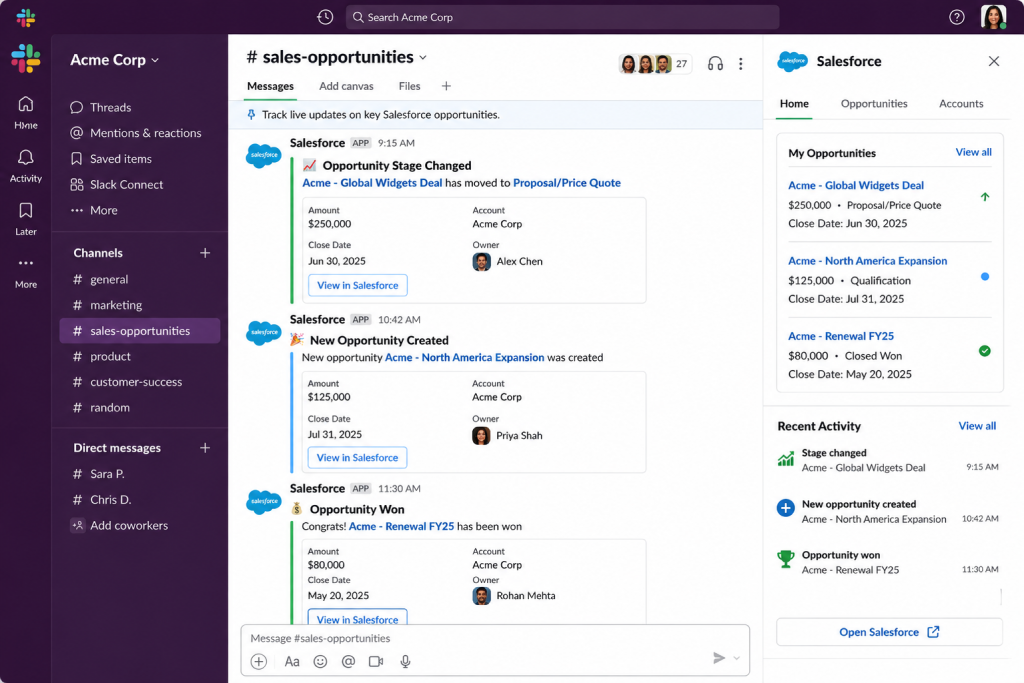
Real-Time Salesforce Alerts in Slack
One of the most powerful features is instant notifications.
Examples:
- New lead assigned
- Opportunity stage change
- Deal closed or lost
- Support case escalation
- High-value customer activity
Instead of logging into Salesforce repeatedly, teams stay updated inside Slack.
Slack Becomes the Collaboration Layer for Salesforce
Instead of Salesforce being a standalone CRM tool, Slack transforms it into:
- A live sales communication hub
- A deal collaboration workspace
- A customer success coordination tool
- A real-time revenue intelligence system
Business Benefits of Slack + Salesforce Integration
1. Faster Sales Cycles
Teams respond to leads and updates instantly.
2. Better CRM Adoption
Users engage more when Salesforce is embedded into daily workflow.
3. Reduced Context Switching
No need to switch between tools constantly.
4. Improved Team Collaboration
Sales, marketing, and support stay aligned in real time.
5. Higher Productivity
Automation reduces manual CRM updates and communication delays.
Slack + Salesforce Use Cases
Sales Teams
- Opportunity tracking
- Deal collaboration
- Lead notifications
Customer Support
- Case escalation alerts
- SLA monitoring
- Real-time resolution coordination
Marketing Teams
- Campaign performance alerts
- Lead qualification updates
Leadership
- Revenue dashboards
- Key account monitoring
How Perigeon Software Helps
We specialize in building seamless Slack Salesforce integration solutions and providing Slack license reseller services that align with your business workflows.
We help with:
- Salesforce Slack integration setup
- Custom workflow automation
- CRM alert configuration
- Sales process optimization
- Enterprise collaboration design
A successful Slack rollout starts long before users send their first message. From defining governance and channel structures to planning integrations and user adoption, having the right implementation strategy is essential for long-term success. Read our complete guide on How to Plan a Slack Implementation to learn the best practices for a smooth and scalable deployment.
Conclusion
Slack + Salesforce integration is one of the most underutilized productivity advantages in modern enterprises.
When connected properly, it transforms how teams collaborate around customers, decisions, and revenue.
Businesses that ignore this integration risk slower workflows, lower CRM adoption, and fragmented communication.