


Table of content
Introduction
The Electronics & Semiconductor Manufacturing Landscape
Why Forecast Accuracy Is Critical in Semiconductor Manufacturing
Key Forecasting Challenges in the Semiconductor Industry
How Salesforce Manufacturing Cloud Improves Forecast Accuracy
Case Study: Semiconductor Manufacturer Improves Forecast Reliability
The Future of Forecasting in Electronics & Semiconductors
Conclusion
Introduction
Semiconductors are the backbone of the modern digital economy. From smartphones and electric vehicles to data centers, medical devices, and industrial automation, every advanced product depends on chips.
Yet semiconductor manufacturing is one of the most forecast-sensitive industries in the world. A single forecast error can ripple across the ecosystem—impacting wafer starts, fab utilization, inventory levels, and customer commitments months down the line.
According to Gartner (2024), semiconductor forecast deviations frequently exceed 30%, driven by cyclical demand, geopolitical factors, and complex multi-tier supply chains.
Salesforce Manufacturing Cloud helps semiconductor manufacturers improve forecast accuracy by aligning customer demand, long-term supply agreements, capacity planning, and AI-driven insights in a single connected platform.
The Electronics & Semiconductor Manufacturing Landscape
Industry Structure
- Fabless design companies
- Foundries and IDMs (Integrated Device Manufacturers)
- OSATs (assembly & testing providers)
End Markets
- Consumer electronics
- Automotive & EVs
- Industrial automation
- Telecom & data centers
Production Characteristics
- Capital-intensive fabs
- Long cycle times (12–26 weeks+)
- Node- and technology-specific capacity
👉 In this environment, forecast accuracy directly determines profitability and fab utilization.
Why Forecast Accuracy Is Critical in Semiconductor Manufacturing
Fab Utilization & ROI
Fabs require near-optimal utilization to justify multi-billion-dollar investments.
Wafer Start Planning
Decisions made today impact output months later.
Customer Commitments
OEMs depend on assured supply for product launches.
Inventory Risk
Overproduction leads to obsolete inventory in fast-moving nodes.
Supply Chain Stability
Forecast errors disrupt upstream materials and downstream assembly.
Key Forecasting Challenges in the Semiconductor Industry
1. Long & Capital-Intensive Production Cycles
- Capacity decisions are locked months in advance
- Late demand changes are extremely costly
2. Extreme Demand Volatility Across End Markets
- Consumer electronics cycles fluctuate rapidly
- Automotive and industrial demand lags and surges unpredictably
3. Foundry–Fabless–OEM Dependency
- Demand signals pass through multiple layers
- Signal distortion is common
4. Capacity Constraints & Node-Specific Planning
- Capacity cannot shift easily between technology nodes
- Poor forecasts strand expensive assets
5. Disconnected Sales, Planning, and Supply Chain Data
- Sales forecasts in CRM
- Capacity planning in MES/ERP
- Supply planning in separate tools
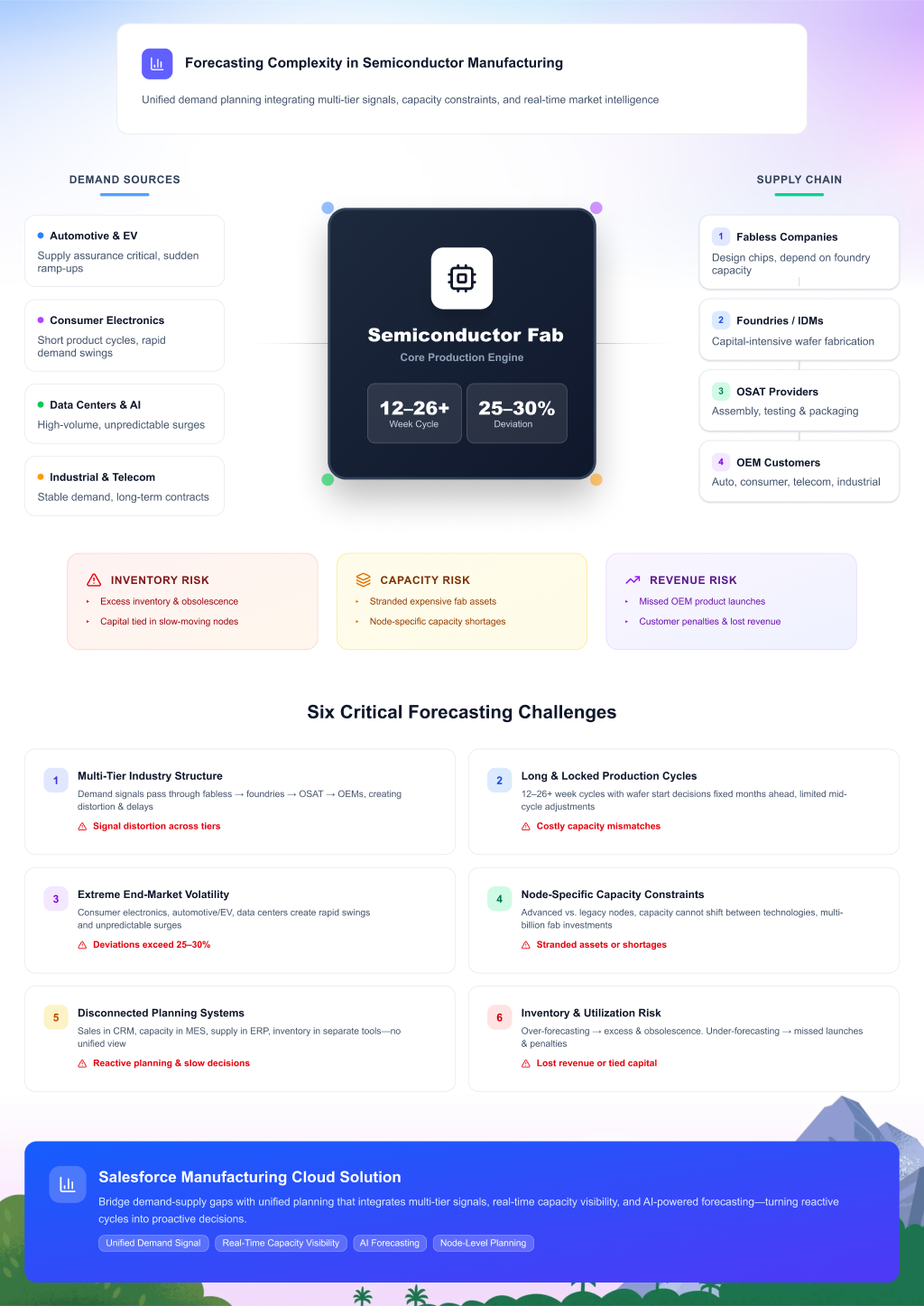
How Salesforce Manufacturing Cloud Improves Forecast Accuracy
1. Customer- & Program-Level Forecasting
- Forecast by customer
- By product program
- By technology node
- Improves accountability and precision
2. Sales Agreement–Driven Demand Commitments
- Converts long-term supply agreements into committed demand signals
- Separates firm commitments from speculative pipeline demand
3. Foundry & OEM Forecast Collaboration
- Secure collaboration portals
- Near real-time visibility into demand changes
4. ERP, MES & Supply Chain Integration
- Integrates Salesforce with ERP, MES, and planning systems
- Aligns forecasts with fab capacity and wafer starts
5. AI-Powered Demand Sensing & Risk Alerts
- Analyzes historical demand cycles
- Tracks end-market indicators
- Monitors customer behavior patterns
- Flags capacity risks, demand cliffs, and inventory obsolescence early
Case Study: Semiconductor Manufacturer Improves Forecast Reliability
A semiconductor manufacturer supplying automotive and consumer electronics OEMs faced:
- Frequent capacity mismatches
- Overstock in legacy nodes and shortages in advanced nodes
After implementing Salesforce Manufacturing Cloud:
- Forecast accuracy improved by 26%
- Fab utilization stabilized across quarters
- Customer fulfillment reliability improved significantly
The Future of Forecasting in Electronics & Semiconductors
- AI-Driven Cycle Detection Models
- Digital Twin Fabs for capacity simulation
- Real-Time OEM Demand Feeds
- Sustainability-Aware Planning for energy-intensive fabs
Conclusion
In semiconductor manufacturing, forecast accuracy is the foundation of resilience and profitability. Salesforce Manufacturing Cloud enables manufacturers to:
- Forecast demand at customer, program, and node level
- Align long-term agreements with capacity planning
- Reduce inventory and utilization risk
- Use AI to anticipate demand shifts early
With Salesforce, semiconductor manufacturers move from reactive planning to predictive, capacity-aligned execution.
🔬 Ready to improve forecast accuracy in semiconductor manufacturing?
👉 Book a Manufacturing Cloud Strategy Session with Perigeon