

Table of content
Introduction
Why Sales Agreements Are Complex in Electronics Manufacturing
Common Challenges in Managing Electronics Sales Agreements
How Salesforce Manufacturing Cloud Aligns Sales Agreements
Case Study: Electronics Manufacturer Improves Contract Execution
The Future of Sales Agreement Management in Electronics
Conclusion
Introduction
Electronics manufacturing operates on long-term supply agreements with OEMs, EMS providers, and distributors—often spanning multiple product generations. These agreements define volumes, pricing tiers, rebates, delivery schedules, and technology transitions.
Yet, many manufacturers still manage contracts across PDFs, spreadsheets, and emails. Gartner (2024) reports that over 40% of electronics manufacturers experience margin leakage due to poor contract visibility and execution.
Salesforce Manufacturing Cloud digitizes and operationalizes sales agreements—turning legal terms into actionable demand, capacity, and revenue plans.
Why Sales Agreements Are Complex in Electronics Manufacturing
- Multi-Year Durations across product lifecycles
- Volume Ramps & Declines tied to product launches and EOL
- Aggressive Price Erosion in competitive markets
- Global Customers with regional delivery commitments
- Tight Coupling between contracts and capacity decisions
Common Challenges in Managing Electronics Sales Agreements
1. Long-Term Volume Commitments
- Forecasts change faster than contract terms
- Capacity decisions lag real demand
2. Rapid Product & Technology Transitions
- Node/process changes mid-contract
- Old agreements don’t reflect new BOMs
3. Price Erosion & Index-Linked Clauses
- Raw material and component prices fluctuate
- Manual recalculations cause disputes
4. Sales–Operations–Finance Misalignment
- Sales owns contracts
- Operations owns delivery
- Finance owns billing—often in silos
5. Limited Contract Visibility
- No single source of truth
- Hard to track compliance and profitability
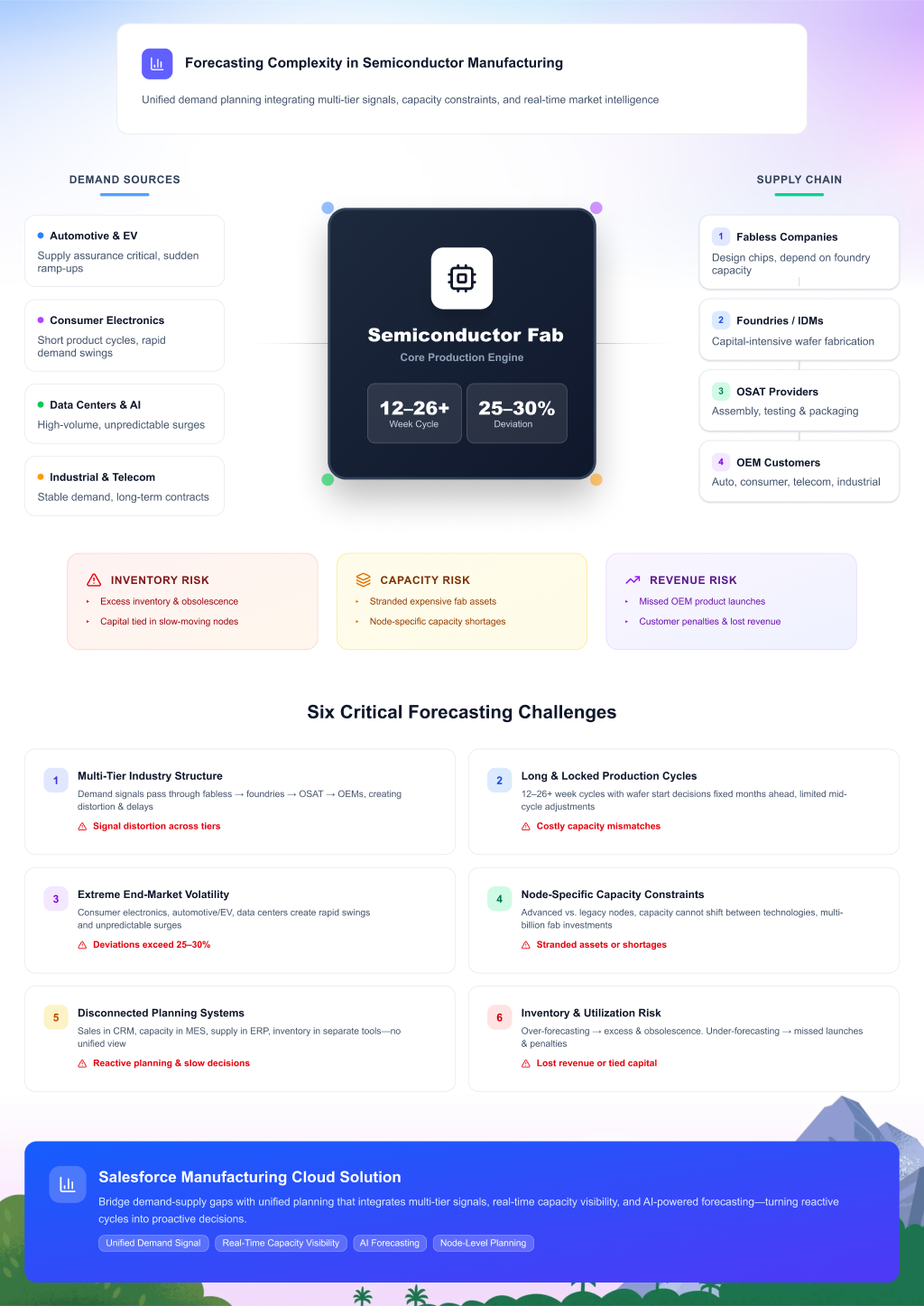
How Salesforce Manufacturing Cloud Aligns Sales Agreements
1. Centralized Agreement Management
- Digitizes all electronics sales agreements
- Links contracts to customers, programs, and SKUs
2. Agreement-Driven Demand & Capacity Planning
- Converts committed volumes into forecast inputs
- Aligns production and procurement proactively
3. Pricing, Rebates & Volume Commitments
- Manages tiered pricing and incentive structures
- Ensures accurate billing and margin control
4. ERP & Finance Integration
- Syncs Salesforce with ERP for invoicing and revenue recognition
- Improves audit readiness
5. AI-Powered Risk & Renewal Insights
- Flags margin erosion risks
- Identifies underperforming contracts
- Highlights renewal and upsell opportunities
Case Study: Electronics Manufacturer Improves Contract Execution
An electronics OEM supplying global consumer electronics brands faced:
- Poor visibility into contract adherence
- Margin leakage during product transitions
After implementing Salesforce Manufacturing Cloud:
- Contract compliance improved by 30%
- Margin predictability increased significantly
- Renewal negotiations became data-driven
The Future of Sales Agreement Management in Electronics
- AI-Driven Contract Simulation
- Smart Clauses for automated price adjustments
- Sustainability-Linked Agreements
- Digital Twin Contracts aligned with production
Conclusion
Sales agreements define success in electronics manufacturing—only if executed well. Salesforce Manufacturing Cloud enables:
- Contract-driven planning
- Cross-functional alignment
- Margin protection and compliance
- AI-powered decision intelligence
📄 Ready to modernize sales agreement management in electronics?
👉 Book a Manufacturing Cloud Strategy Session with Perigeon