
For years, CRM (Customer Relationship Management) has been synonymous with sales pipelines and customer service dashboards.
But in 2026 and beyond, the smartest organizations are redefining what CRM truly means.
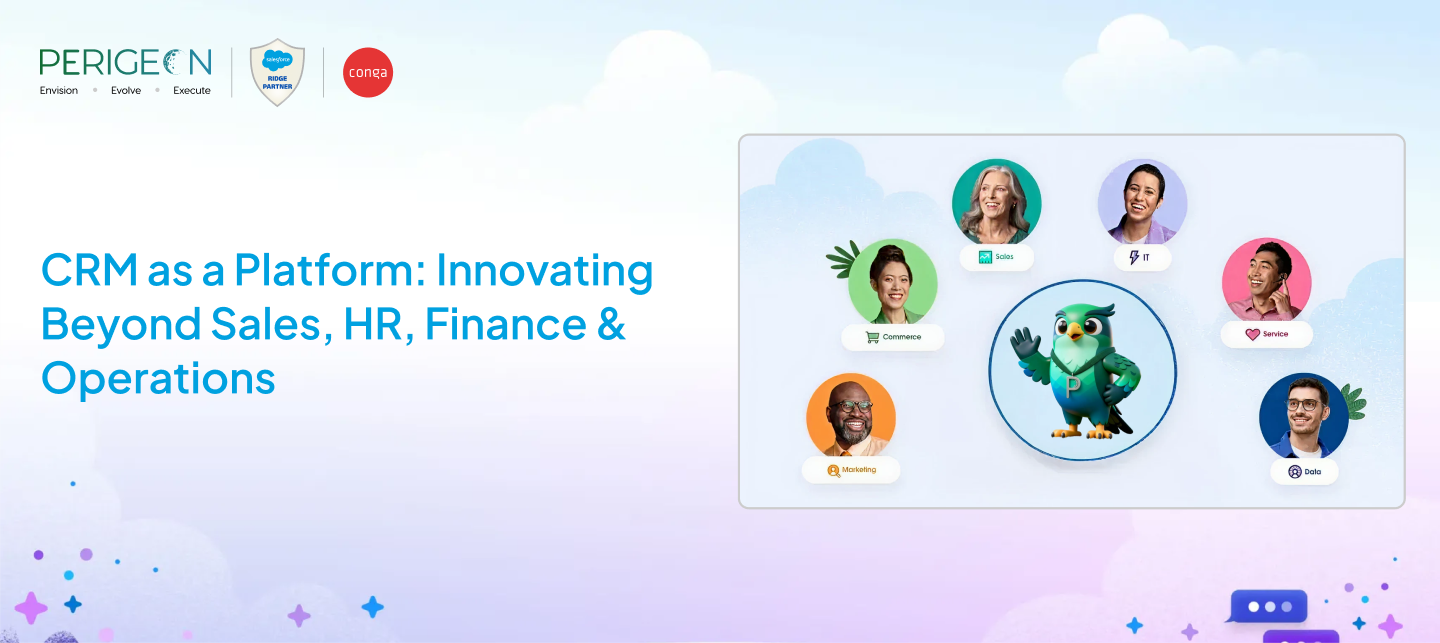
Because today, CRM isn’t just a sales tool, it’s a business platform.
Modern CRM systems like Salesforce have evolved far beyond tracking deals. They now serve as powerful enterprise operating systems, connecting teams across HR, finance, operations, IT, and beyond.
At Perigeon Software, we’ve seen firsthand how forward-thinking organizations are transforming everyday business functions by placing CRM at the center of their innovation strategy.
Let’s explore how CRM is becoming the backbone of the modern digital enterprise.
Why CRM Is No Longer Just for Sales
Traditional CRM focused on:
- Lead tracking
- Opportunity management
- Customer service workflows
Today’s business reality demands far more:
- Cross-department collaboration
- Unified data visibility
- Workflow automation
- Secure self-service portals
- AI-driven decision support
Salesforce and modern CRM platforms now offer:
- Low-code application development
- Enterprise-grade automation
- AI-powered insights
- Seamless ERP and HRIS integration
- Secure partner and employee portals
This evolution has turned CRM into a Company Relationship Management platform, managing not just customers, but every critical stakeholder interaction.
1. HR & Employee Experience: Internal Service Becomes Seamless
If employees are your internal customers, why not manage their experience with the same excellence?
Organizations are now using Salesforce to build:
- Employee helpdesks
- Digital onboarding workflows
- Self-service HR portals
- Learning and benefits management platforms
With tools like Service Cloud and Experience Cloud, HR teams can:
- Track employee inquiries and service requests
- Automate onboarding journeys
- Manage document workflows
- Provide personalized learning and benefits portals
- Monitor workforce engagement metrics
This transforms HR into a responsive, data-driven function that delivers consistent, scalable employee experiences across locations and teams.
2. Finance & Vendor Management: Transparency and Automation
CRM data isn’t limited to customers; it can just as easily manage vendors, partners, and financial workflows.
Forward-thinking companies are using Salesforce to:
- Manage vendor onboarding and compliance
- Track invoice approvals and payment milestones
- Maintain vendor performance records
- Create finance dashboards for spend visibility
- Automate procurement workflows
By integrating Salesforce with ERP or accounting platforms, finance teams gain real-time insights into both revenue and expense pipelines, bridging the operational gap between sales and finance.
This enables leadership to make faster, data-driven financial decisions while maintaining full audit transparency.
3. Operations & Project Management: End-to-End Visibility
In project-based and service-driven organizations, CRM can serve as the single source of truth for delivery operations.
Using Salesforce custom apps and automation, teams can:
- Track project progress and milestones
- Assign and reassign tasks dynamically
- Monitor delivery timelines and SLAs
- Capture customer feedback post-delivery
- Integrate with tools like Jira, Slack, and Microsoft Teams
This creates unified operational visibility across sales, delivery, and support teams, ensuring accountability, clarity, and execution speed.
4. Partner & Vendor Portals: Collaboration at Scale
Salesforce Experience Cloud enables organizations to create secure, external-facing portals for:
- Partners
- Resellers
- Vendors
- Franchisees
- Service providers
These portals provide real-time access to:
- Deal registration and tracking
- Support tickets and case updates
- Shared documentation and resources
- Performance dashboards
- Training materials
This replaces fragmented email threads and spreadsheets with transparent, structured collaboration, strengthening your entire business ecosystem.
5. The Future: CRM as the Innovation Hub
With low-code tools like:
- Salesforce Platform
- Flow
- App Builder
- Einstein AI
Organizations are building entirely new business applications without traditional development cycles.
From compliance management to IT service tracking, CRM is rapidly becoming the innovation hub of the digital enterprise.
At Perigeon Software, we help clients reimagine CRM as a platform for everything, not just managing customers, but enabling every stakeholder interaction with intelligence and automation.
Conclusion
The organizations that thrive in the digital age are those that see CRM not as a database, but as a platform for transformation.
By extending Salesforce beyond sales, you create a connected, intelligent enterprise where:
- Every process is unified
- Every team is empowered
- Every relationship is data-driven
- Every decision is insight-backed
It’s not just Customer Relationship Management anymore.
It’s Company Relationship Management.
At Perigeon Software, we help organizations unlock Salesforce’s full potential, transforming CRM into the engine that powers enterprise innovation.
Ready to extend Salesforce beyond sales?
Transform CRM Into a Business Platform

Frequently Asked Questions (FAQs)
Using CRM as a business platform means extending it beyond sales and customer service to support HR, finance, operations, IT, and partner management.
Modern platforms like Salesforce allow organizations to:
- Build custom business applications
- Automate cross-department workflows
- Integrate ERP and HR systems
- Create secure employee and partner portals
- Manage all stakeholder relationships from one unified system
This transforms CRM from a tracking tool into a complete enterprise operating system.
Traditional CRM systems focused mainly on:
- Lead tracking
- Opportunity management
- Customer service cases
Modern CRM platforms now offer:
- Low-code application development
- AI-powered analytics
- Cross-department collaboration
- Secure portals for employees and partners
- Automation across finance, HR, and operations
CRM has evolved into a unified enterprise operating system that connects people, processes, and data across the entire organization.
Yes. Organizations are increasingly using CRM platforms to manage internal employee services and experiences.
CRM can support HR functions such as:
- Employee onboarding workflows
- HR helpdesk and service requests
- Self-service employee portals
- Learning and development management
- Document approvals and compliance tracking
- Workforce engagement analytics
This approach improves employee satisfaction while standardizing and automating HR operations.
CRM platforms can centralize and automate financial and vendor-related processes.
Common use cases include:
- Vendor onboarding and compliance management
- Invoice approvals and payment milestone tracking
- Vendor performance monitoring
- Procurement workflow automation
- Real-time financial dashboards
When integrated with ERP or accounting systems, CRM provides visibility into both revenue and expense pipelines, improving transparency and decision-making.
Absolutely. CRM can serve as a centralized system for managing operational workflows and project delivery.
Organizations use CRM to:
- Track project milestones and timelines
- Manage SLAs and delivery performance
- Assign and reassign tasks dynamically
- Capture post-delivery customer