


Table of content
Introduction
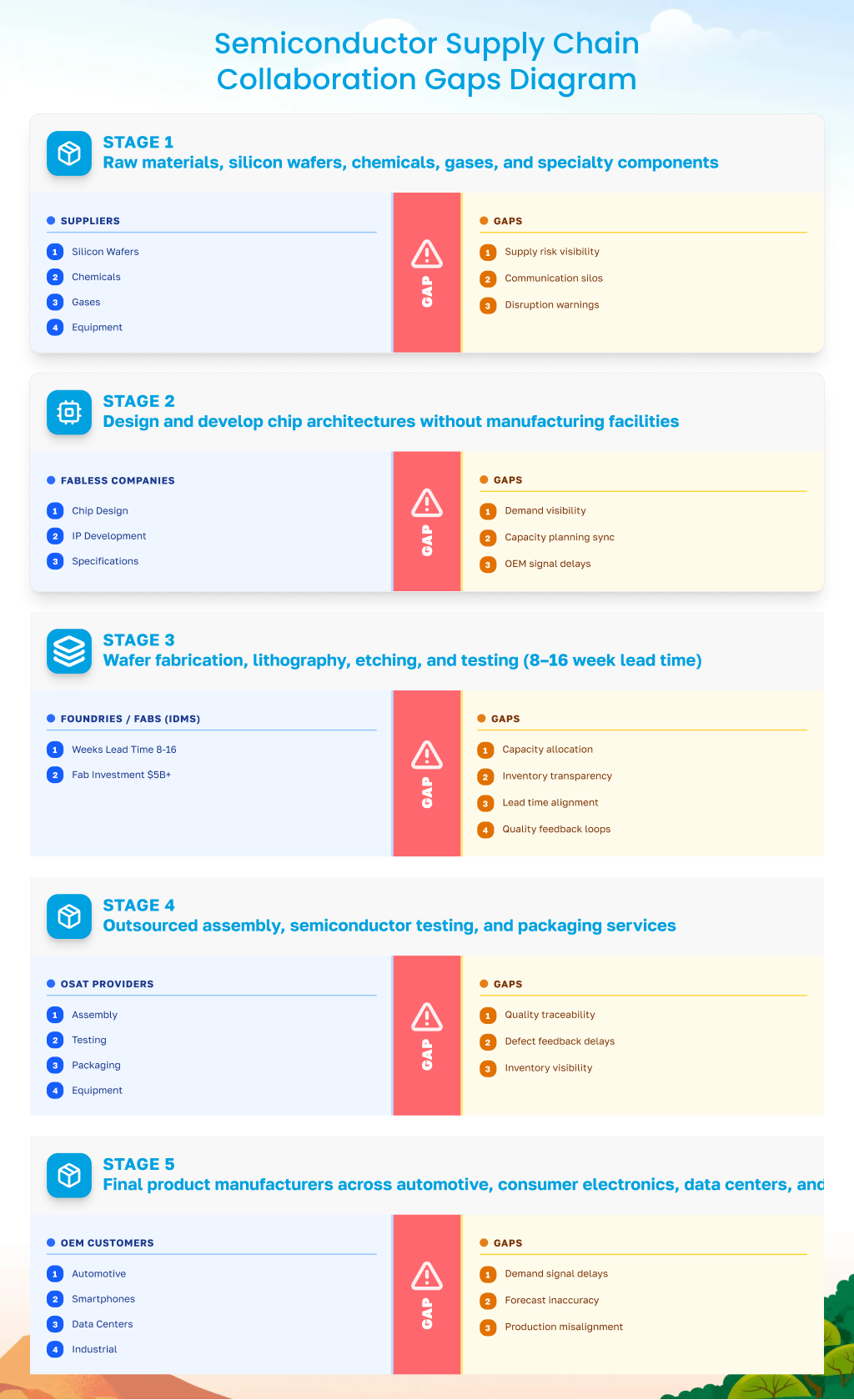
The Multi-Tier Semiconductor Supply Chain
Why Collaboration Breaks Down in Semiconductor Production
Key Supply Chain Collaboration Challenges
How Salesforce Manufacturing Cloud Strengthens Supply Chain Collaboration
Case Study: Semiconductor OEM Improves Supply Chain Resilience
Conclusion & CTA
Introduction
Semiconductor production relies on one of the most complex supply chains in manufacturing. From silicon wafers and specialty chemicals to lithography equipment, foundries, and OSATs—any disruption cascades across months of production.
McKinsey (2024) highlights that over 70% of semiconductor delays originate from supply chain coordination gaps rather than capacity shortages.
Salesforce Manufacturing Cloud creates a collaborative digital backbone—connecting suppliers, foundries, partners, and OEMs around shared forecasts and execution plans.
The Multi-Tier Semiconductor Supply Chain
- Tier 1: Foundries / IDMs
- Tier 2: OSATs (assembly & testing)
- Tier 3: Materials, chemicals, and equipment suppliers
- Tier 4: OEM customers
👉 Alignment across tiers is essential to maintain throughput, yield, and delivery reliability.
Why Collaboration Breaks Down in Semiconductor Production
- Forecast updates don’t propagate in time across partners
- Capacity allocation decisions lack transparency
- Supplier risks aren’t visible early enough
- Critical data lives in disconnected systems
Key Supply Chain Collaboration Challenges
1. Foundry, OSAT & OEM Coordination
- Demand changes ripple slowly through the ecosystem
- Manual coordination via emails and calls delays response
2. Long Lead-Time Materials & Equipment
- Specialty materials and tools require months to procure
3. Capacity & Allocation Conflicts
- Competing customers for the same process nodes and tools
4. Limited Real-Time Visibility
- No single view of demand, supply, and capacity
5. Risk & Disruption Management
- Geopolitical and supplier risks are difficult to model proactively
How Salesforce Manufacturing Cloud Strengthens Supply Chain Collaboration
1. Partner Collaboration Portals
- Secure portals for suppliers, foundries, and OSATs
- Shared access to forecasts, allocations, and milestones
2. Shared Forecasts & Capacity Signals
- One aligned forecast feeds all partners
- Reduces bullwhip effects across the supply chain
3. Supplier & Foundry Visibility
- Real-time insight into capacity commitments and constraints
4. ERP, MES & Logistics Integration
- Synchronizes execution systems with Salesforce
- Improves throughput and delivery reliability
5. AI-Powered Risk Prediction
- Predicts supplier delays
- Identifies capacity bottlenecks
- Flags demand–supply mismatches early
Case Study: Semiconductor OEM Improves Supply Chain Resilience
A semiconductor OEM supplying automotive and industrial customers faced frequent allocation conflicts and limited supplier visibility.
After implementing Salesforce Manufacturing Cloud:
- Supply chain disruptions were reduced by 25%
- Allocation decisions became transparent and data-driven
- Customer confidence improved significantly
Conclusion & CTA
Supply chain collaboration is the difference between resilience and chaos in semiconductor manufacturing. Salesforce Manufacturing Cloud enables:
- Shared forecasts across partners
- Capacity-aligned execution
- Early risk detection with AI
- End-to-end ecosystem visibility
With Salesforce, semiconductor manufacturers build connected, resilient, and scalable supply chain ecosystems.
🔗 Ready to strengthen semiconductor supply chain collaboration?
👉 Book a Manufacturing Cloud Strategy Session with Perigeon