

Table of content
Introduction
Why Retailers & Distributors Drive Appliance Demand
Key Challenges in Appliance Retail & Distribution Networks
How Salesforce Manufacturing Cloud Streamlines Channel Networks
Case Study: Appliance OEM Digitizes Channel Collaboration
The Future of Appliance Channel Management
Conclusion
Introduction
Retailers and distributors are the frontline demand owners for appliances. Large-format stores, regional dealers, and e-commerce marketplaces determine shelf space, promotions, and replenishment cadence.
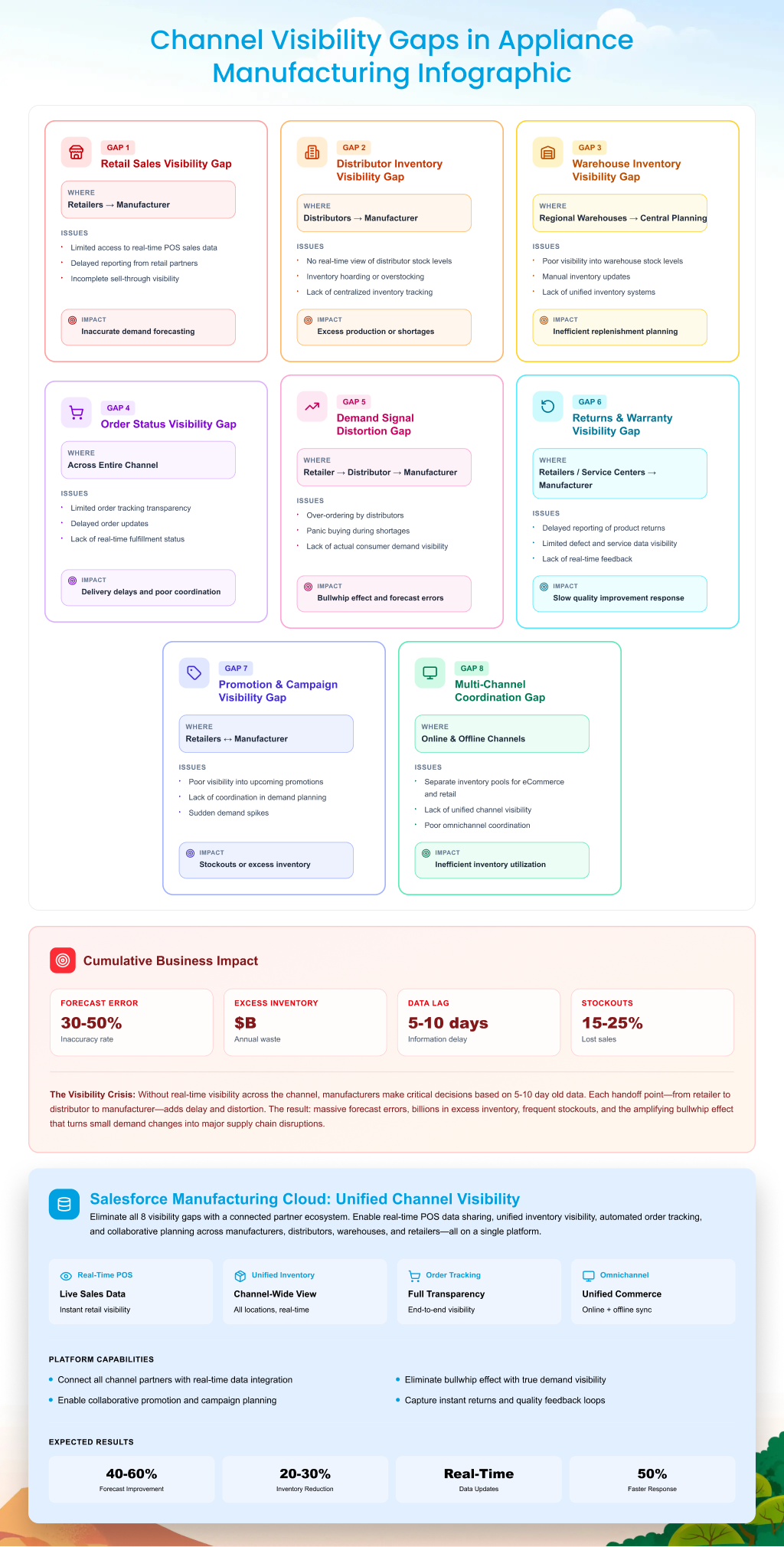
When collaboration breaks down, manufacturers misread demand—leading to stockouts during peak season and excess inventory post-promotion.
Industry benchmarks show that over 50% of appliance manufacturers lack real-time visibility into channel inventory and sell-through. Salesforce Manufacturing Cloud creates a shared operating model connecting manufacturers, retailers, and distributors in real time.
Also Read – Driving Demand Forecasting for Appliance Manufacturing with Salesforce
Why Retailers & Distributors Drive Appliance Demand
- Shelf & Assortment Decisions: Determine visibility and conversion
- Promotion Timing & Pricing: Create short-term demand spikes
- Inventory Ownership: Shifts working capital across the chain
- After-Sales & Returns: Reverse logistics directly impact margins
👉 Tight collaboration is essential to protect availability, inventory turns, and margins.
Key Challenges in Appliance Retail & Distribution Networks
1. Fragmented Channel Visibility
OEMs rely on delayed reports, while real sell-through remains opaque.
2. Pre-Buys vs. Sell-Through Gaps
Pre-season stocking masks true consumption and delays corrective action.
3. Regional Pricing, Credit & Incentives
Complex slabs, terms, and claims increase disputes and revenue leakage.
4. Bulky Inventory & Reverse Logistics
Returns, exchanges, and refurbishments are costly and slow.
5. Weak Feedback Loops to Production
Production plans are disconnected from live channel demand signals.
How Salesforce Manufacturing Cloud Streamlines Channel Networks
1. Retailer & Distributor Collaboration Portals
Secure portals for orders, forecasts, inventory, promotions, and claims.
2. Shared Forecasts, Inventory & Order Visibility
Single view of pipeline, on-hand, and in-transit inventory across channels.
3. Automated Incentives, Rebates & Claims
Rule-based eligibility, faster settlements, and fewer disputes.
4. ERP, WMS & Logistics Integration
Aligns production, warehousing, dispatch, invoicing, and returns.
5. AI-Powered Channel Performance Insights
Einstein AI highlights aging risk, replenishment gaps, promo ROI, and regional growth opportunities.
Case Study: Appliance OEM Digitizes Channel Collaboration
A national appliance OEM working with large retailers and more than 1,000 dealers achieved:
- 22% reduction in aged inventory
- 18% improvement in peak-season in-stock rates
- 60% fewer incentive and rebate disputes
The Future of Appliance Channel Management
- Real-time POS integrations
- AI-driven replenishment and allocation
- Mobile-first dealer and distributor apps
- Sustainability tracking for returns and refurbishment
Conclusion
Channel collaboration determines win-or-lose outcomes in appliance manufacturing. Salesforce Manufacturing Cloud enables shared forecasts, coordinated promotions, automated incentives, and AI-driven insights—at speed.
Ready to digitize appliance channel collaboration?
👉 Book a Manufacturing Cloud Strategy Session with Perigeon