


Table of content
Introduction
The Telecom Equipment Manufacturing Landscape
Why Scaling Is Uniquely Challenging
Key Scaling Challenges
How Salesforce Manufacturing Cloud Enables Scalable Growth
Case Study
The Future of Scalable Telecom Manufacturing
Conclusion
Frequently Asked Questions (FAQs)
1. Introduction
Telecom equipment manufacturers power global connectivity — from 5G radios and core networks to fiber and transmission systems.
Demand is shaped by infrastructure rollouts, not steady replenishment cycles. During nationwide deployments, demand can spike 2–3× within a single planning cycle.
Salesforce Manufacturing Cloud helps telecom producers scale predictably by aligning project demand, contracts, supplier capacity, and AI-driven insights in one execution framework.
2. The Telecom Equipment Manufacturing Landscape
Product Segments
- Radio Access Network (RAN) equipment
- Core network hardware
- Optical fiber & transmission systems
- Towers, power systems, enclosures
Customers
- Telecom operators
- Infrastructure providers
- Governments & utilities
Production Characteristics
- Project-based, high-value orders
- Strict compliance & certification
- Global, multi-tier supplier ecosystems
👉 Scaling too late is as risky as scaling too early.
3. Why Scaling Is Uniquely Challenging
- Demand Is Lumpy – Rollouts follow spectrum and regulation cycles
- Contracts Drive Commitments – Timelines and penalties are locked early
- Deep Supply Chains – RF components and chips have long lead times
- Deployment Coordination – Factory output must match site readiness
- Capital & Margin Pressure – Scaling errors create costly misalignment
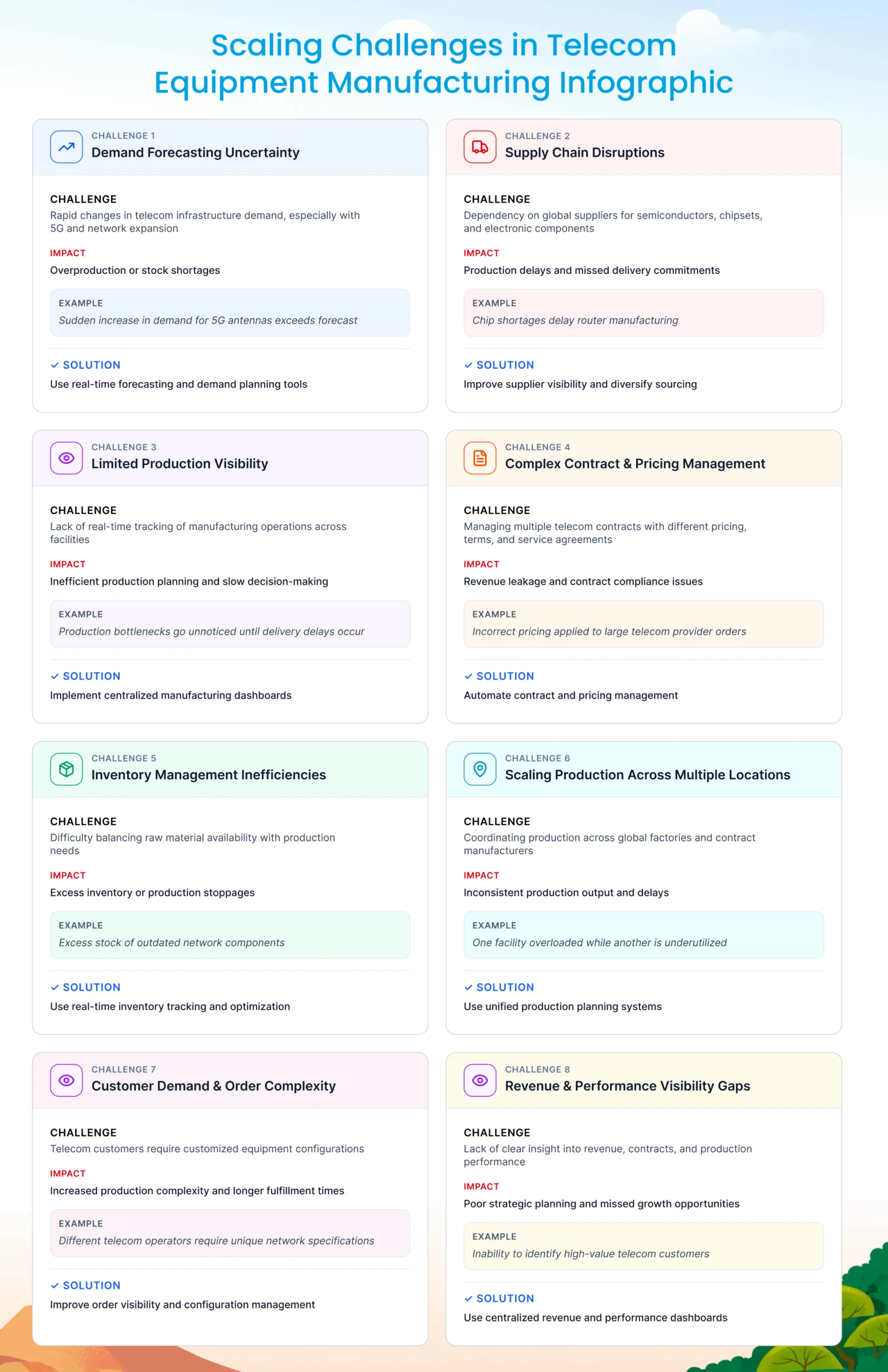
4. Key Scaling Challenges
1. Infrastructure-Driven Demand Surges
Sudden operator rollouts create steep ramps that traditional forecasts miss.
2. Long Certification & Deployment Cycles
Regulatory approvals delay production timelines.
3. Project-Heavy, Contract-Led Sales
Poor visibility increases milestone and penalty risk.
4. Component & Supplier Constraints
Semiconductor and RF components are capacity-limited.
5. Limited Visibility Across Teams
Sales, supply, and deployment schedules often operate in silos.
5. How Salesforce Manufacturing Cloud Enables Scalable Growth
1. Project- & Program-Based Demand Planning
Forecast by operator, rollout phase, geography, and technology (4G/5G/Fiber).
2. Contract-Driven Capacity Alignment
Convert contracts into committed demand signals for early production planning.
3. Operator & Partner Collaboration
Secure portals for operators, infrastructure partners, and vendors.
4. ERP & Supply Chain Integration
Connect CRM with ERP, SCM, and deployment tools for synchronized execution.
5. AI-Powered Scale & Risk Insights
Einstein AI detects rollout risks, supplier constraints, and milestone gaps early.
6. Case Study
A telecom equipment manufacturer supporting nationwide 5G rollout faced supply bottlenecks and coordination gaps.
After implementing Manufacturing Cloud:
- Production ramp aligned with rollout phases
- Supplier readiness improved
- Contract penalties reduced significantly
7. The Future of Scalable Telecom Manufacturing
- AI-driven rollout simulations
- Digital twin factories & networks
- Real-time deployment feedback loops
- Sustainability-aware planning
8. Conclusion
Salesforce Manufacturing Cloud enables telecom equipment producers to:
- Scale production with rollout demand
- Align contracts, supply, and deployment
- Reduce risk during rapid expansion
- Use AI to anticipate bottlenecks
Scale confidently, predictably, and profitably.