


Table of content
Introduction
Why Forecast Accuracy Is Harder in Consumer Electronics
Key Forecasting Challenges Across the Electronics Supply Chain
How Salesforce Manufacturing Cloud Improves Forecast Accuracy
Case Study: Electronics Brand Improves Supply Chain Forecasts
The Future of Forecasting in Consumer Electronics
Conclusion
Introduction
Consumer electronics supply chains must respond to fast-moving demand signals across retail, e-commerce, and operator channels—often with weeks (not months) to adjust. Minor forecast errors quickly become stockouts at launch or obsolete inventory mid-cycle.
Industry analysis shows forecast deviations of 25–35% are common during launches and promotional periods. Salesforce Manufacturing Cloud improves accuracy by aligning channel demand, product lifecycle, promotions, and supply constraints into a single, actionable forecast.
Why Forecast Accuracy Is Harder in Consumer Electronics
- Launch spikes followed by rapid normalization
- Variant proliferation (memory, color, region, bundles)
- Component constraints (ICs, displays, batteries)
- Promotion pull-forward masking true consumption
- Asynchronous channels reacting at different speeds
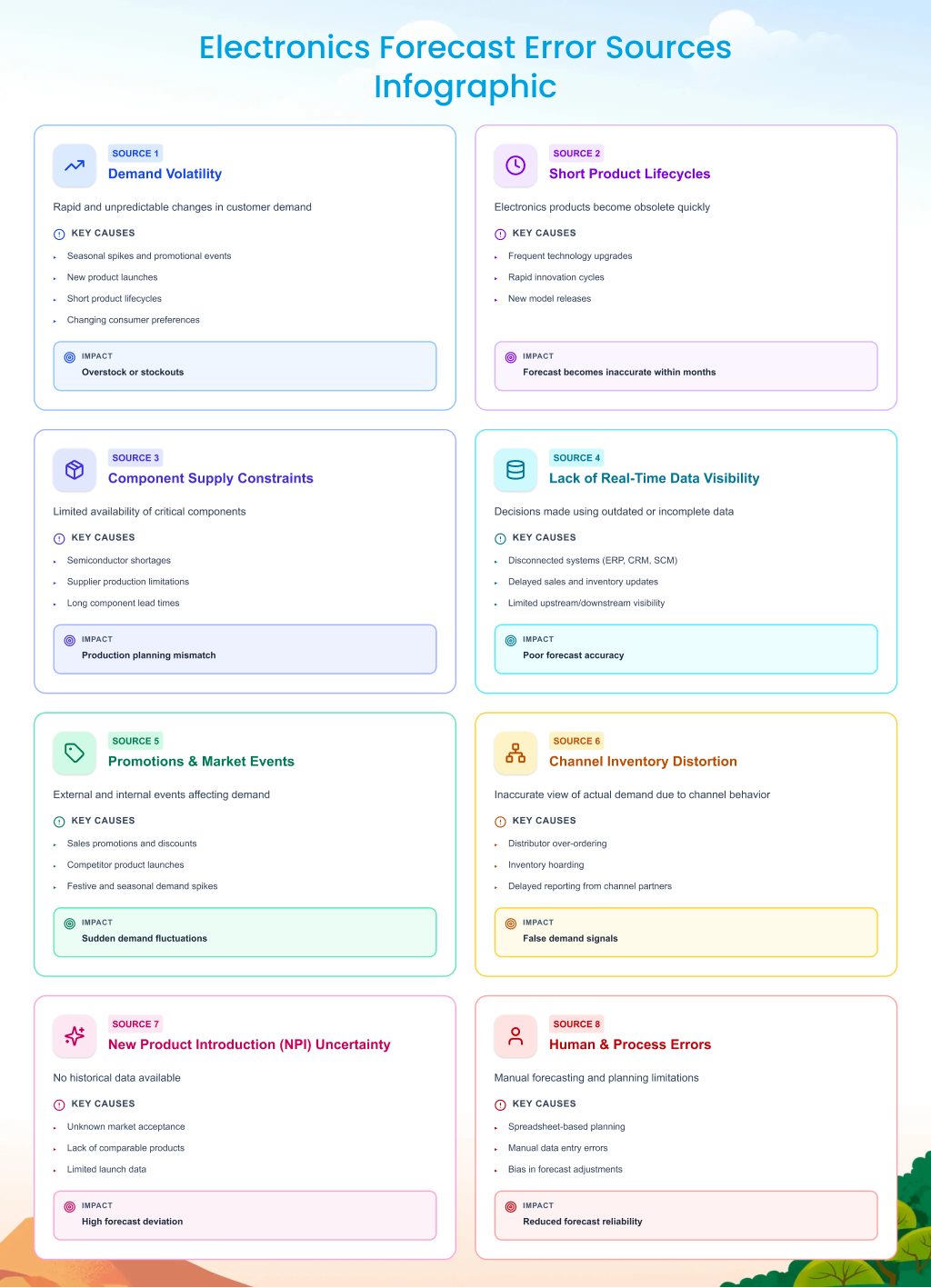
Key Forecasting Challenges Across the Electronics Supply Chain
1. Multi-Channel Demand Distortion
Retail pre-buys don’t equal sell-through; e-commerce flash sales skew weekly demand.
2. Rapid Model & Variant Transitions
Successor models cannibalize current SKUs faster than planned.
3. Component Constraints & Allocation
Forecast errors cascade into shortages or stranded components.
4. Promotion-Driven Volatility
Short campaigns inflate demand without sustaining velocity.
5. Siloed Planning Across Functions
PLM, sales, supply, and finance operate on different cadences.
How Salesforce Manufacturing Cloud Improves Forecast Accuracy
1. Channel- & Account-Level Forecasting
Forecast by retailer, e-commerce platform, operator, and region—improving ownership and precision.
2. Lifecycle-Aware Demand Planning
Forecasts tagged by launch, growth, maturity, and EOL to time ramps correctly.
3. Promotion-Adjusted Forecast Models
Separates base demand from promotional lift to avoid overbuilds.
4. ERP, PLM & Supply Planning Integration
Keeps versions, BOMs, inventory, and capacity aligned as models change.
5. AI-Powered Demand Sensing & Risk Alerts
Einstein AI flags early signals for demand cliffs, variant underperformance, and allocation risk.
Case Study: Electronics Brand Improves Supply Chain Forecasts
A global consumer electronics brand launching multiple SKUs per quarter faced launch stockouts and EOL write-offs.
After implementing Salesforce Manufacturing Cloud:
- Forecast accuracy improved by 28%
- EOL write-offs reduced by 24%
- Launch fill-rates exceeded 95%
The Future of Forecasting in Consumer Electronics
- AI micro-forecasting by variant and channel
- Digital twin supply chains for scenario testing
- Real-time sell-through feeds
- Sustainability-aware EOL planning
Conclusion
Accurate forecasting in consumer electronics requires speed, granularity, and lifecycle awareness. Salesforce Manufacturing Cloud delivers all three—turning volatility into advantage.
🔗 Ready to improve forecast accuracy?
👉 Book a Manufacturing Cloud Strategy Session with Perigeon